Real Lives
Israeli import limits shorten the night shift that feeds Gaza
Graphic: Times of Palestine
Original Reporting
The Newsdesk gathers reporting from wire services and primary sources and rewrites every story in-house before publication. How our journalism is made →
Gaza's overnight economy has contracted again since the regional escalation that began on 28 February 2026, with border crossings closed or running at reduced capacity, according to Willy Niyeko, emergency coordinator and head of the World Food Programme office in Gaza, in remarks distributed by UN media on 8 May 2026.
Niyeko said that after the October 2025 ceasefire all crossings opened, commercial and humanitarian goods increased, bakeries restarted and famine was reversed. Since late February, he said, the territory has entered a phase of fragility "with a very negative outlook."
The bakeries are the clearest measure of what that means after dark. Ovens are fired before dawn so bread reaches counters at first light, and they run on wheat flour and cooking gas that enter only through the crossings Israel controls.
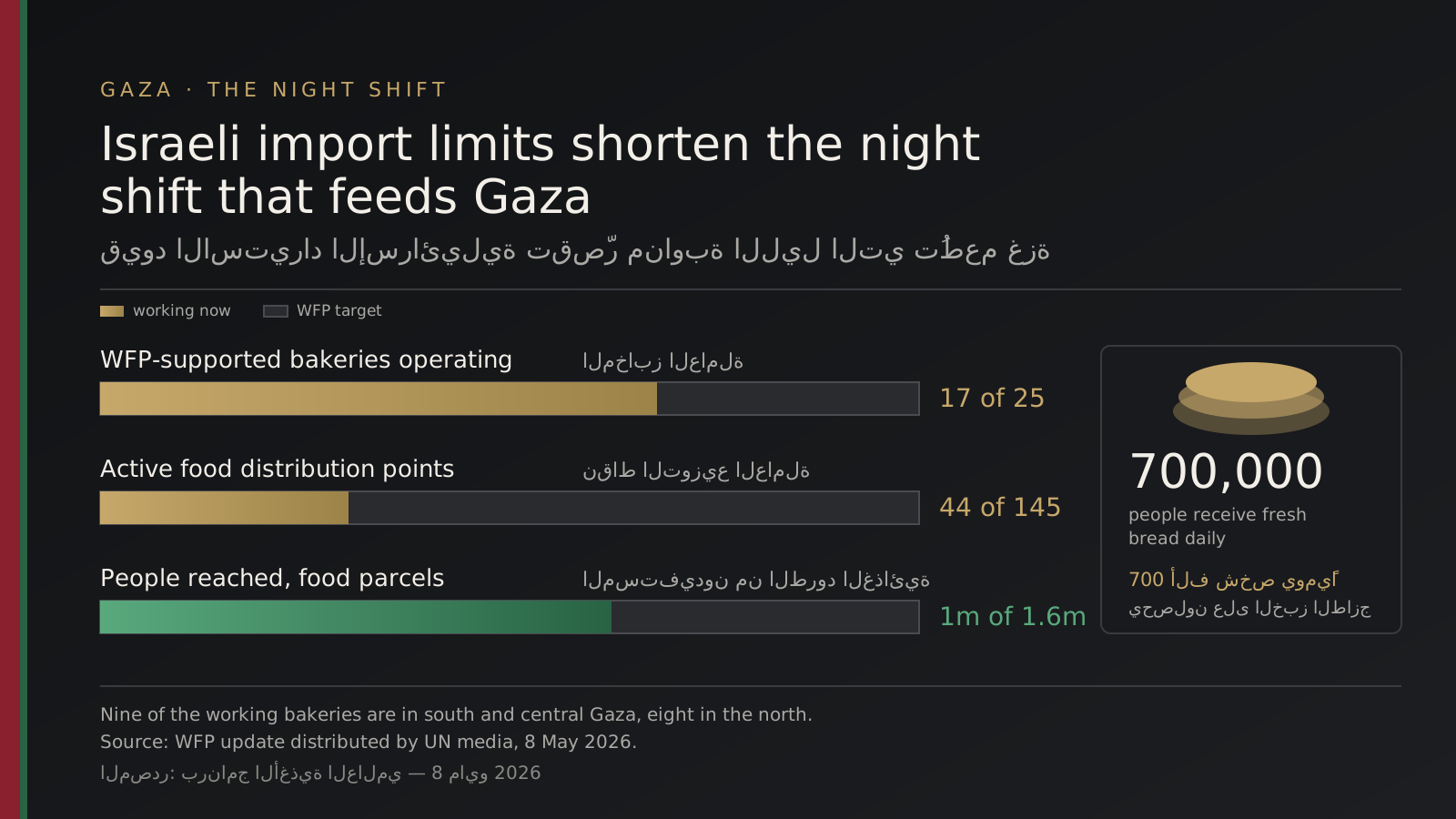
WFP reported that an estimated 700,000 people receive fresh bread daily through 17 WFP-supported bakeries, nine in south and central Gaza and eight in the north, against a target of 25. The same update put family food parcels at one million people reached against a target of 1.6 million, and 44 active distribution points against a target of 145.
Al Jazeera reported on 18 May 2026 that more than a third of Gaza's population depends on subsidised bread from WFP-supplied bakeries, where a bundle of roughly eight or nine pitas is sold at a capped price of about one dollar.
A shortage of flour and fuel in the preceding weeks, the outlet reported, was caused by Israeli restrictions on imports, and bakeries could not bake what the queues needed. A 14-year-old boy interviewed in a Gaza City queue said he expected to leave without bread.
The system has failed completely before. OCHA recorded that all 25 UN-supported bakeries shut by early April 2025 after more than four weeks in which no aid entered, the last ten in central and southern Gaza closing on 31 March and nine in the north on 1 April.
In the week before the shutdown, OCHA said, those bakeries had raised output by more than 20 per cent, from 160,000 to 193,000 bundles a day.
Production resumed only in stages. WFP said on 22 May 2025 that a handful of bakeries in south and central Gaza restarted after dozens of trucks collected cargo overnight at Kerem Shalom, the first fresh bread in more than two months. WFP country director Antoine Renard called it "a drop in the bucket."
Night work in the hospitals is carried out in buildings that no longer function fully. The Israeli access-rights organisation Gisha, writing on 15 February 2026, cited UN reporting that as of 5 February no hospital in Gaza was fully operational and only 18 of 36 were partially operational.
WHO's report to the 79th World Health Assembly states that no hospital is fully functional anywhere in the Strip, none are operating in the north, and facilities face severe shortages of health workers, fuel and medical supplies; it records inpatient beds rising from 107 to 140 through rehabilitation work and prefabricated units.
Staffing was already the binding constraint a year earlier. Dr Arej Ahmed Al-Shaer of the emergency department at Nasser Medical Complex told WHO in May 2025 that once the European Hospital went out of service, Nasser became the only hospital covering southern Gaza, producing a significant shortage of medical staff as surgical and internal cases transferred in.
Working the shift has cost lives. Médecins Sans Frontières reported that Israeli forces struck the Nasser compound on 19 May 2025 about 300 feet from its intensive care unit.
Al-Ahli Arab Hospital's director, Suhaila Tarazi, said Dr Ahmad Attallah Qandil was killed by an Israeli drone strike on 14 July 2025 as he returned home from a surgical shift. No Israeli military account of either incident appears in the material those organisations published.
The technicians who keep phones working operate on the same margins.
The Palestine Economic Policy Research Institute reported in March 2025, citing an interview with Paltel Group's Fadi AbuZaid, that the operator relies on deep-buried cables and layered backup power — standby generators, solar panels and batteries — but that continuity depends on fuel and repair equipment entering from outside.
Middle East Monitor, citing Palestinian Central Bureau of Statistics figures, reported that 64 per cent of mobile towers were out of service as Gaza entered 2026 and that Paltel had lost roughly 80 per cent of its more than 500 towers, with coverage in Rafah down to 27 per cent and sector reconstruction costed at a minimum of 90 million dollars.
At sea, the pre-dawn shift has largely stopped. The FAO reports fishing activity at less than ten per cent of pre-war levels after boats, ports and equipment were destroyed, and says people fishing metres from shore are being targeted.
The Palestinian Centre for Human Rights recorded that on 12 July 2025 Israeli forces announced strict restrictions in the naval area barring all access to the sea, warning that violations would be met with enforcement measures.
Gisha cited OHCHR documentation of 28 attacks on fishermen between 1 January and 16 May 2025, in which 11 were killed and 34 injured.
Zakaria Bakr, head of the union of workers in Gaza's fishing sector, told Asharq Al-Awsat in March 2026 that Israel is depriving fishermen of the sea deliberately, describing it as collective punishment. Nafez Jarbou, 53, from the Beach refugee camp, told the paper Israeli naval boats destroyed his vessel during the war and that he supports 16 people, including four relatives who fished with him.
What any of these shifts pay is not on the public record. No current wage series for bakery, hospital or telecom workers in Gaza appears in the UN, WFP or Palestinian statistical material available.
Nor is it established what fishing distance, if any, applies under the October 2025 ceasefire arrangement. Fishermen quoted by Asharq Al-Awsat put that question to the mediators overseeing it, asking for two or three nautical miles; no answer from them is on record.