Health & Healing
Aid agencies reach a fraction of Gaza's traumatised children
Graphic: Times of Palestine
Original Reporting
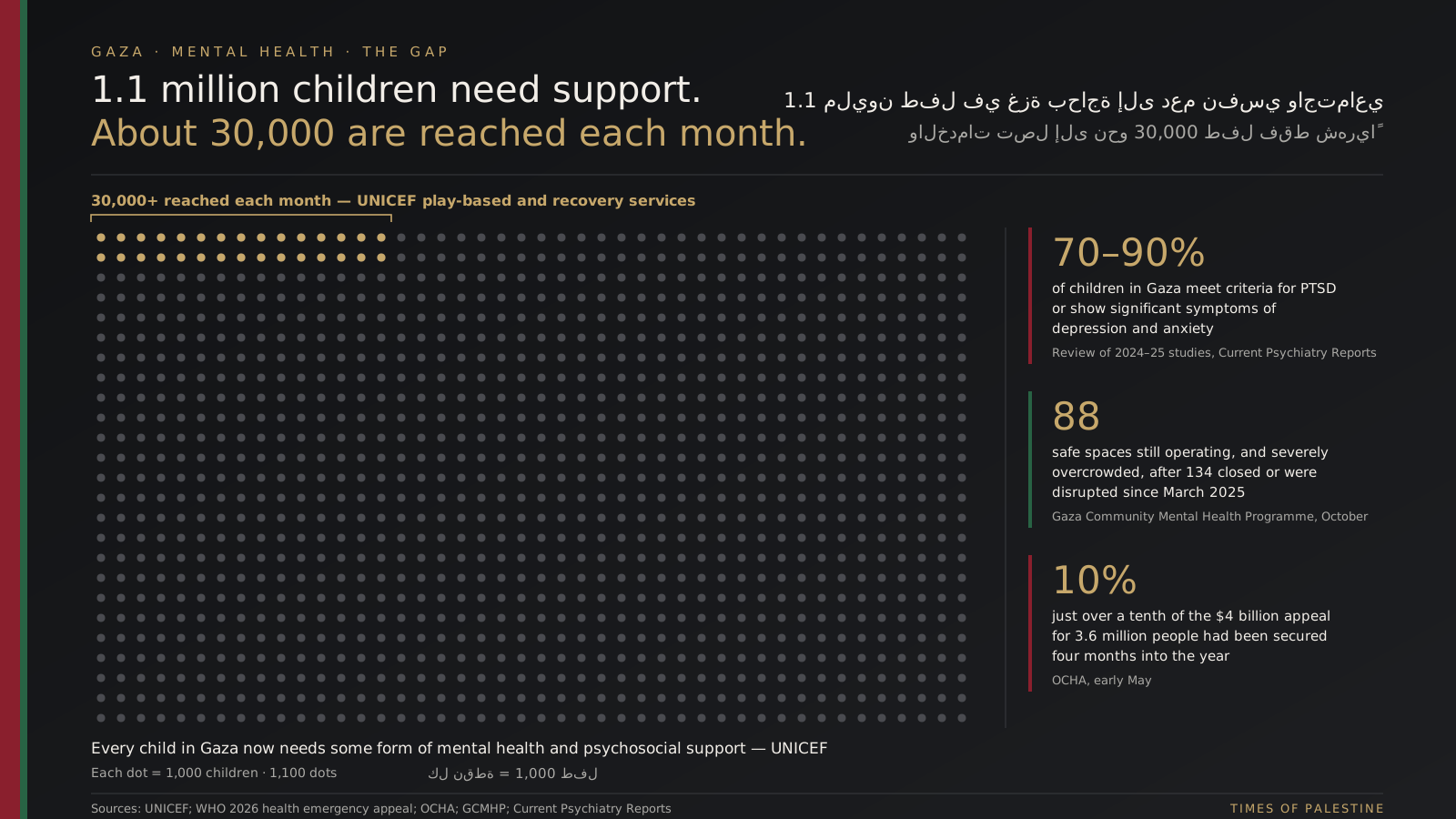
UNICEF says every child in the Gaza Strip now needs some form of mental health and psychosocial support — about 1.1 million children. UNICEF also says its play-based and recovery services in Gaza reach more than 30,000 children a month.
That is the gap the ceasefire has exposed rather than closed.
The World Health Organization's Director-General, Tedros Adhanom Ghebreyesus, said last October, in figures relayed by OCHA, that the number of people in Gaza needing mental health care had more than doubled over two years of hostilities, from about 485,000 to more than a million.
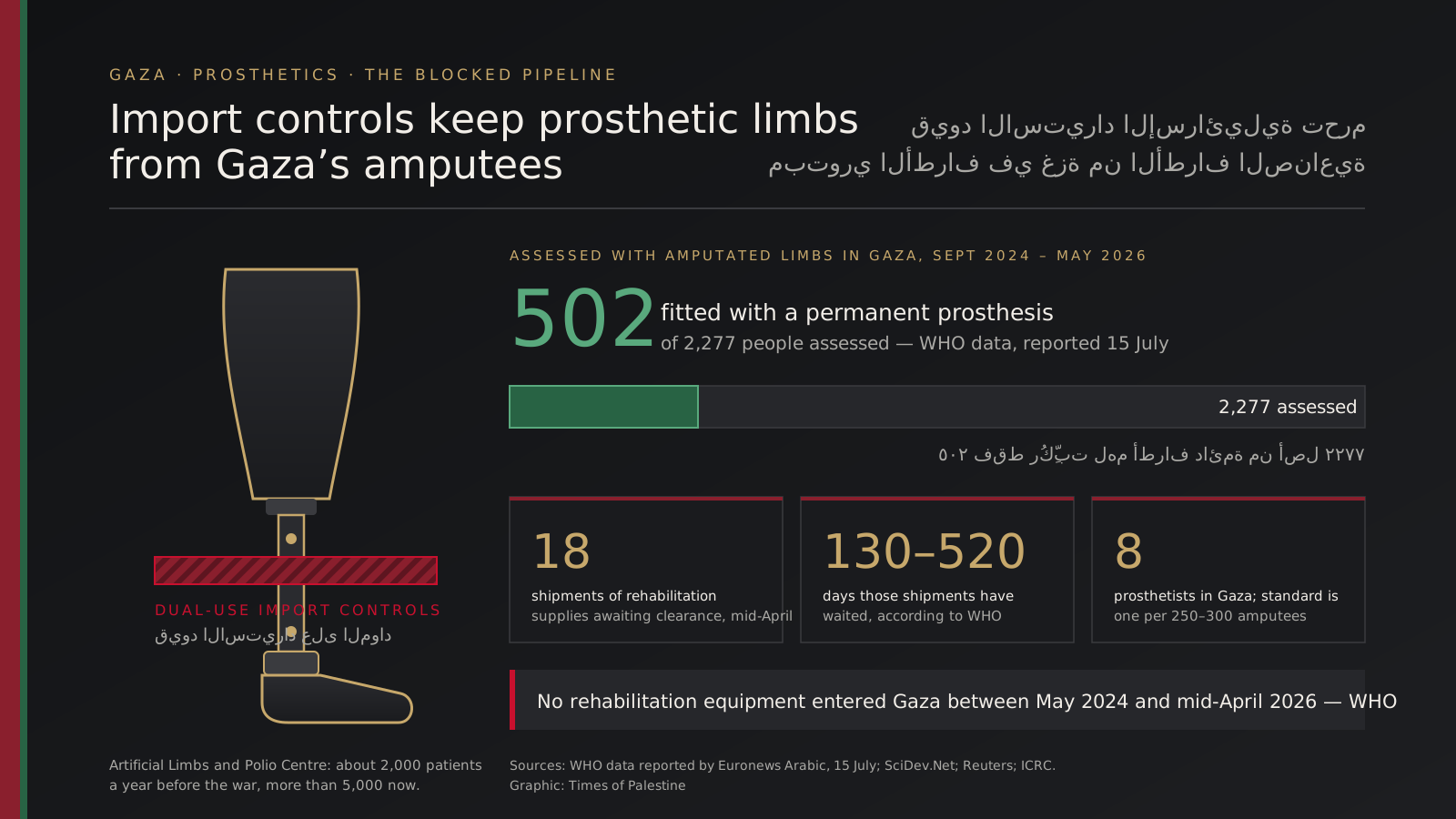
WHO's 2026 health emergency appeal for the occupied Palestinian territory repeats the estimate of one million people in need of mental health and psychosocial support, alongside more than 18,500 patients waiting for medical evacuation and over 5,000 amputations.
Prevalence figures for children come from separate studies rather than any single population survey.
A review of research from 2024 and 2025 published in Current Psychiatry Reports found that studies place between 70 and 90 per cent of children in Gaza as meeting criteria for post-traumatic stress disorder or showing significant symptoms of depression and anxiety — a range, the authors note, drawn from work using different methods, and framed by them within structural conditions rather than individual pathology.
A 2020 study cited in The Lancet Psychiatry had already found PTSD in 53.5 per cent of Gaza's children before this war began.
UNFPA data cited by its adolescent and youth programme officer, Sima Alami, in remarks to UN News in March and reported by WAFA, put PTSD at 61 per cent among adolescents and young people in Gaza, depression at 38 per cent and anxiety at 41 per cent. The same data indicate that 96 per cent of children in Gaza feel death is imminent.
What exists to treat this is thin and getting thinner in places.
Gaza's only psychiatric hospital was destroyed in November 2023, according to a correspondence published in The Lancet Psychiatry in February by a clinician who worked in a Gaza primary care facility over December and January.
The same account reports that specialist services remain almost entirely unavailable, that access to psychotropic medication is limited and inconsistent, forcing prescribing decisions based on what is in stock, and that even before the war Gaza had fewer than one psychiatrist per 100,000 people.
The Gaza Community Mental Health Programme, founded in 1990 and for three decades the main non-governmental provider in the Strip, reported in mid-2024 that two of its three clinics had been destroyed along with the psychiatric hospital.
In its report marking two years of the war, published last October, GCMHP said 134 safe spaces used for psychological and social support had closed or been disrupted since the collapse of the March 2025 ceasefire, leaving 88 operational and severely overcrowded, which it said reduced privacy and blunted the response. GCMHP put the number of children needing psychological and social support at about 1.2 million.
The largest school-based network is UNRWA's. OCHA reported in October that UNRWA, working with 236 school counsellors and more than 300 assistant counsellors, had run over 330,000 psychosocial support sessions since October 2023 for roughly 730,000 displaced people, more than half a million of them children.
In the week of 16 to 22 October, OCHA recorded UNRWA health teams — 49 psychiatrists, counsellors and supervisors — handling 3,266 cases across Gaza city, Deir al Balah and Khan Younis.
Providers have themselves been hit. The Gaza Mental Health Foundation said the Gaza City headquarters of the Aisha Association for Women and Child Protection was struck on 7 September 2025, killing a staff member along with a pregnant woman and a child who were visiting its clinic.
The model most agencies are now pushing is task-shifting: training non-specialists to deliver basic care where psychiatrists do not exist. WHO's account of its 2025 work in the territory describes integrating mental health into primary health care centres through task-shifting and rebuilding services on a structured basis.
OCHA reported in June that partners in the mental health working group were being trained on WHO's Mental Health Gap Action Programme community toolkit, aimed at expanding psychosocial support for children and adolescents.
Smaller pipelines run through local institutions. Ma'an News Agency reported in May 2025 that GCMHP's training department held a course for 20 kindergarten teachers on child mental health, and a month-long course on mental health and human rights for 17 officers of the interior ministry in Gaza.
Money is the binding constraint. The humanitarian appeal for the occupied Palestinian territory this year seeks just over $4 billion for 3.6 million people; OCHA reported at the start of May that four months in, just over 10 per cent of the required funding had been secured. UNRWA's separate $1.26 billion appeal for 2026 promises mental health support to 350,000 people through health staff, school counsellors and social workers.
Access remains restricted. WHO's 2026 appeal states that bureaucratic impediments and access restrictions continue to hinder operations despite the ceasefire; OCHA reported that a Health Cluster shipment of 160 air mattresses entered Gaza in June after a 17-month wait for Israeli approval. No Israeli official response to those specific accounts appears in the published record.
Euronews Arabic reported in November that most of Gaza's pre-war mental health centres were destroyed or out of service, and quoted a displaced mother from Zeitoun saying the absence of specialists leaves any psychological intervention discontinuous.
No published plan sets out when inpatient psychiatric care will be restored in Gaza, or how many trained counsellors the Strip will have a year from now.
International Medical Corps, which published a needs assessment in March citing OCHA's estimate that 2.1 million people in Gaza require protection and mental health support, describes needs that outrun the mapped services.
Whether the school counselling network can be rebuilt at the scale UNRWA has budgeted for depends on funding that has not arrived and on approvals that are not in the agency's hands.