Financial Freedom
Palestinian economist Saifedean Ammous reshaped Bitcoin’s intellectual canon
Graphic: Times of Palestine
Original Reporting
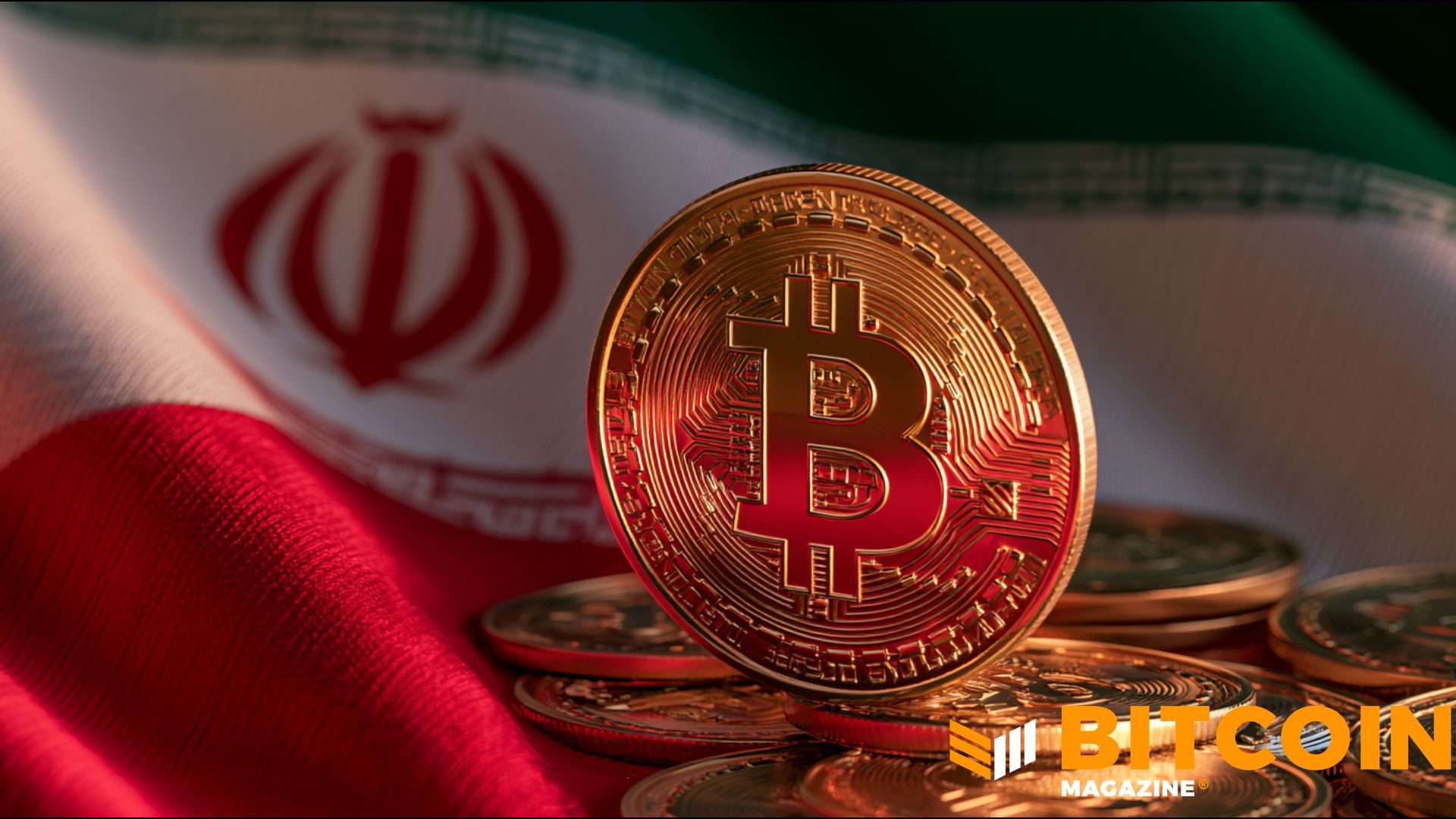
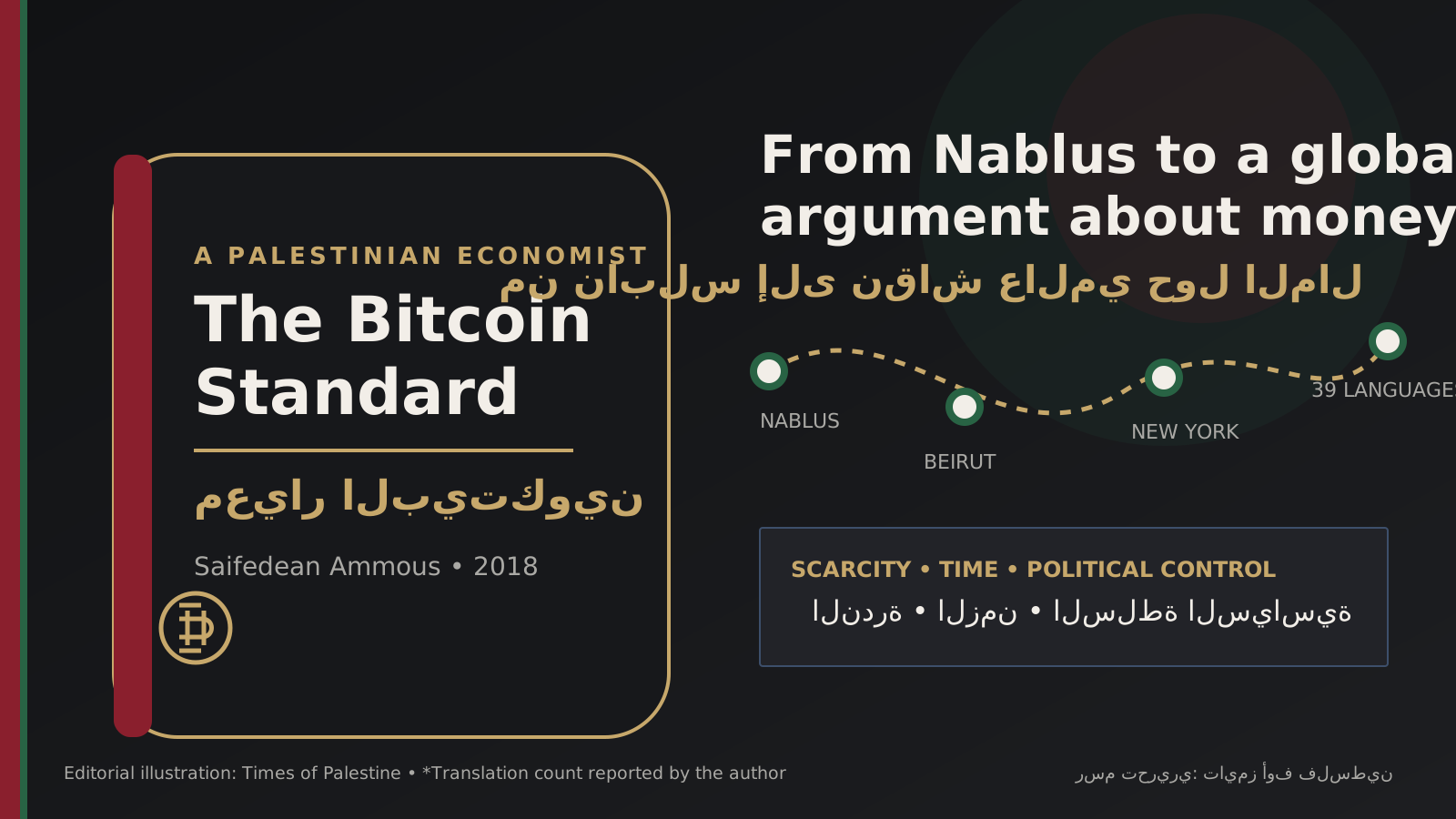
Before Bitcoin became a balance-sheet asset, a national policy experiment or a permanent fixture on financial television, a Palestinian economist helped give it a historical story. Saifedean Ammous’s 2018 book The Bitcoin Standard did not invent Bitcoin and was not the first attempt to explain it.
Its influence came from a different achievement: it recast a technical network as the latest chapter in the long contest over what makes money credible, scarce and resistant to political control.
That framing made Ammous one of the most widely read intellectuals produced by the Palestinian diaspora. Wiley’s publication announcement described the book as a history of monetary technologies and a case for Bitcoin as a politically neutral, free-market alternative to central banking.
Ammous’s own translation catalogue now lists editions of his work in 39 languages and says his three books have sold more than one million copies. Those are author-supplied figures rather than an independently audited sales statement, but the breadth of the editions is visible: Arabic, Turkish, Persian, Japanese, Korean, Spanish and dozens more.
His Palestinian route into that debate matters. A 2025 Italian-language profile produced by Lugano’s Plan ₿, clearly labelled by its host as advertiser content rather than independent reporting, says Ammous was born in Nablus and grew up across Saudi Arabia, Brazil and Ramallah.
Wiley records a bachelor’s degree in mechanical engineering from the American University of Beirut, a master’s in development management from the London School of Economics and a doctorate in sustainable development from Columbia University. He later taught economics at Lebanese American University.
The book changed the question#
Most introductions to Bitcoin begin with software: blocks, mining, wallets and the 21-million-unit limit. Ammous began further back, with shells, metals, coinage and the economic properties that allow one object to carry value through time. He built his argument around “hardness”: money is harder when producing new units is difficult relative to the existing stock.
Gold held monetary power because its supply could not be expanded quickly; Bitcoin, he argued, translates that scarcity into code.
That move was consequential because it changed the question many readers brought to Bitcoin. Instead of asking only whether the system could process payments, they asked what happens when saving is conducted in an asset whose issuance schedule no government or company can revise. The book’s subtitle — “The Decentralized Alternative to Central Banking” — made its political economy explicit.
Ammous extended that project in The Fiat Standard in 2021 and Principles of Economics in 2023. The first reverses the original book’s device: instead of examining Bitcoin as though it were a monetary system, it examines government currency as though it were a technology, built around credit and debt.
The second turns his preferred school of thought into a course-length account of economics. Together they show that the 2018 book was not a one-off market intervention. Ammous was building an alternative curriculum, with Bitcoin as its most visible entry point.
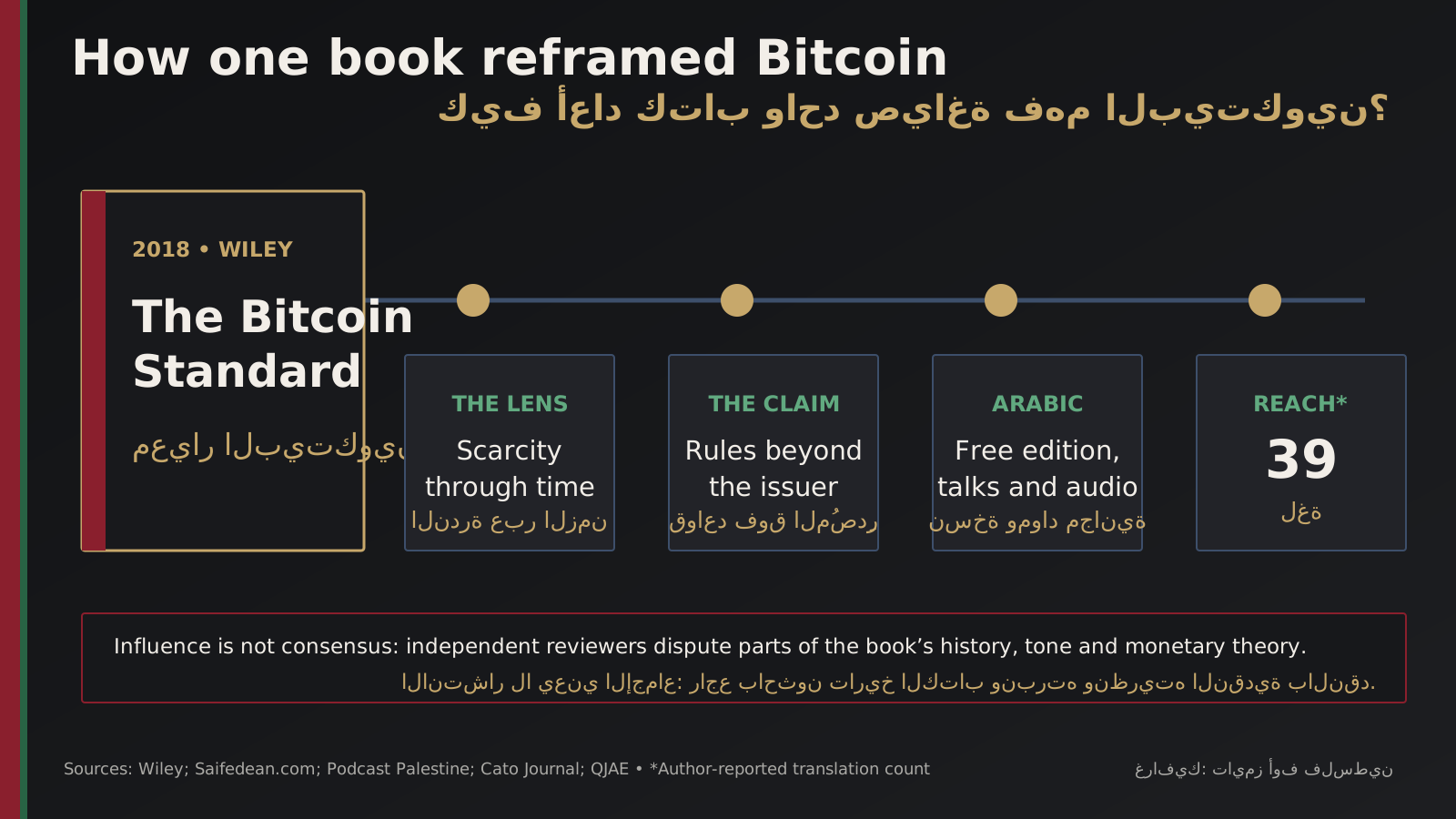
The argument also carried Ammous’s strongest commitments and sharpest limitations. He writes from the Austrian school of economics, emphasizing individual choice, market coordination and skepticism toward discretionary monetary policy. That is a tradition, not an uncontested finding.
A Cato Journal review praised the book’s ambition while criticizing its compressed monetary history, its tone and its limited treatment of Bitcoin’s unresolved economic questions.
A 2020 review indexed by the Directory of Open Access Journals likewise treated the book as important enough for sustained scholarly engagement while identifying claims about banking, history and monetary theory that deserve challenge.
That critical record does not reduce the book’s reach. It explains it more accurately. The Bitcoin Standard became canonical inside a movement, not a settled economics textbook outside it. Its power lies in the coherent lens it offers; readers still have to test that lens against evidence, rival theories and Bitcoin’s actual performance.
Ammous built an Arabic door into the debate#
The author did more than wait for commercial translation. His official Arabic page offers an Arabic edition of The Bitcoin Standard without charge, credits Ahmad Hamdan as translator and says Bitfury supported the project. The accompanying Arabic-language hub gathers an audiobook, interviews, lectures and introductory material. That choice widened access to a debate often conducted in technical English and priced in foreign editions.
The route into Arabic is significant for another reason. Discussions of inflation, currency weakness and blocked access to savings are not imported curiosities in the region. Lebanon’s banking collapse, repeated devaluations across several Arab economies and Palestine’s lack of a sovereign currency give the subject an immediate audience.
None of those crises proves Ammous’s Bitcoin thesis; each has its own institutions and causes. But they help explain why an argument about saving beyond a discretionary issuer can travel well beyond traders watching a price chart.
His Arabic interviews also show how the argument changes when the audience changes. In a long conversation catalogued by Podcast Palestine, Ammous moves from first principles — why money matters — through inflation, Bitcoin’s volatility, supply control, gold and the practical problem he believes Bitcoin solves. The episode’s chapter marks are useful because they expose the full structure of his case rather than clipping a prediction about price.
At Birzeit University, in a lecture linked from his Arabic hub, he addressed monetary policy, central banks, wallets and the distinction he draws between Bitcoin and other digital currencies.
In another officially archived interview on Islam and Bitcoin, he argued that Bitcoin’s commodity-like issuance is more compatible with Islamic finance than government money created through interest-bearing debt. That remains Ammous’s interpretation, not a religious ruling; Islamic scholars and finance practitioners disagree over cryptocurrency’s permissibility, risk and speculative use.
A Palestinian author, not a Palestinian consensus#
It would be a mistake to turn Ammous’s biography into automatic endorsement of every conclusion he reaches. Palestinians do not hold one view of Bitcoin, central banking, the Austrian school or the proper role of the state.
Bitcoin itself carries severe practical risks: large price swings, irreversible mistakes, scams, custody failures and dependence on communications and energy. People under occupation can face all of those risks at once. Nor can a digital asset replace sovereignty, legal rights, functioning public institutions or a productive economy.
But it would also be a mistake to miss the scale of the intellectual export. A Palestinian born in Nablus built one of the texts through which a global movement explains itself. He then made a route back into Arabic through free editions, lectures and long-form conversations.
Whether readers accept or reject his monetary conclusions, Ammous changed the vocabulary of the Bitcoin debate — from price and payment speed to scarcity, time, state power and the freedom to hold value outside an issuer’s control.
That is why his work belongs in Times of Palestine’s Financial Freedom coverage. The section will examine the claims as closely as the author: celebrating Palestinian intellectual reach, preserving disagreement and asking what these ideas can — and cannot — deliver for people whose money, movement and property remain constrained by powers they do not control.