West Bank & Jerusalem
Israeli settlers emptied ten Palestinian communities this year, OCHA records
Graphic: Times of Palestine
Original Reporting
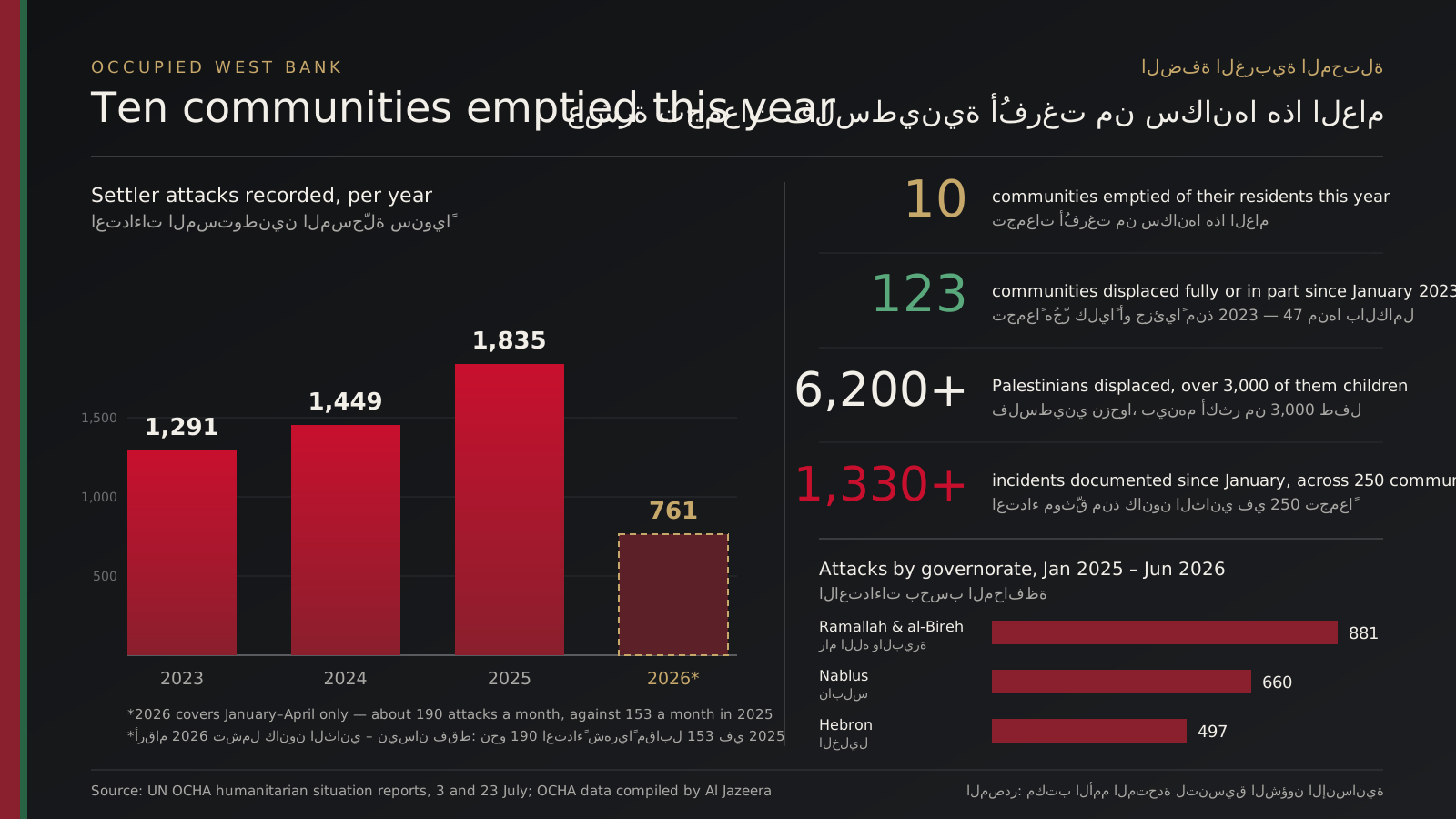
Ten Palestinian communities in the occupied West Bank have been emptied of their residents so far this year, according to the UN Office for the Coordination of Humanitarian Affairs, which counted 46 communities fully displaced and 121 fully or partially displaced between January 2023 and 29 June 2026 in its humanitarian situation report of 3 July.
By 6 July, OCHA had revised the running total to 123 communities displaced in full or in part since January 2023, 47 of them entirely. More than 6,200 Palestinians, including over 3,000 children, have left in that period, OCHA said in its 23 July report, more than 2,300 of them this year alone.
The attacks driving those departures are counted separately. OCHA said in a statement in late July, reported by Middle East Monitor and Middle East Eye, that it had documented more than 1,330 incidents involving Israeli settlers since January that caused casualties, property damage or both. Its 23 July report placed those incidents across 250 Palestinian communities, an average of more than six a day.
Al Jazeera, using OCHA data, reported 1,291 settler attacks in 2023, 1,449 in 2024, 1,835 in 2025 and 761 in the first four months of 2026 — about 190 a month, against 153 a month the previous year. Ramallah and al-Bireh governorate recorded 881 attacks between January 2025 and the end of June 2026, more than any other, followed by Nablus with 660 and Hebron with 497.
Displacement is concentrated in the same places. At least 1,988 Palestinians were displaced across the West Bank in the first four months of 2026, according to OCHA figures compiled by Al Jazeera, already 20 per cent above the total for all of 2025. Ramallah accounted for 1,205 people displaced in settler attacks since January 2025, Jericho 861 and Tubas 619.
The communities have names and dates.
OCHA reported on 5 February that nearly 700 Palestinians in nine communities had been displaced by settler attacks since the start of the year, including about 600 from the Ras Ein al-Auja Bedouin community in Jericho governorate — a community the UN counted in 2025 as 111 households, roughly 550 people, that had absorbed 59 settler attacks in the first half of that year.
January 2026 was the second-highest single month for displacement since the peak that followed October 2023, OCHA said, exceeding the entire 2024 total of 621 people.
Al Jazeera reported on 19 February that the last 15 families had left the al-Burj Bedouin community in the Jordan Valley after attacks on tents and property and the burning of homes, dismantling their own structures as they went. OCHA recorded the full displacement of the Ein Ayoub Bedouin community in August 2025.
Amnesty International, in a report published in June, described Ein al-Hilweh, also called Um al-Jamal, a herding community of around 50 people whose structures were demolished by Israeli forces in July and August 2025, and Makhoul, reduced to four families after all 58 of its structures were demolished in 2013.
Where an outpost goes up, the figures move. After settlers established an outpost in Area B on the eastern edge of Atara village in Ramallah governorate in August 2025, OCHA documented at least 30 attacks there between that month and January 2026, against a single recorded incident between January 2020 and July 2025. Twelve Palestinians were injured and 31 herders from Atara, Birzeit and Ein Siniya were displaced, OCHA said.
Counts differ by who is counting. B'Tselem states that as of 16 March 2026 Israel had forcibly displaced 60 Palestinian communities in Areas B and C, home to more than 4,082 people, with 507 more residents pushed out of 16 partially displaced communities.
The Palestinian Commission against the Wall and Settlements, cited by the agency Palinfo in July and by Al-Quds al-Arabi this week, recorded 3,488 settler attacks in the first half of 2026, 17 Palestinians killed, and between 18 and 26 Bedouin and herding communities displaced fully or partially — figures well above OCHA's for the same period.
The UN human rights office told reporters in Geneva on 29 July that attacks were running at about 190 a month and that the West Bank was on course to exceed 2,000 for the year.
UN News reported OHCHR saying 18 Palestinians had died this year in attacks involving settlers as of 20 July, twelve at the hands of settlers, three killed by Israeli forces and responsibility for three disputed; a syndicated version of the same briefing put the toll at 76 as of 24 July, and the difference has not been explained.
OHCHR's March report found Israeli settlement expansion had forcibly displaced more than 36,000 Palestinians.
Almost none of this reaches a courtroom.
Yesh Din, in its data sheet covering 2005 to 2025 published in February, found that 93.6 per cent of Israeli police investigation files it monitored into ideologically motivated offences by Israelis against Palestinians closed without an indictment, that police failed in the investigation of 82 per cent of cases, and that 3 per cent of investigations ended in a full or partial conviction.
Its previous sheet put the raw figures at 1,701 files, 109 indictments and 53 convictions. Yesh Din also documented nearly 30 incidents of organised mass violence between 2023 and November 2025, with soldiers or police reported present at 16. No Israeli police response to the February data sheet is on the public record.
The state is funding the other side of the ledger.
Reuters reported on 14 July that the security cabinet had approved 1.3 billion shekels, about $434 million, for 34 new settlements, with Finance Minister Bezalel Smotrich announcing a further 1.075 billion shekels for access roads and calling the decision "a day of celebration for Israel and settlements".
Ynet reported that the settlement approvals were taken in March and the budget in June, both kept secret to avoid embarrassing Washington, and that the new total of authorised settlements reaches 103.
Israel National News, citing i24NEWS, reported that infrastructure work was approved before land regularisation is complete, and that Labour MK Gilad Kariv condemned the move.
The Khan al-Ahmar Bedouin community east of Jerusalem, roughly 200 people, was again facing removal in May, according to Monte Carlo Doualiya. B'Tselem records that of the at least 32,000 people driven from northern West Bank refugee camps in early 2025, none had been allowed to return as of February.