Economy & Aid
Palestinian banks hold the economy while Israel holds the clearing keys
Graphic: Times of Palestine
Original Reporting
The Newsdesk gathers reporting from wire services and primary sources and rewrites every story in-house before publication. How our journalism is made →
Palestine has no currency of its own, no sovereign payment system, and thirteen licensed banks holding the savings of a nation anyway. Who owns those banks — and the chokepoint every one of them passes through on the way to the outside world — is the map of Palestinian financial life, and this summer that chokepoint is closing.
The sector is supervised by the Palestine Monetary Authority, the Ramallah central-bank-in-waiting created in 1994 under the Paris Protocol, the economic annex of Oslo that also left Palestine using the Israeli shekel. The banks beneath it divide into three families: Palestinian-owned banks, Jordanian banks with deep West Bank networks, and the Islamic banks serving the fastest-growing segment of the market.
The owners#
The flagship is Bank of Palestine — founded in Gaza in 1960 by Hashim Atta Shawa to bank the citrus economy, and led ever since by the Shawa family of Gaza, with the founder's grandson Hashim Shawa chairing the group today.
The group describes assets approaching $8 billion, on the order of two-fifths of Palestinian GDP, and its stake in the Arab Islamic Bank extends the family's reach into Islamic finance.
The largest outside player is Arab Bank — the Jordanian giant chaired by Sabih al-Masri, whose profile this newspaper published today — whose Palestinian branch network is the biggest foreign banking presence and the historic keeper of Palestinian salaries and savings.
Cairo Amman Bank, the Housing Bank, Bank of Jordan, Jordan Ahli, Jordan Kuwait and Jordan Commercial extend Amman's banking system across the river; the Egyptian Arab Land Bank carries Cairo's state-owned flag.
The homegrown challengers round out the map. The National Bank has built the sector's widest ownership, with more than 8,000 shareholders — a bank owned, unusually, by its own public. Quds Bank, Palestine Investment Bank and the Islamic trio — Palestine Islamic Bank, Arab Islamic Bank and Safa Bank — complete the licensed roster.
Across the sector the pattern repeats: the same families and holding groups that anchor the bourse — Shawa, al-Masri, the PADICO and APIC orbits — anchor the banks.
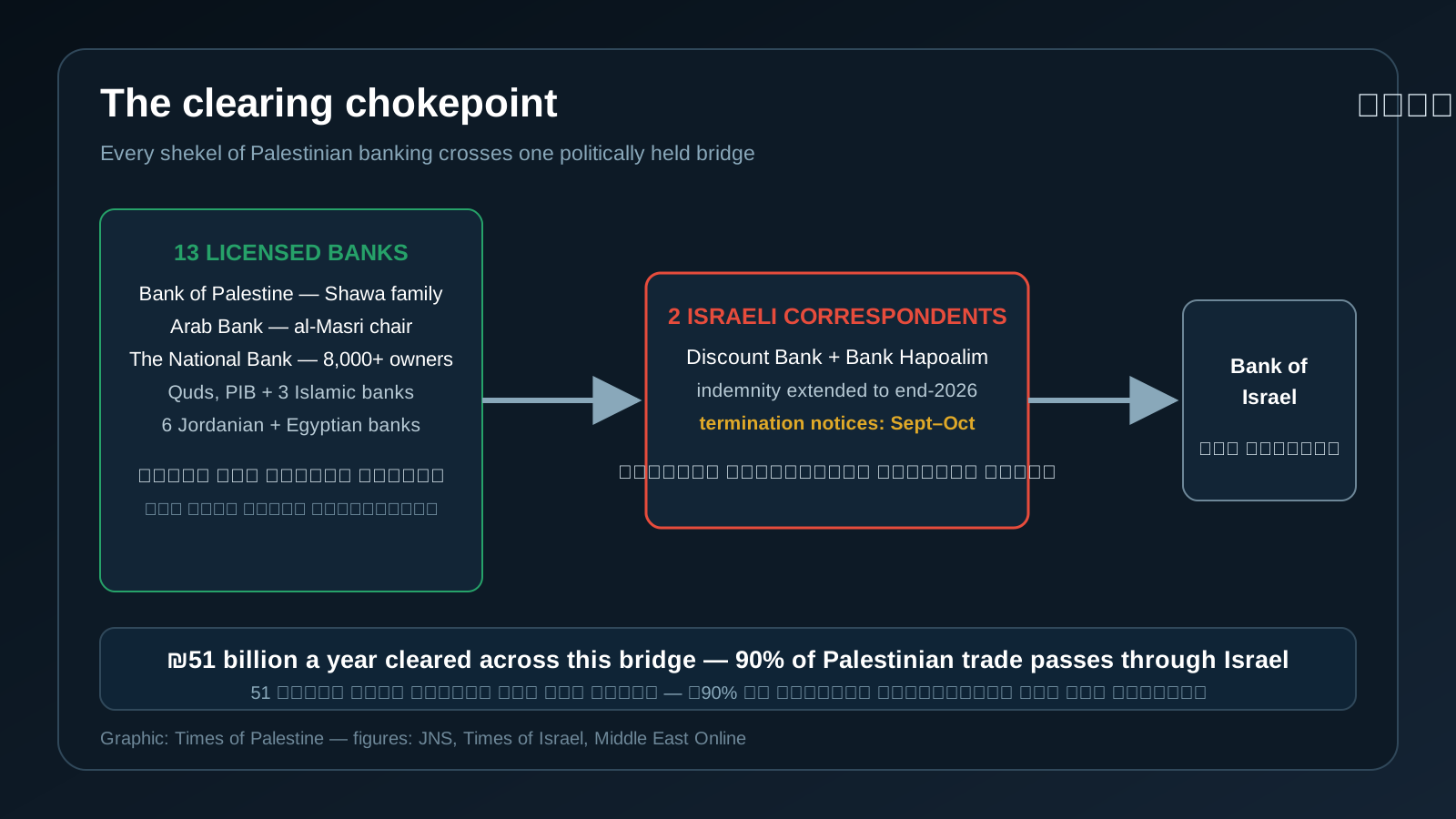
Thirteen licensed banks, two Israeli correspondents, one indemnity. Graphic: Times of Palestine.
The Israeli chokepoint#
None of these banks can clear a shekel on its own. With no access to Israel's payment system, the entire sector depends on two Israeli correspondent banks — Israel Discount Bank and Bank Hapoalim — which process some 51 billion shekels a year in Palestinian transactions, covering the roughly 90 percent of Palestinian trade that passes through Israel, under a Finance Ministry indemnity shielding them from Israeli terror-financing liability.
That indemnity has become a weapon. Finance Minister Bezalel Smotrich ordered it cancelled, citing the Authority's international campaigns against Israel, before reported American pressure produced an extension through the end of 2026.
The reprieve did not hold the banks themselves: Discount and Hapoalim have notified Palestinian banks they intend to end correspondent services from 1 September and 1 October — a severance that would leave fuel, food and medicine imports without a payment rail.
The stakes are not abstract. Cut the correspondent line and the shekel economy of the West Bank cannot pay for its imports; the surplus banknotes Palestinian banks cannot bank — billions of shekels of physical cash — already pile up awaiting Bank of Israel intake.
Economists on all sides, including the Atlantic Council's reconstruction analysts, describe the same conclusion from different directions: a banking sector this sound, held hostage to a switch this political, is the Paris Protocol's unfinished business.
The ownership map explains the resilience — family institutions, diaspora capital and an 8,000-shareholder bank have kept deposits safe through intifadas, splits and war. The clearing map explains the fragility: every one of those institutions ends, for now, at a desk in Tel Aviv that Israel's cabinet can close.