Economy & Aid
Security contractors and consultancies capture Gaza's aid spending
Graphic: Times of Palestine
Original Reporting
The Newsdesk gathers reporting from wire services and primary sources and rewrites every story in-house before publication. How our journalism is made →
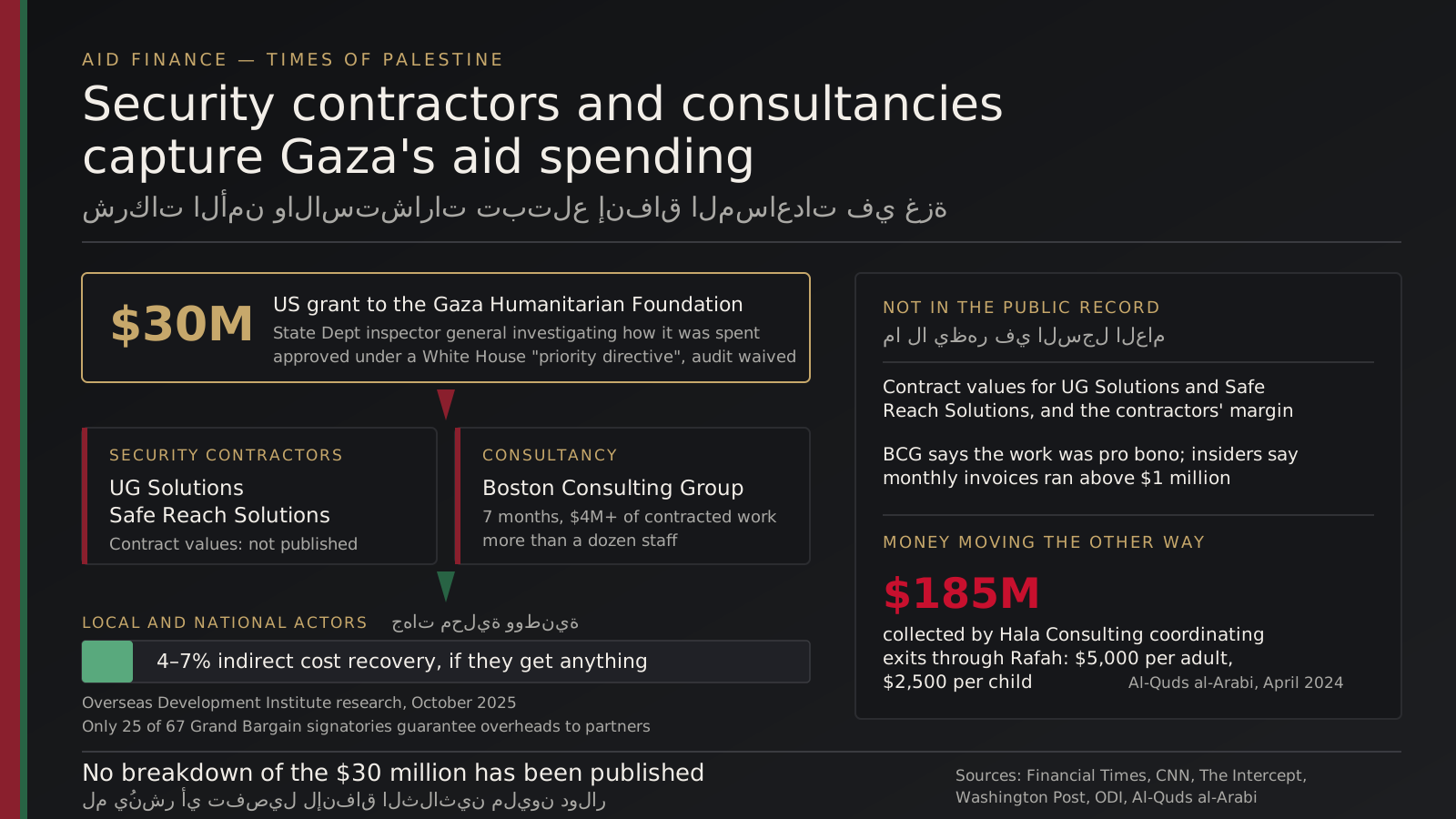
The State Department's Office of Inspector General is investigating how the now-defunct Gaza Humanitarian Foundation spent a $30 million US grant, according to the Financial Times, which reported the inquiry on 20 May and said investigators are examining which budget the money came from, how it was distributed, and the prices the foundation paid for food and logistics services.
The report, relayed by i24NEWS, the Jerusalem Post and Arab News, cited three people familiar with the inquiry.
The grant itself was approved outside the normal controls.
In a letter to Secretary of State Marco Rubio in July 2025, Senators Chris Van Hollen and Peter Welch and 19 colleagues wrote that the State Department approved $30 million for the foundation in late June under a "priority directive" from the White House and the department, and that the administration exempted the group from the comprehensive audit usually required of organisations receiving a USAID grant for the first time.
CNN reported that a USAID review days before the award raised critical concerns, and that tranches of the money were to be released only as the foundation completed tasks normally required beforehand — registering in the government system, pre-vetting its partners and producing evidence of external audits. State Department spokesperson Tammy Bruce said at the time that the funding had not yet been disbursed.
What the money would have bought was, from the outset, a security service as much as a food service. France 24 and PassBlue reported that the distribution scheme relied on two US firms, North Carolina-based UG Solutions and Safe Reach Solutions, the latter tied to the Wyoming wealth management firm Two Ocean Trust.
The Intercept reported in October 2025 that Safe Reach Solutions served as the foundation's lead contractor and that Wyoming corporate records showed the company had been administratively dissolved.
Neither firm's contract value has been published. What the guards, the trucking, the fencing and the site management cost, and what margin the contractors took, is not in the public record.
The consultancy layer is documented only in fragments. The Financial Times, summarised by the Business and Human Rights Resource Centre, reported that Boston Consulting Group's involvement stretched over seven months, covered more than $4 million of contracted work and drew in more than a dozen staff.
BCG has said the foundation work was pro bono; the Washington Post reported that insiders disputed that, saying the firm submitted monthly invoices above $1 million.
In written answers to a UK parliamentary committee in July 2025, BCG said it collected no fees for the project or related work, that its client was McNally Capital, that the work was directed by the US security contractor Orbis Operations, and that separate modelling of post-war "relocation" scenarios was carried out without approval, without a contract and without a client billing code.
The New Humanitarian reported that major aid agencies which condemned the scheme were unwilling to say how much they had paid BCG for unrelated work, and Health Policy Watch reported that Save the Children suspended its relationship with the firm.
At the other end of the chain, the rates are known and they are small. Research by the Overseas Development Institute published in October 2025 found that local and national humanitarian actors typically receive between 4 and 7 percent indirect cost recovery, if they receive anything at all.
Development Initiatives, which maps the sector's policies, found that only 25 of 67 Grand Bargain signatory organisations have a policy guaranteeing overheads to local partners, and that four of eight UN agencies it examined set a percentage for national partners.
Audit findings on the wider US programme are thin but not absent. The USAID inspector general's published work on the West Bank and Gaza includes an audit finding that the agency did not identify key fraud risks for cash assistance and relied on non-governmental organisations' own assessments and on remote monitoring.
Deputy Inspector General Adam Kaplan said in March 2026, in remarks reported by Jewish Insider, that his office had designated Gaza high-risk for diversion and misuse of US-funded assistance.
European audit of aid to Palestinians is older. The European Court of Auditors, in special report 14/2013, questioned the sustainability of EU direct financial support to the Palestinian Authority while finding the Commission had delivered it under difficult conditions; the Commission has since cited that report's assessment of its screening controls as robust, most recently in a November 2023 communication reviewing assistance to Palestine.
Money also moves the other way, out of Palestinian hands.
Al-Quds al-Arabi reported in April 2024 that the Egyptian firm Hala Consulting and Tourism Services had collected roughly $185 million coordinating exits through Rafah, charging at least $5,000 per adult and $2,500 per child; The Times of London, cited by Egyptian outlet Manassa, put earnings at no less than $88 million between March and April 2024 alone.
Al Jazeera reported in June 2026 that coordination prices then ran from about $6,000 for infants to more than $20,000 for adults, and quoted a woman who paid around $25,000 to leave with three children. No public response from the company is on record, and no audit of the fees exists.
The reconstruction phase is being contracted now. The Guardian reported in December 2025 that a White House Gaza taskforce had circulated slide decks with logistics prices, financial projections and warehouse locations, and that two former officials of the US government-cutting effort were leading its humanitarian conversations.
Responsible Statecraft reported in April 2026 that Israel banned 37 NGOs which had worked in Gaza for decades under rules conditioning access on staff data and political compliance.
No breakdown of the $30 million has been published by either the State Department or the foundation, and the inspector general's office has not issued findings.