Economy & Aid
Permit brokers take a third of Palestinian workers' wages
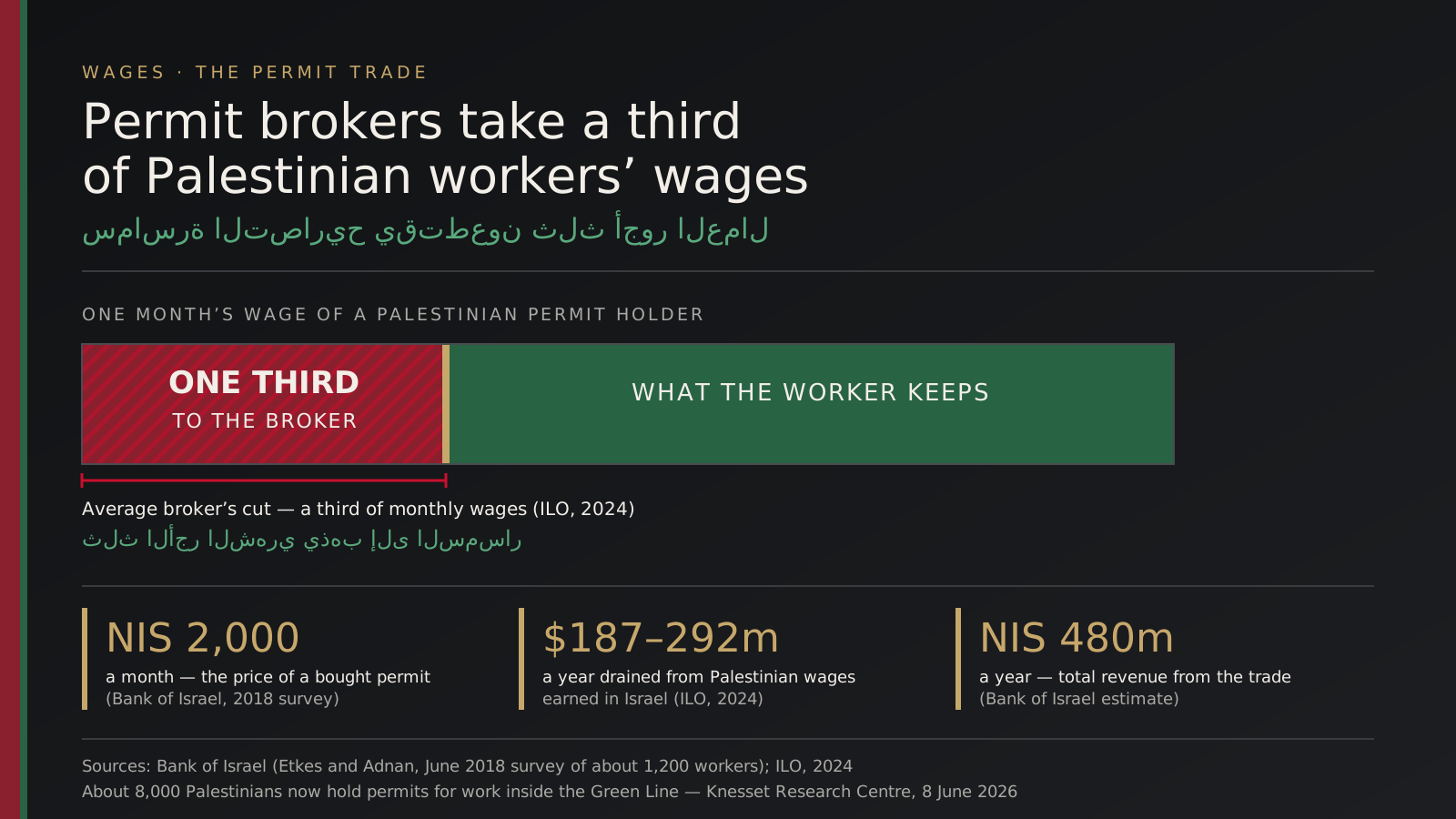
Graphic: Times of Palestine
Original Reporting
The Newsdesk gathers reporting from wire services and primary sources and rewrites every story in-house before publication. How our journalism is made →
The market in Israeli work permits has outlasted the labour market that created it. Palestinian brokers are charging more than triple the pre-war price for a permit, Hasan Joma, who ran a business in Tulkarem placing workers inside Israel before the war, told the Associated Press in February.
There is far less to sell. After 7 October 2023 Israel barred some 115,000 West Bank permit holders from their jobs inside Israel, according to Back to Work, the report published in May 2025 by Gisha, LEAP and Kav LaOved, which counted about 14,000 workers holding permits for Israel at the time of publication.
The Knesset Research and Information Centre, drawing on Civil Administration data in a report dated 8 June 2026, put the number of Palestinians holding permits for work inside the Green Line at about 8,000, with 5,972 workers actually entering on 29 April 2026 and a further 2,472 working in border areas, according to the Palestinian outlets Raya and Al-Quds.
The trade itself was documented by Israel's central bank.
A study by Haggay Etkes of the Bank of Israel research department and Wifag Adnan of New York University Abu Dhabi, based on a targeted survey of about 1,200 workers conducted in June 2018, found that roughly 20,000 Palestinian workers — about 30 percent of those employed in Israel on a permit — had bought their permits.
The bank put the price at about NIS 2,000 a month, equal to about a fifth of a worker's gross monthly income, and the average monthly profit to the seller, net of compulsory payments to the state, at about NIS 500.
The Bank of Israel's conservative estimate of total revenue from the trade was about NIS 480 million a year, with profits of about NIS 120 million. Most of it, the bank said, was in construction, where most Palestinian workers are employed.
The bank located the cause in the design of the permit system rather than in criminality alone. Israeli employers receive permits for named Palestinian workers and can cancel them easily; the permit allows the worker to enter Israel only to work for the employer who requested it.
Where the worker in fact works elsewhere, a rent is created — and it is that gap between the administrative allocation and the labour market that is sold.
Kav LaOved, the Israeli workers' rights group, reported in 2018 that brokerage fees reaching its caseload ran between NIS 1,500 and NIS 3,500 a month per worker.
In one case the group described, a worker was paying NIS 2,600 a month for a permit sold to him by a middleman from a village near Nablus; the same middleman, according to Kav LaOved, supplied permits to about 200 other workers at NIS 2,000 to NIS 3,000 each per month, and was one link in a longer chain.
Etkes, processing Palestinian Central Bureau of Statistics figures, estimated in 2023 that of about 150,000 Palestinians then working in Israel, 53,000 were on legal employment programmes, 39,000 worked without permits and 58,000 had purchased their permits, with more than 60 percent of Palestinian permit holders in construction having bought them. Jason Silverman, co-founder of the Shrinking the Conflict Initiative, said permits were advertised openly online, with responses handled privately.
The International Labour Organization put the cost to workers higher.
In its 2024 report on the occupied Arab territories, the ILO found that around half of permit-holding Palestinian workers paid brokers, that the average cost amounted to a third of monthly wages, and that the practice drained between 187 and 292 million US dollars a year from Palestinian wages earned in Israel and the settlements.
The ILO's director-general said in 2025 that the permit regime and its broker practices "must be reformed".
The reform the Bank of Israel analysed in 2019 was described in the bank's own paper as approved by the Israeli government but not yet implemented. No implementation is recorded in the ILO's subsequent reports.
The ILO's 2026 report to its annual conference recorded 44,000 Palestinians working in Israel and the settlements in 2025 and a 59 percent rise in work without permits, from 11,500 in 2024 to 18,300 in 2025, according to an account of the report published by the Egyptian daily Youm7.
That account also cites some 59,000 workers dealing with intermediaries who take large shares of their pay, and an average daily wage in Israel of NIS 294; the summary does not explain how the broker figure relates to the smaller employment total.
Palestinian officials have used similar numbers.
The labour minister, Nasri Abu Jaish, said in December 2022 that a worker loses about a third of his wage — some NIS 2,500 to NIS 3,000 — to obtain a permit, and that the Palestinian economy loses more than NIS 1.2 billion a year to permit brokers, the economic outlet Aliqtisadi reported.
The general secretary of the Palestinian General Federation of Trade Unions, Shaher Saad, told Maan in 2019 that permits changing hands cost between NIS 2,000 and NIS 6,000, and that the practice breached Article 37 of the Paris Protocol, which routes worker movement through official employment offices.
Enforcement on the Palestinian side is thin and its results are not published. Al-Hayat Al-Jadida reported in 2018 that the labour ministry said it was pursuing brokers and had referred files to the judiciary; the outcome of those files is not on the public record.
Committees formed by the Palestinian cabinet in every governorate since 2020 to confront broker exploitation have become less active because most permit categories are suspended, the governor of Tulkarem, Maj. Gen. Abdullah Kmeil, told Al-Araby Al-Jadeed in November 2025.
What replaced the wage permit is a security document. The trade union federation told Al-Araby that more than 25,000 "00" security permits are in Palestinian hands, concentrated in Hebron and Bethlehem, and that the few remaining work permits are now issued directly by the Israeli employer, without passing through the Palestinian civil liaison office, since 7 October.
Settlement employers kept most of their workforce. Of roughly 48,000 Palestinians employed in settlements before the war, more than 65 percent retained their permits, Gisha found; Israeli officials did not answer AP's questions about why settlement work was treated differently.
Israel Hayom reported at the end of July that the army's Central Command would reopen settlement industrial zones to Palestinian workers, according to The New Arab — a decision whose effect on broker prices has not yet been measured by anyone.








.jpg?width=640)