Arab Support
Arab donors keep Gaza hospitals running while billions await disbursement
Graphic: Times of Palestine
Original Reporting
The Newsdesk gathers reporting from wire services and primary sources and rewrites every story in-house before publication. How our journalism is made →
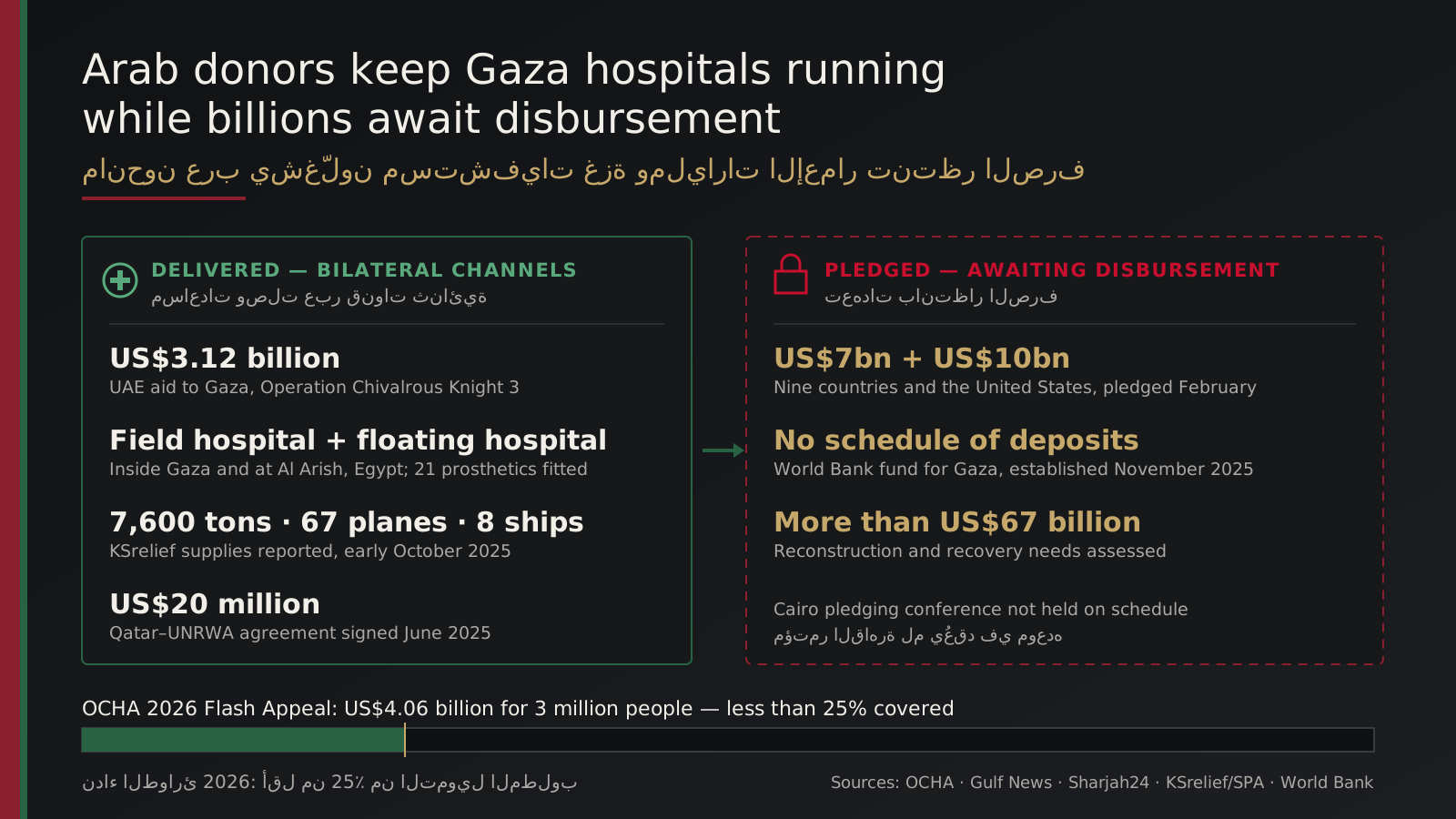
The Arab money that can be traced into Gaza this quarter arrived almost entirely through bilateral channels — aid convoys, a field hospital, a hospital ship berthed in Egypt — while the multilateral fund created to receive reconstruction pledges has published no schedule of deposits against the billions announced in February.
The gap shows in the humanitarian ledger. OCHA's 2026 Flash Appeal seeks US$4.06 billion to deliver life-saving support to 3 million people across the Occupied Palestinian Territory.
In its situation report of 26 June, OCHA said funding for relief efforts remained insufficient, with less than 25 per cent of this year's requirements covered — an improvement on the position at the start of May, when the same office reported that four months into 2026, just over 10 per cent of the funding required for critical humanitarian operations had been secured.
The United Arab Emirates publishes the most detailed running total of any Arab donor.
Gulf News reported on 24 July that Emirati aid to Gaza had reached $3.12 billion under Operation Chivalrous Knight 3, launched on 5 November 2023, a framework covering humanitarian, medical, food and shelter assistance delivered by land, sea and air, and including the UAE Field Hospital inside Gaza and the UAE Floating Hospital at Al Arish in Egypt.
That machinery kept operating through the quarter. The Emirates News Agency reported on 12 August that the operation's mobile medical clinic was still travelling between residential areas, communities and shelters, providing examinations and consultations to patients, elderly people, children and families unable to reach health facilities.
Sharjah24 reported on 13 August that the Floating Hospital had fitted prosthetics for 21 Palestinians under a programme called Step of Hope, alongside convoy tallies of 938 tonnes across five convoys, and 792 tonnes across five earlier ones.
The field hospital was inspected in July by a delegation from OCHA and the Office of the UN Resident Coordinator, reviewing the medical services it provides.
Saudi delivery is documented in activity counts rather than a cash total. The Saudi Press Agency reported that a King Salman Humanitarian Aid and Relief Centre convoy carrying tents entered Gaza on 18 August.
Arab News reported a food convoy distributed by KSrelief's Gaza partner and 25,000 hot meals from the agency's central kitchen for families in central and southern Gaza, and, in April, 717 food baskets distributed in Gaza City reaching 4,302 people.
The Council on Foreign Relations, reviewing Arab contributions in May, recorded that KSrelief reported delivering more than 7,600 tons of supplies by 67 planes and eight ships in early October 2025, about twenty ambulances to the Palestinian Red Crescent Society, and $90 million in signed agreements with international organisations.
Qatar's most recently published core commitment to the UN agency serving refugees is a $20 million agreement with UNRWA signed in June 2025 covering the agency's work in 2025–2026 across the occupied territory, Syria, Lebanon and Jordan, including primary healthcare and education.
Measured against national income, the ALNAP humanitarian assistance report for 2026 found that in 2025 Qatar spent 0.49 per cent of gross national income on humanitarian aid, the UAE 0.35 per cent and Saudi Arabia 0.13 per cent.
The reconstruction pledges sit in a different structure. The World Bank established the Financial Intermediary Fund for Gaza Reconstruction and Development in November 2025 after a Security Council resolution called on the Bank and other financial institutions to help fund reconstruction through a donor-based trust fund.
TRT World reported that at the first Board of Peace meeting in Washington on 19 February, World Bank President Ajay Banga said the fund was ready for donations, that the board would direct disbursements, and that a Bank financial controller had been seconded to the board.
Banga described the Bank's role in April as "a limited trustee of a trust fund" into which governments want to put money, holding the funds while the Board of Peace decides.
The Carnegie Endowment, examining the structure in March, noted the Bank carries "no responsibility or accountability, fiduciary or otherwise, for the use of the funds after they have been transferred".
The research group Development Front wrote in March that nine countries pledged $7 billion at that February meeting, in addition to $10 billion pledged by the United States, without naming them. No statement from the fund's trustee or the board has matched those pledges to dated deposits. Reconstruction and recovery needs exceed $67 billion, according to the World Bank-supported addendum to the interim damage and needs assessment.
The Cairo pledging conference that was to convert Arab plans into commitments has not produced them. President Abdel Fattah al-Sisi announced in October 2025 that Egypt would host an international reconstruction conference in November, and Egypt's foreign ministry said preparations covered funding and financial pledges and an updated assessment of Gaza's destruction.
Asharq Al-Awsat reported in late November, citing an Egyptian source, that the conference would not be held on schedule. This week in Cairo, a meeting on economic recovery ended with agreement to form a joint committee to survey private-sector needs, propose measures and prepare a work programme for participation in reconstruction — coordination, not money.
Medical corridors remain the narrowest channel. The Lancet Global Health reported in March that 10,600 patients were evacuated during the war, primarily to Egypt, Qatar and the United Arab Emirates.
Inkstick reported that the cumulative total stood at 11,124 patients as of March 2026, that 7,802 left between October 2023 and September 2025 according to WHO, and that in the first two weeks of April only 85 patients and 160 caregivers were evacuated. Before the war, WHO recorded 50 to 100 patients leaving daily.
Accounts differ on the crossing: the Lancet dates Rafah's closure to 24 May 2025, while Inkstick reports it partly reopened in February 2026 for the first time since May 2024.
WHO's stated asks are unchanged: more member states accepting patients, restoration of the medical corridor to the West Bank including East Jerusalem, and more corridors through Egypt and Jordan. The Lancet noted that five human rights organisations petitioned the Israeli High Court in late November 2025 to allow evacuations into the West Bank and East Jerusalem; no ruling appears on the record retrieved.
What the next tranche has to cover is already measurable. OCHA reported on 6 August that more than 65 per cent of active displacement sites have no direct site management support or structured winter preparedness activities, and that 234 private-sector trucks, 28 per cent of the total, carried non-essential items instead of shelter and water supplies.


.jpg?width=640)