Economy & Aid
Israel withholds $6 billion it collects for Palestinians
Graphic: Times of Palestine
Original Reporting
The Newsdesk gathers reporting from wire services and primary sources and rewrites every story in-house before publication. How our journalism is made →
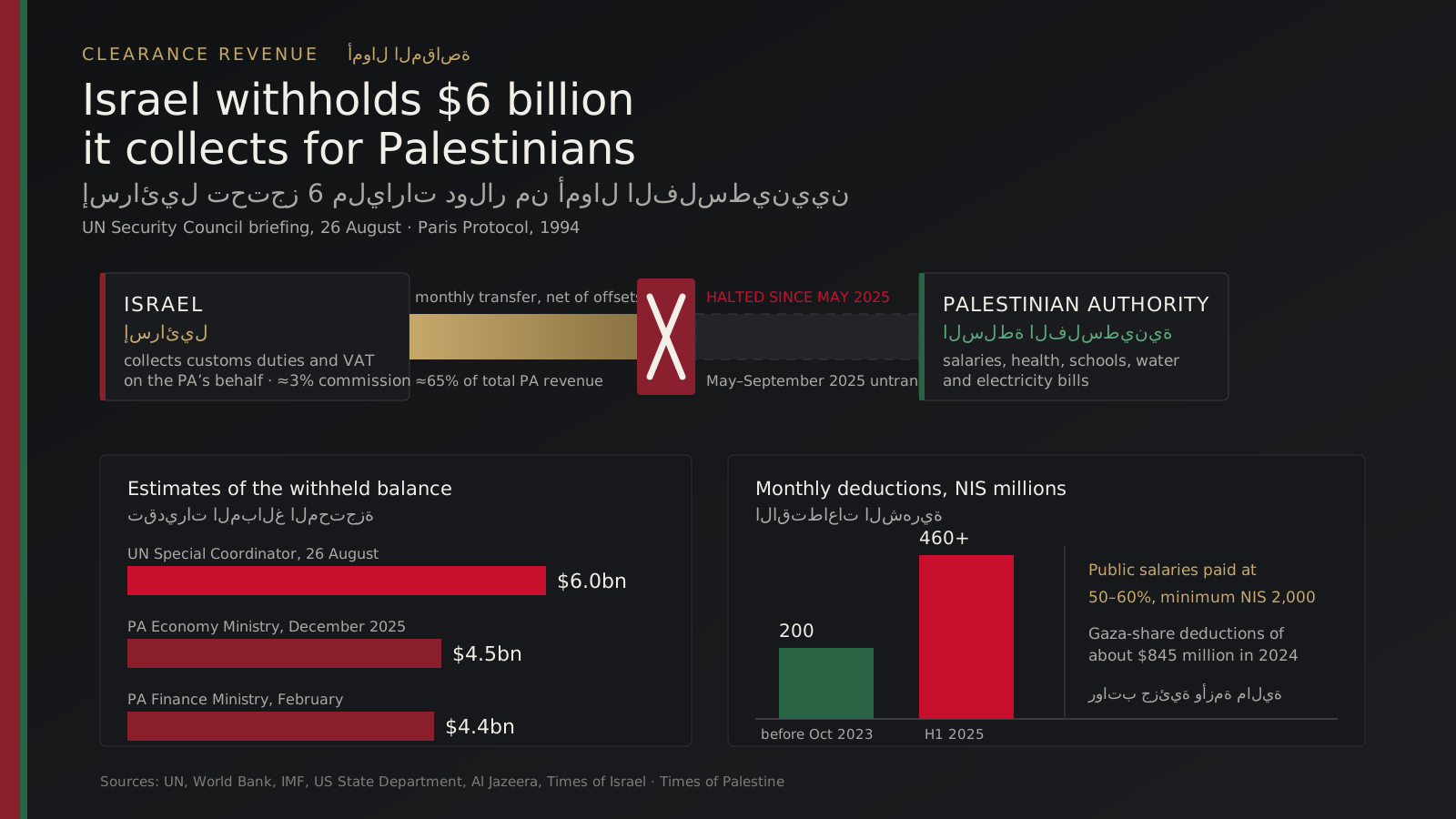
Israel is withholding roughly $6 billion in customs and tax revenue it collects on behalf of the Palestinian Authority, the UN's acting Special Coordinator for the Middle East Peace Process, Ramiz Alakbarov, told the Security Council on 26 August, adding that uncertainty over correspondent banking poses a further serious threat to Palestinian financial stability.
The money is not aid. Under the 1994 Paris Protocol, described by the Israeli business daily Calcalist, Israel collects taxes and customs duties on the Palestinian Authority's behalf and transfers them monthly, net of offsets for services such as electricity and water.
Al Jazeera's reference desk puts the collection commission at about 3 percent and the clearance transfer at around 65 percent of total PA revenue, making its continued flow a precondition for paying salaries and funding basic services.
Those transfers stopped.
The World Bank recorded that monthly deductions averaged more than NIS 460 million in the first half of 2025, against about NIS 200 million before October 2023, and that since May 2025 the transfer of clearance revenues has been completely halted, with May through September 2025 still untransferred at the time of drafting.
The Bank's country assessment states that the PA faced one of its most dire fiscal crises in 2025 after Israel completely suspended clearance revenue transfers in May, that the PA cut public salary payments to 50–60 percent in late 2025, and that it expanded domestic bank borrowing beyond prudential limits while accumulating arrears to employees, the private sector and the pension fund.
The deductions were built in stages, each with a stated Israeli legal basis. The IMF's 2023 report to the Ad Hoc Liaison Committee attributed the squeeze in part to a doubling of unilateral deductions from clearance revenues by the Government of Israel under the 2018 Israeli Palestinian Prisoners Law.
Ynet reported that in January 2023 the finance minister announced the transfer of NIS 138.8 million of Palestinian Authority funds to Israeli victims of attacks, to satisfy a judgment in the Litvak case.
After 7 October 2023, Haaretz reported, the security cabinet decided to offset from the tax money the portion allocated to the Gaza Strip, in addition to the deduction already made over payments to prisoners and families. The US State Department's 2025 investment climate statement put those Gaza deductions at approximately $845 million in 2024.
The full halt from May 2025 rests on political grounds rather than a statutory offset. The Times of Israel reported that Finance Minister Bezalel Smotrich has refused to transfer the funds since May 2025, saying at the time it was in protest at PA-backed unilateral moves; the same outlet reported in January 2026 that Israel proposed using a portion of the withheld revenues to pay for clearing rubble in Gaza.
Figures for the accumulated balance differ and have not been reconciled. Al Jazeera reported in December 2025 that Palestinian Economy Minister Mohammed al-Amour put the withheld sum at about $4.5 billion and called it collective punishment.
The Palestinian news site Arab48 reported Finance Minister Estephan Salameh giving a figure of roughly $4.4 billion, some NIS 13 billion in February. The UN's $6 billion is the highest figure on the record five months later.
Israeli petitioners have argued the opposite case in court.
Ynet reported that rights-of-victims organisations filed three petitions to the High Court asking it to change the method of calculating the sums transferred so they follow containers actually unloaded rather than importers' declarations, order criminal enforcement against importers filing false declarations, and order the state to recover billions transferred to the Authority, with a hearing held in September 2024 before Justices Solberg, Mintz and Elron.
For employees, the arithmetic is now measured in months. The Palestinian Ministry of Finance announced in May that it would pay 50 percent of public sector salaries, with a minimum of NIS 2,000, for the month of February 2026 — a three-month lag on a half salary.
In January, Al Jazeera reported the ministry had paid October 2025 salaries at no less than 60 percent, minimum NIS 2,000. The Israeli institute INSS wrote in July that the PA continues to function despite the crisis, paying salaries partially and operating its civil and security apparatuses.
The second front is the banking channel.
The Jerusalem Post reported in June 2025 that Smotrich instructed the finance ministry to cancel the indemnity given to correspondent banks dealing with banks in the Palestinian Authority — a waiver that had let Israeli banks process shekel payments for services and salaries without exposure to money-laundering and terror-financing charges.
JNS reported this month that Bank Hapoalim and Israel Discount Bank provide those services under a finance ministry indemnity, that the cancellation was ordered last year over what the minister described as a delegitimisation campaign, and that the indemnity was later extended amid reported pressure from the Trump administration.
Israel's N12 reported this month that the two banks announced they were ending the activity, and noted that trade with the Palestinian Authority stood at more than $7 billion in 2025 and ran through that channel.
Cash has piled up as a result. The Atlantic Council estimated the shekel surplus in Palestinian banks at about $4 billion by the end of 2025, cutting bank profitability by roughly 20 percent, with some banks barring the opening of cash accounts.
Arab News reported that Palestine Monetary Authority governor Yahya Shannar said shipments of excess currency originally planned for the fourth quarter of 2026 had been brought forward, a move he said would ease the surplus and support Palestinian banks' accounts with their Israeli counterparts.
The PMA said in June 2025, through Wafa, that given Israel's refusal to allow surplus shekels to move to Israeli banks it was seriously studying alternatives, including a shift away from the shekel.
Whether the correspondent channel survives the banks' notice, and on what terms the withheld balance is ever released, is unsettled. The Palestinian cabinet, quoted by Raya, said in March that it would keep paying a percentage of salaries according to available means until clearance transfers resume, and that its emergency measures are not a substitute for Palestinian rights to the funds held by the Israeli government.