The Diaspora
Nehad and Sara Albattniji opened New Zealand's first Palestinian restaurant

Image credit: Musakhan — Alice Wiegand (Lyzzy) via Wikimedia Commons (CC BY-SA 4.0) · License
Original Reporting
The Newsdesk gathers reporting from wire services and primary sources and rewrites every story in-house before publication. How our journalism is made →
Dominion Road is where Auckland goes to eat other people's home cooking — a long southward strip of Chinese, Malaysian and Indian kitchens, one to a shopfront, lit until late.
This year the strip gained something it had never carried. At number 353, in Mt Eden, a dining room called Zaitoon serves the food of Gaza, and on weeknights people are still arriving after nine o'clock.
Nehad Albattniji cooks it. His wife Sara, a school deputy principal, runs everything that is not the kitchen. The New Zealand Herald's Viva magazine, which told their story on 2 October, reported that the couple believe Zaitoon is the first of its kind in the country.
"This is the first Palestinian restaurant in New Zealand, not just Auckland," Nehad told the magazine. "There are lots of Palestinian owners of restaurants, but they're not serving Palestinian food."
The cook who left on the third attempt#
He grew up in Gaza with nine brothers and two sisters, and by his own account he learned to cook for a practical reason: in a house that size, the one who makes the food eats well.
The skill became two jobs. He cooked at a school in Gaza through the mornings — falafel, hummus, sandwiches, and barrad, the lemon-and-banana slushie that Gazan children queue for in summer — and cut hair in the afternoons.
Sara is half-Palestinian and was living in New Zealand. The two met online and kept talking until the question of marriage became a question of borders. Nehad left Gaza to marry her, crossing into Egypt in 2010 on his third attempt.
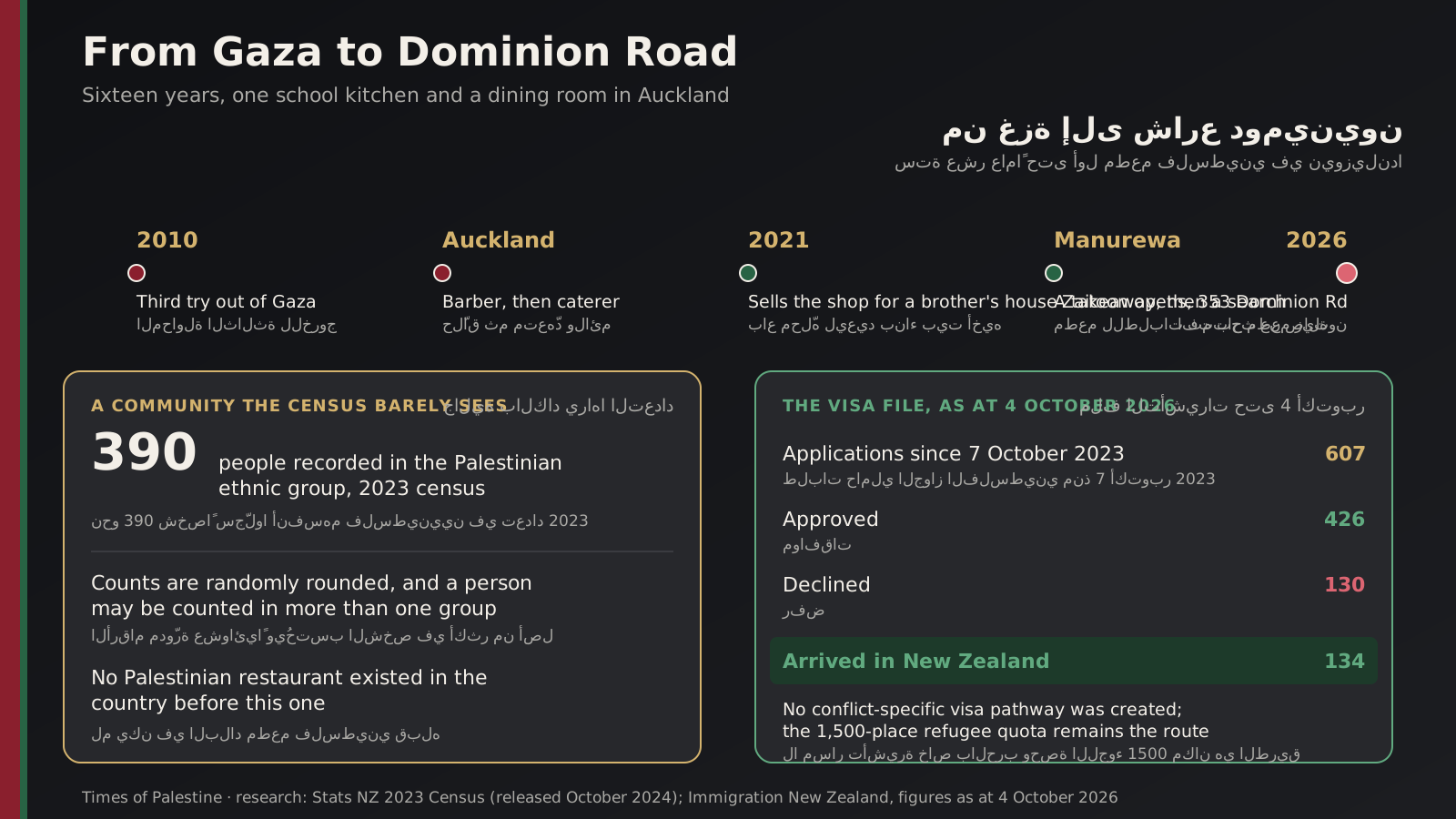
In Auckland he cut hair again, then catered, then ran a Ponsonby barbershop that did well, then opened a takeaway in Manurewa — also called Zaitoon — and closed it when he decided he wanted a room with tables in it.
The Ponsonby shop did not survive that run of good fortune, and not because the business failed. In 2021 he sold it to help a brother rebuild a house in Gaza that Israeli forces had destroyed.
Israeli attacks have killed more than a hundred of his relatives in Gaza since October 2023, Nehad told the magazine. He and Sara send money home regularly. The restaurant on Dominion Road is, among other things, the machine that generates it.
"If not now, when?"
Sara Albattniji, on opening the restaurant in the middle of a war
The room the city built#
Zaitoon was not fitted out by a hospitality group. It was assembled, largely by hand, by a circle of people who had come to know each other through Palestine solidarity work in Auckland, and who turned up with whatever skill they had.
Viv Teo, who founded the refugee-focused food project Breakbread, did the prop styling. Simon Endres took the branding, Frances Carter the photography, Olivia Cootes the social media, Sam Bratton the systems that make a restaurant run. Samir Allen helped set up the kitchen and shape the menu. Sara's father Ashraf did the renovation.
That is the part of the story that does not appear on a menu: a community too small to have built an institution before this one, building one.
The city answered quickly. On 7 October the same magazine's restaurant critic, Jesse Mulligan, gave Zaitoon 18 out of 20 and called the food some of the best he had come across this year — after the restaurant turned him away on his first attempt, with not a table free.
He described the crowd rather than the decor: couples, student groups, people coming off shifts, whole families. The place is unlicensed and serves no alcohol, which he decided improved the evening rather than diminishing it.
What he ate reads like a map of the Levant with Gaza at the centre of it. Muhammara, the walnut and pepper dip, at fifteen dollars. Musakhan — sumac chicken, caramelised onion, pine nuts, flatbread — at thirty, which he praised above everything else on the table.
And dagga gazawiya at eighteen: the crushed tomato, chilli, cucumber and tahini dish that belongs to Gaza specifically, hot enough that the critic noticed. A dish most of Auckland had no way of meeting until this year is now on a menu six kilometres from the city centre.
A community the census barely sees#
The reason Zaitoon is the first is arithmetic. Stats NZ's 2023 census, released in October 2024, recorded the Palestinian ethnic group in New Zealand in age bands that add to roughly 390 people — randomly rounded for confidentiality, and an undercount by design, since ethnicity is a multiple-response question and many Palestinians here are also counted as Arab or Middle Eastern.
Even allowing generously for that, this is one of the smallest Palestinian communities in the world to have opened a public Palestinian institution. Chile's community is counted in the hundreds of thousands. Auckland's fits inside a school hall.
The war has moved those numbers only slightly. Immigration New Zealand, publishing figures as at 4 October 2026, records 607 visitor and residence applications from Palestinian passport holders since 7 October 2023, of which 426 were approved and 130 declined, with 35 still in progress. Of the people approved across all visa types, 134 have arrived in the country.
The agency is explicit that no conflict-specific pathway was created for them, as one was for Afghanistan in 2021 and Ukraine in 2022. The refugee quota — 1,500 places a year, filled on referral from the UN refugee agency — remains the main route, and changes to immigration policy, the agency notes, are a decision for the government rather than for officials.
Papers released under the Official Information Act in 2024 show that a dedicated humanitarian visa for the families of New Zealand-based Palestinians was under consideration at the time. It has not been established. What has continued is quieter work: New Zealand's embassy in Cairo still petitions the Israeli and Egyptian governments to let holders of valid New Zealand visas leave Gaza at all.
What a dining room answers#
For a community of that size, scattered across a country of five million at the far end of the world, a restaurant does something a committee cannot. It gives the community an address.
One of the small details in Viva's account carries more weight than it looks. A fifteen-year-old walked in with her friends and held her birthday party there. Somewhere in Auckland there is now a teenager whose idea of a celebration is a table of maqluba turned out upside down onto a platter, in a room where the cook comes out to say hello.
That is the whole argument of the place, and Sara has made it plainly. "Through food, we're preserving a culture," she told the magazine. "We're showcasing the beauty of Palestine and the Middle East."
The family is clear-eyed about the odds — Sara has said the next six months to a year will decide whether the venture holds. But the thing that was missing for decades is no longer missing, and it took a cook from Gaza, a deputy principal and a crowd of volunteers with paintbrushes to supply it.