The Diaspora
Westchester Palestinians raised $14,000 for Gaza's orphans at one bazaar

Image credit: Chest panel from a Gaza dress, Tiraz: Widad Kawar Home for Arab Dress — Ma'moun Othman via Wikimedia Commons (CC BY-SA 4.0) · License
Original Reporting
The Newsdesk gathers reporting from wire services and primary sources and rewrites every story in-house before publication. How our journalism is made →
On the first Saturday of November, a mosque hall in northern Westchester County turned into a market. Tables of olive oil and painted pottery went up where the congregation usually prays. A kunafa truck parked outside.
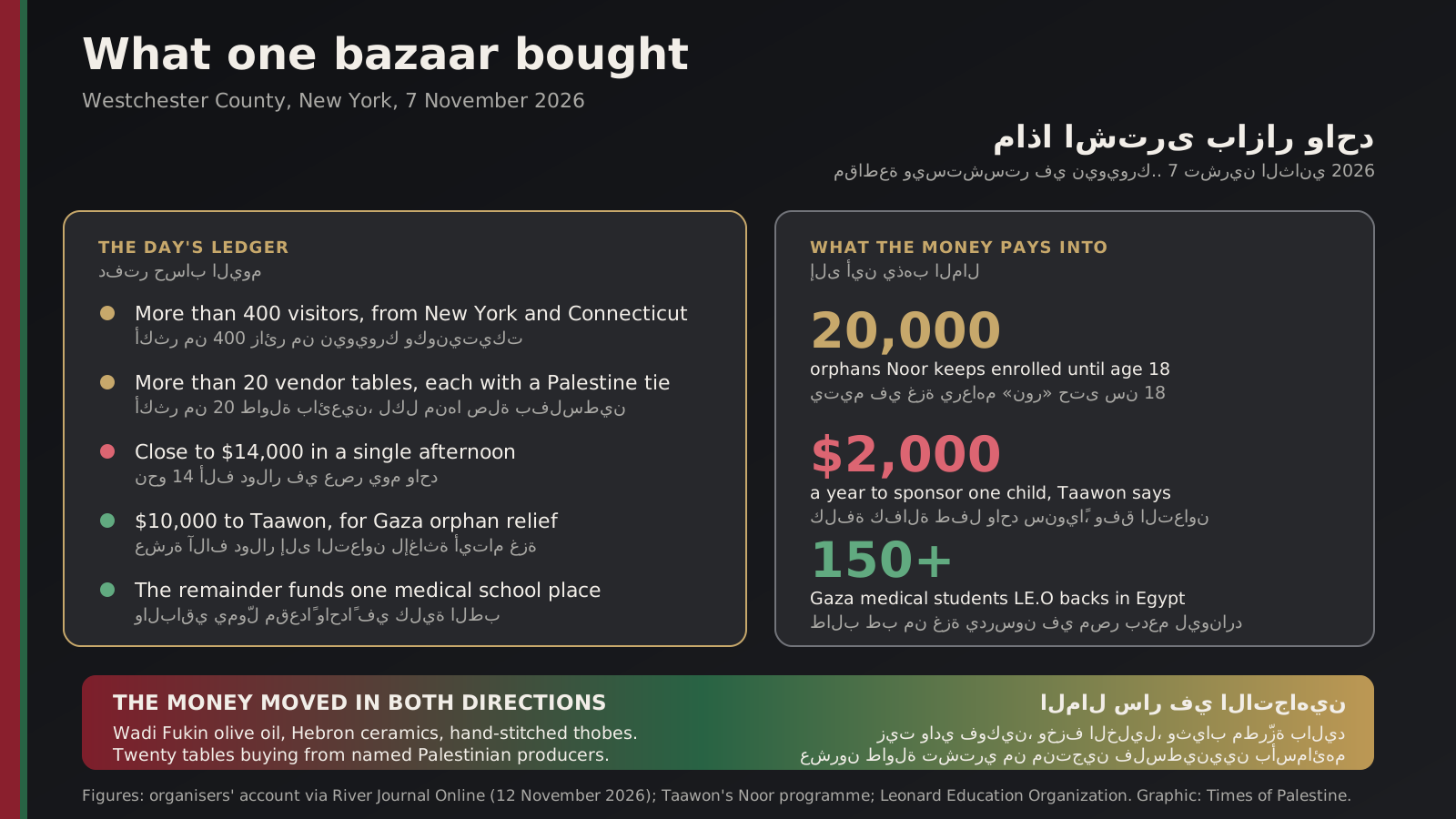
By the end of the day more than 400 people had come through from New York and Connecticut, and the hall had raised close to $14,000 for two institutions working inside Palestine.
The bazaar was called Gather for Gaza. It was held on 7 November at the Upper Westchester Muslim Society, and the organisers published their account of the day through River Journal Online, the weekly that covers the Hudson river towns from Tarrytown up to Peekskill.
The organiser with her own Gaza file#
The day was convened by Seeds of Solidarity, a small grassroots group whose founder is identified in the account only by her surname, Savoca. Her father left Gaza in 1967. She spent childhood summers there until 1997.
Her extended family has lost more than 200 of its members since the war began, by the organisers' count.
"Every vendor was hand-selected for their unique story and connection to Palestine and Gaza."
Savoca, founder of Seeds of Solidarity
That sentence is the part worth slowing down on, because it is where a charity sale stops being a charity sale and becomes a trade route.
More than twenty small businesses took tables. Darna Palestine brought organic olive oil pressed from Nabali and Rumi olives grown in Wadi Fukin, the farming village in the Bethlehem hills; the company says it buys from small producers who still farm and dry by hand, and ships from a warehouse in New York.
Quds Orchard brought ceramics from Hebron, where the painted-pottery workshops are among the oldest continuously working trades in the West Bank. Hadil Sarar's family sold hand-stitched garments under the name Thobe Tale. Women stitched tatreez in the room while visitors watched them work.
The food came from the City Kunafa truck and from Grill House, a Palestinian-owned restaurant in Yonkers. There was face painting and henna for the children.
So before a dollar was counted for Gaza, money had already travelled the other way — to olive farmers, potters and embroiderers inside Palestine.
Wadi Fukin's growers have spent two decades documenting what the settlement of Betar Illit above them has cost: springs that stopped running, and sewage that comes down into the terraces. The Applied Research Institute–Jerusalem's land monitoring project has kept that record, and the Israeli press has carried it since the mid-2000s.
Where the money went#
About $10,000 of the proceeds went to Taawon, the Welfare Association, for urgent relief for Gaza's orphans.
Taawon is not a wartime start-up. It was launched in Geneva in 1983 by a group of Palestinian business figures and intellectuals, it is run today from Ramallah, and it says it has invested close to a billion dollars in Palestinian institutions since.
Its orphan programme is called Noor. Taawon describes it as a commitment, made with the Bank of Palestine Group, to care for 20,000 orphaned children in the Gaza Strip and to keep each one enrolled until the age of 18. Sponsoring a single child, the programme's page says, costs $2,000 a year.
Set the two numbers beside each other and the Westchester hall bought roughly five children a year of care. That is the honest arithmetic of a community bazaar, and it is also why Noor is built to take money from everywhere at once.
In August the Saudi relief agency KSrelief signed agreements with Taawon worth about $2m, of which $1.5m went to Gaza orphan care expected to reach 915 children. In October a sponsored Kilimanjaro climb for the same programme had raised $760,100 against a $2m goal.
The remainder of the Westchester proceeds went somewhere narrower, and more specific. It funded a medical school scholarship, through the Leonard Education Organization, for an orphaned student who is living in a tent in Gaza.
Gaza's two medical schools are rubble#
LE.O is a small American charity, registered as a 501(c)(3), that works by matching Palestinian students to scholarships that already exist and then covering the gap that would otherwise stop them enrolling. Its students come from the West Bank, Gaza, Lebanon and Jordan.
In 2024 it set up what it calls the Gaza Medical Initiative, which it says supports more than 150 Gazan medical and dental students studying at universities in Egypt. It runs a fund named for the staff of al-Shifa Hospital, and a scholarship named for Dr Razan Hamdan Abulebdeh that gives priority to women from eastern Khan Younis.
Those programmes exist because the thing they replace is gone. A commentary published this year under the title Saving Gaza's Medical Education described the Islamic University of Gaza and Al-Azhar University — the Strip's two main medical schools — as reduced to rubble, with the training of thousands of students broken, and most of those students still inside Gaza.
Teaching has restarted since the ceasefire of October 2025, partly on damaged campuses and partly online. Palestinian health-science educators, writing this year in the journal Health Science Reports, recorded universities reopening to new students and resuming on-site teaching in part.
At the Islamic University, laboratory subjects have been taught through digital simulations and recorded experiments because the laboratories themselves no longer exist, and students still struggle to physically reach what is left of the campus.
A scholarship for one orphaned student in a tent is not a medical school. It is a seat held open in somebody else's medical school until Gaza has its own again.
Winter, and the arithmetic of a hall#
The timing was not incidental. Storms in early November flooded an estimated 70,000 displacement tents across Gaza, and on 12 November France 24 reported the death of a nine-month-old baby from the cold.
The medical route out is narrowing rather than widening. Save the Children reported this autumn that child medical evacuations have fallen by 75 per cent since the first year of the war, and the health ministry in Gaza puts the number of people still waiting to be evacuated at 21,000, a quarter of them children.
Against that, the Westchester coalition is modest and knows it. Seeds of Solidarity planted the idea, and Ola Nosseir, who founded Our Common Beliefs, secured the hall through her role at the Upper Westchester Muslim Society.
Hadil Sarar coordinated Westchester for Palestine, which handled the logistics on the day. Students from Sarah Lawrence College's Students for Justice in Palestine chapter volunteered, alongside the Lower Hudson Valley branch of the Democratic Socialists of America.
"While Seeds of Solidarity helped plant the idea, what happened on November 7 was truly grown by our entire community."
Savoca, founder of Seeds of Solidarity
What the day actually produced is a working model, and a replicable one: a borrowed hall, twenty vendors each buying from a named Palestinian producer, two grassroots relief tables, and a ledger that ends inside two Palestinian institutions with names, addresses and published programmes.
It is a small sum against the need. It is also one of the few routes a diaspora of shopkeepers, students and families can build without waiting for a government to open a crossing — and this month, in a hall in Westchester County, four hundred people built it in an afternoon.