The Diaspora
Mexico City volunteers won refuge for eighteen Palestinians from Gaza

Image credit: Street market, Colonia Narvarte, Mexico City — Adam Jones via Wikimedia Commons (CC BY-SA 2.0) · License
Original Reporting
The Newsdesk gathers reporting from wire services and primary sources and rewrites every story in-house before publication. How our journalism is made →
Tuesday begins before dawn for Mohammed Abed. He loads the trays, crosses Mexico City and sets up in the open-air market in Condesa, where the awnings go up in the dark and the first customers arrive with the light.
What he sells is a Gaza menu: hummus, baba ghanoush, falafel, shawarma, kebab. On Sundays he works a second market, and his wife caters Palestinian banquets. His younger brother Fadi runs a cart of his own, announcing falafel over cumbia, a routine the Mexico City daily Excélsior put in a headline.
Abed is 36 and a systems engineer by training, from Jabalia in northern Gaza. He is also, by the count the Reuters news agency published from his stall in early October, one of roughly 160 Palestinians living in the whole of Mexico.
That number is the point of everything that follows. A community small enough to fit along one market street got eighteen people out of Gaza, into a country that had never taken in refugees from the Strip before.
The father who had already made the journey#
The door existed because Kamal Abed walked through it first. He left Jabalia for Mexico in 2009, according to the Reuters account, after the family's marble business was destroyed, and in time he took Mexican nationality.
When the war began he went to Egypt to pull the rest of the family out behind him. He did not finish. He died of a heart attack, and his body was taken back to Gaza for burial.
His son Shadi picked the file up where his father had set it down. He filed with Mexico's foreign ministry from Egypt and then spent roughly a year and four months in the slow traffic of consular paperwork.
One migration organisation declined the case. The legal clinic for refugees at the Universidad Iberoamericana, the Jesuit university in Mexico City, took it.
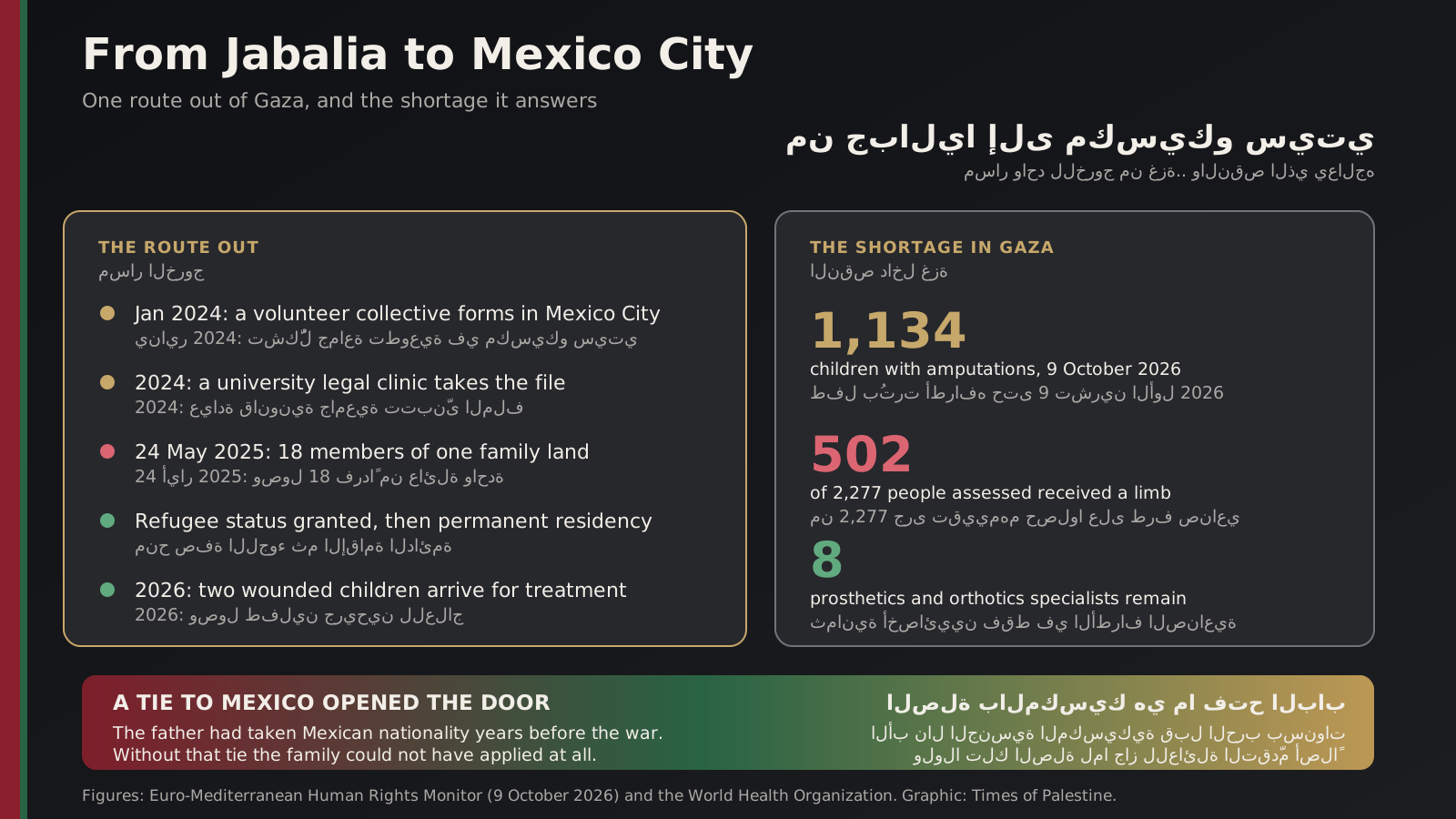
Around it a collective assembled. Two activists, Gabriela Bejarano and Ishtar Mubarak, founded De Gaza a México in January 2024 with a single stated purpose: to bring the Abed family to Mexico.
The eighteen landed at Benito Juárez International Airport on 24 May 2025, into an arrivals hall that had been filling since about one in the morning.
Raíchali, the Chihuahua-based outlet that published Arturo Contreras Camero's account of that night, recorded what one of the youngest daughters, Alma, managed in new Spanish as she came through: "¡Gracias, México, por ayudarnos a salvar la vida!" Thank you, Mexico, for helping us save our lives.
Mexico's refugee commission granted all eighteen refugee status. The migration institute granted permanent residency.
"Someone with no tie to Mexico could not have applied for this refuge mechanism at all."
Ishtar Mubarak, De Gaza a México
What a tie to a country is worth#
Mubarak's sentence is the structural fact under the whole story, and the reason this route is narrow rather than wide. The mechanism that let the Abeds apply ran through Kamal's Mexican nationality. A Gaza family with no relative who emigrated a generation ago has no equivalent handle to grip.
That is why a community of 160 matters out of all proportion to its size. Every Palestinian who settled in Mexico decades ago is a potential door, and the volunteers' work is to find it and prove to a consulate that it exists.
The same logic has shaped what the newcomers do next. The family's income is food, which needs no licence recognition, no revalidated engineering degree, no Spanish beyond a price. Fadi's Instagram account, @hijo.de.palestina — son of Palestine — has gathered some 48,000 followers, and the site Sopitas points readers to the family's WhatsApp orders and a pickup point in Tlalpan.
In April the BDS México campaign filled a pulquería in Cuauhtémoc for a solidarity fair where the drink was pulque and the food was the Abeds' — a three-month arrangement, the outlet Somos el Medio reported, that was an income as much as a gesture.
Abed lost a four-year-old daughter to an Israeli airstrike before the family left. He speaks about the present rather than that. His youngest son, Yusuf, was born in Mexico City in May and was a Mexican citizen from the first minute. Abed is now working to bring two sisters out of Gaza.
Speaking at the capital's human rights commission in October, in an account carried by the magazine El Chamuco, he called the Tlalpan borough a second birth, and said what he most regrets is that his Spanish is not yet good enough to tell everything he wants to tell.
"I don't like politics. I want to live, like everyone else, in peace."
Mohammed Abed, Jabalia and Mexico City
From a family's route to a medical corridor#
A route proven once can carry someone else. This year it carried two children.
The American organisation HEAL Palestine expanded its Global Healing programme to Mexico City and flew in two families from Gaza. Mira, six, came with her mother and two sisters and needed neurosurgery after a head injury; Muath, fourteen when he arrived, came with his mother and baby sister, having lost a leg in a bombing.
The organisation describes it as its first evacuation anywhere since the United States suspended visas for Palestinian patients.
Nadya Rasheed, the Palestinian ambassador to Mexico, met them at the airport. Muath was assessed at a Mexico City clinic, fitted with a prosthesis at a specialist limb centre in the city, and went home walking.
On 5 October the ambassador took that fact to the Mexican Senate. Higinio Martínez Miranda, who presides over the chamber's governing board, received her and said Palestinians could count on Mexico's solidarity; she told the senators that two children had been treated and that one had left the country a few days earlier with a leg that would let him walk and play again.
Two children is a small number, and nobody involved has pretended otherwise.
The Euro-Mediterranean Human Rights Monitor counted 1,134 children in Gaza who have lost limbs to Israeli attacks as of 9 October. The World Health Organization's figures for September 2024 to May 2026 record 2,277 people with amputations assessed and 502 fitted with a prosthesis. Eight prosthetics and orthotics specialists remain in the Strip, for all of them.
Euro-Med's argument is that the obstacle is not surgical but administrative: movement restrictions that keep children from referrals abroad, limits on the entry of the materials prostheses are made from, and barriers to specialists coming in to train Gaza's remaining staff. A child's limb has to be refitted as the child grows, which makes an interrupted course of care a permanent one.
Against that, a corridor through a country with 160 Palestinians in it is not a solution and was never offered as one. It is a demonstration that one more state will take the children, process the paperwork and pay for the leg — the argument every ministry weighing the same question needs to see made somewhere.
The people who made it number about fifteen volunteers, by the reckoning of the Latino outlet mitú, which spent October with the community and found them supporting around thirty refugees: hospital appointments, apartment viewings, government offices, job leads, a hospital bill when Abed's son was born. Adham Bakry, an Egyptian artist who interprets between Arabic and Spanish, calls himself the group's cultural anchor.
The community has roughly doubled since 2022, mitú reported, which in absolute terms means it has grown by about eighty people. In Santiago the Palestinian community is counted in the hundreds of thousands. In Mexico City it is counted by name, and every name on the list is someone's door.