Culture & Arts
Yasmine Al Massri brings a stateless childhood to Palestine's Oscar entry
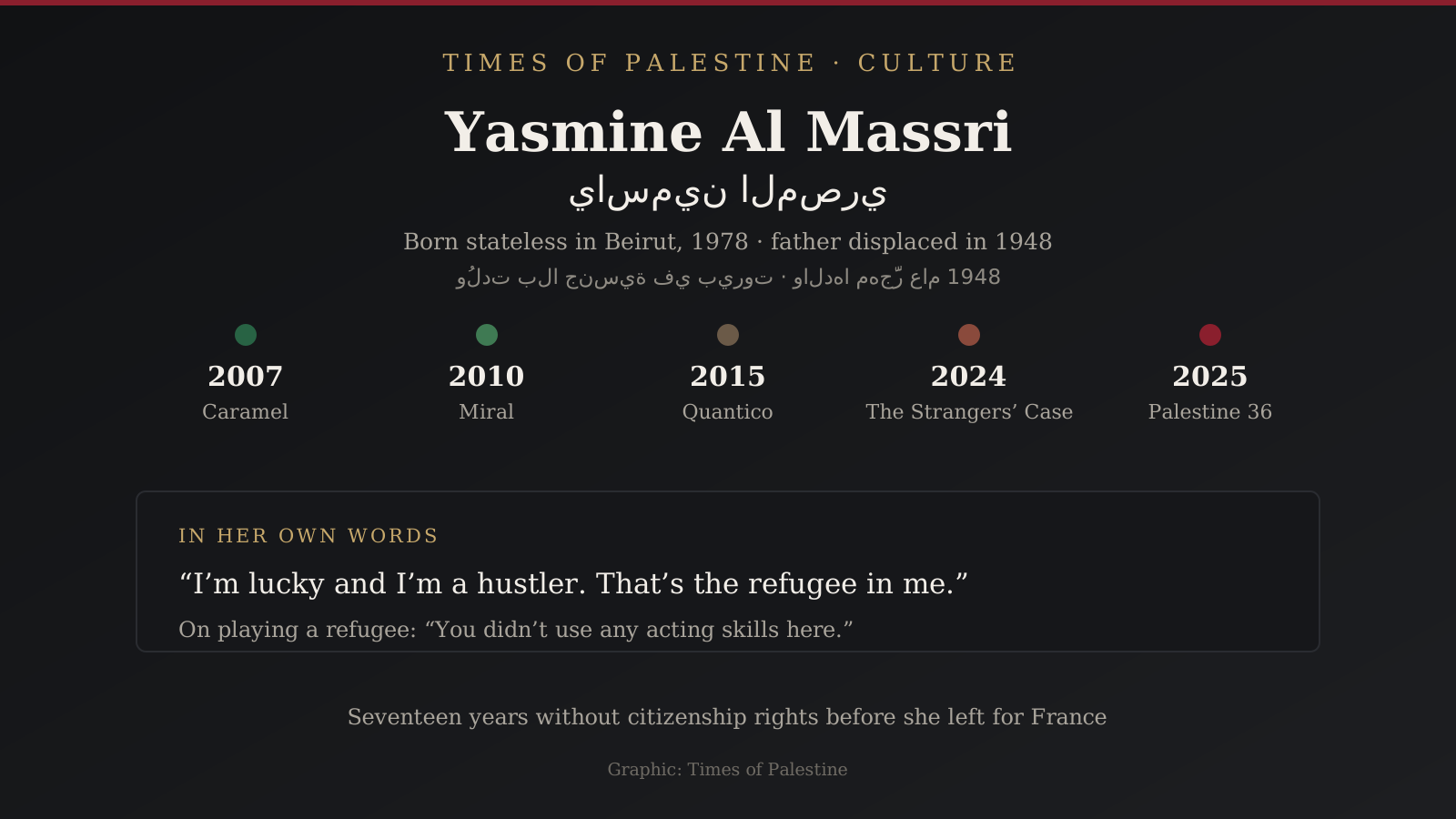
Graphic: Times of Palestine
Original Reporting
The Newsdesk gathers reporting from wire services and primary sources and rewrites every story in-house before publication. How our journalism is made →
Yasmine Al Massri spent seventeen years without the rights of a citizen of anywhere. She now appears in the film about the revolt that came before the catastrophe which made her family stateless in the first place.
She was born in Beirut in 1978, to a Palestinian father displaced in 1948 and an Egyptian mother, and grew up through the Lebanese civil war. Lebanon did not give Palestinian refugees citizenship, and the consequences were practical rather than abstract: scholarships she could not take, professions closed to her by law. In her late teens she left for France, which is where her working life actually began.
In Paris she took a dual degree in multimedia and live performance at the École des Beaux-Arts, and danced with Thouraya Baghdadi's company, developing a style that drew on Arab, African and Latin traditions at once. She came to acting from movement, not from drama school.
The parts that found her#
Her film debut was Caramel in 2007, Nadine Labaki's Beirut beauty-salon story, which became the most commercially successful Arab film of its day and won its ensemble of actresses the best actress prize at the Abu Dhabi International Film Festival.
In 2010 she appeared in Julian Schnabel's Miral, alongside Hiam Abbass, Vanessa Redgrave, Freida Pinto and Willem Dafoe — an adaptation of Rula Jebreal's novel about a Jerusalem orphanage, and one of the few English-language features of its era to put Palestinian women at its centre.
Then in 2015 came Quantico, ABC's primetime thriller, in which she played Nimah and Raina Amin — identical twin Muslim FBI recruits, one devout and one not, sharing a single trainee identity. Two Arab Muslim women on American network television, written as competent professionals who disagreed with each other about faith. On a schedule that had spent a decade casting Arabs as suspects, that was a departure.
In 2024 she played Amira, a paediatric surgeon in Aleppo, in the refugee ensemble drama The Strangers' Case.
Asked about that role, she was blunt about how little of it was invention.
I'm lucky and I'm a hustler. That's the refugee in me.
Of playing a woman fleeing a war, she said the obvious thing that interviewers rarely hear: you were born a refugee, you know that civil war, you didn't use any acting skills here.
Palestine 36#
Her most recent work is Palestine 36, Annemarie Jacir's feature about the Arab revolt of 1936 to 1939 against British colonial rule — the uprising that preceded the Nakba by a decade and shaped everything that followed it.
She appears alongside Hiam Abbass, Saleh Bakri, Karim Daoud Anaya and Zaid Ghaza, with Jeremy Irons, Liam Cunningham and Robert Aramayo. The film was Palestine's submission for the Academy Awards and was shortlisted, and in May 2026 Netflix took MENA rights, putting it on the region's largest streaming platform.
There is a symmetry in that casting worth naming. The revolt of 1936 is the event whose defeat set the conditions for 1948; 1948 is what displaced her father; her father's displacement is why she was born without papers in a Beirut at war. She is not playing a history that happened to other people.
What the career actually shows#
Al Massri's filmography reads as a series of refusals as much as choices. She has largely avoided the roles the industry reliably offers Arab actresses — the silent wife, the veiled victim, the terrorist's sister — and taken parts where Arab women are the subject rather than the setting: a Beirut salon, a Jerusalem orphanage, an FBI training academy, an Aleppo hospital, a Palestinian village under British rule.
That is a narrow path to walk for twenty years. It is narrower still for someone who spent her first seventeen years unable to claim a nationality.
Statelessness is usually described as an absence — of documents, of protection, of a place to return to. In her case it also produced something: an actress who recognises the condition when a script asks for it, and who has spent a career making sure the people who live it are shown as people.