Israeli Press
Israel's own press documents how outposts empty Palestinian villages
Graphic: Times of Palestine
Original Reporting
The Newsdesk gathers reporting from wire services and primary sources and rewrites every story in-house before publication. How our journalism is made →
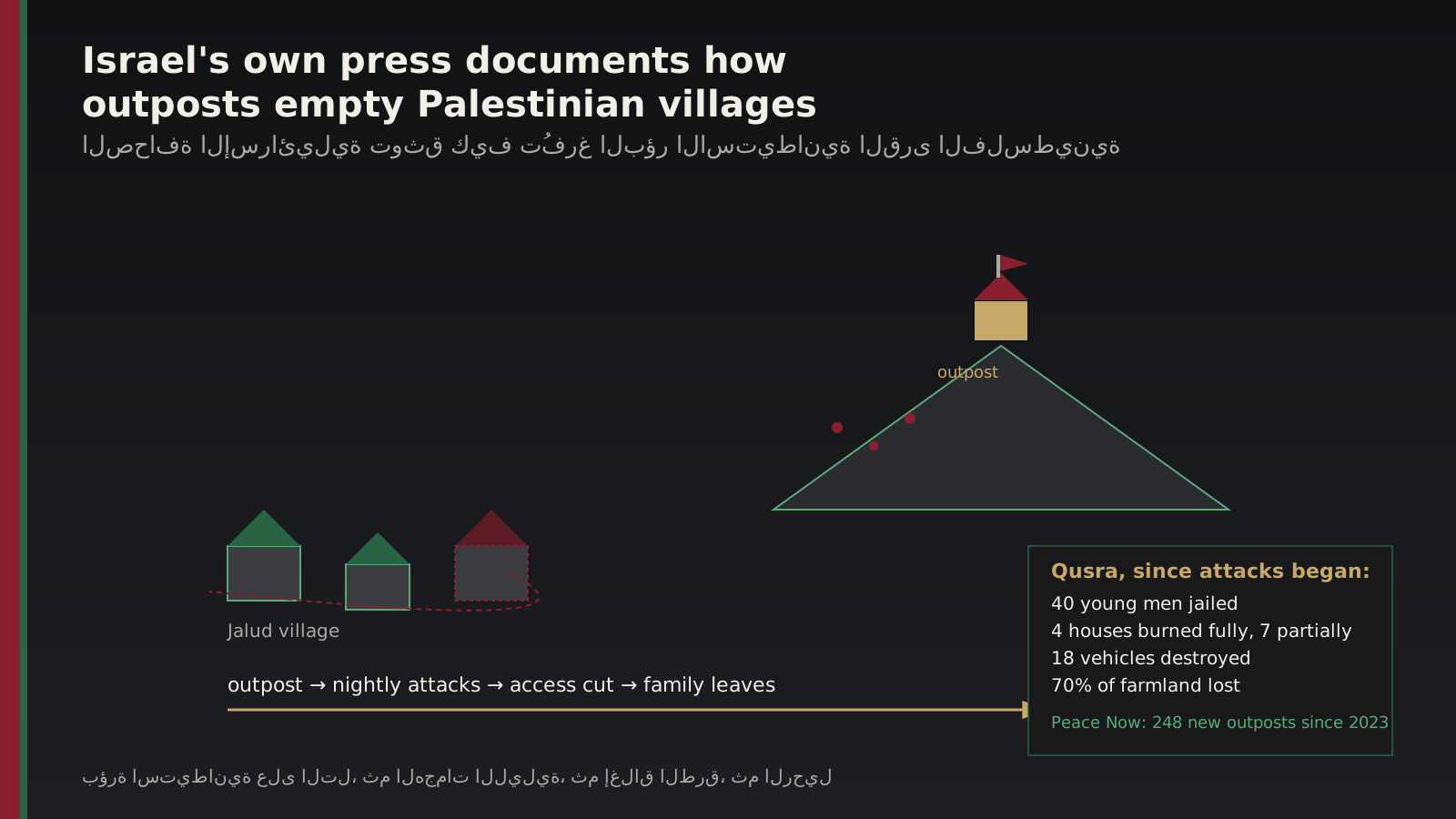
Since August, Israel's Hebrew-language press and Israeli monitoring groups have put on the record, with dates and place names, the method by which Palestinian families are pushed out of their homes in the occupied West Bank: an outpost appears on a nearby hill, attacks follow nightly, access is cut, and the family leaves. The army has answered individual incidents. It has not publicly answered the aggregate findings.
The fullest account is Oded Shalom's investigation in Ynet on 24 August, headlined with a displaced man's words, "We knew it was over". Shalom reported that Mahmoud and Aida Tubasi can see their two stone houses on the north-eastern edge of Jalud, near Nablus, from the house where they now live, and cannot return.
Shalom wrote that pressure on the family began on 3 April, after a new settler outpost appeared on a nearby hill. Tubasi told Ynet that on the first night settlers poured fuel on the doors of the houses and set them alight, and that later a wall was broken through and a storage room burned.
The family complained to Palestinian liaison officials, the Israeli Civil Administration, the army and the police, Tubasi said, and each authority pointed to another. They held out until 22 July, were refused permission to bring in a vehicle for their belongings, and left on foot. Ynet published a photograph of a "Messiah" flag on the sons' house, where it reported Israeli soldiers are now stationed.
“to prevent lawbreakers and rioters from reaching the area and to preserve the fabric of life in the region”
In the same report, Ynet cited mapping by the Israeli group Peace Now showing 26 settler outposts established in Areas A and B, where under the Oslo framework Israel does not hold civil control.
The army told Ynet the allegations were being examined and that forces were operating around Jalud and Qusra "to prevent lawbreakers and rioters from reaching the area and to preserve the fabric of life in the region."
Shalom returned to the subject on 5 September from Qusra, where the home of Louay Abu Rida, an American citizen, had been cut off for nearly four weeks.
He described the method plainly: an outpost is set up in or beside the yard of a Palestinian family's home, and the residents are harassed around the clock until they break. Residents of Jalud, Talfit and Qusra began reporting daily attacks by often masked settlers soon after the outpost went up, he wrote.
The army's response, carried by Ynet beside his account, was that it had deployed reinforced forces to prevent friction, had coordinated eight entries to the house over two weeks, and that the closed military zone protected the residents.
The figures Shalom collected in Qusra were 40 young men jailed since the attacks began, four houses burned completely and seven partially, 18 vehicles destroyed, and 70 per cent of the village's farmland lost to settlements over the years.
Three days before Shalom's first piece, on 21 August, Yesh Din published "The Next Frontier", which maps 225 incidents of settler violence it documented in 2025 and 2026 and finds that in 2026 about two-thirds, 62.6 per cent, took place in Areas A or B.
The organisation records that dozens of settlers attacked Jalud on the night of 21–22 March 2026, and that outposts have begun to be established in Area A. Ynet reported in late October that Yesh Din had logged 640 incidents in 24 days of the olive harvest, and that Jalud is surrounded by 13 outposts.
Israeli military commentary has framed the same events as a collapse of control rather than a policy.
In a Ynet analysis on 6 August, the veteran defence analyst Ron Ben-Yishai wrote that the army "has lost control of the extremists among the settlers and has become a security company for their whims and illegal actions", citing a gun battle near the village of Tell and roughly 100 unauthorised outposts and farms set up in recent months.
Ynet's Elisha Ben Kimon reported in late August that security forces had been demolishing outposts across the West Bank, some of them in Area B near Palestinian villages, including one erected on a military airstrip that put the strip out of use, and another near Ariel where, he wrote, rioters blocked the forces with rocks, threw stones, tried to steal a confiscated tractor and set fire to orchards.
Three people were arrested.
Palestinian accounts place the army inside the method rather than outside it.
Al Jazeera reported on 23 October that the army itself sealed all four entrances to Madama with earth mounds on 11 October, citing security reasons, and that Wail Qut, a Madama resident and lawyer with the Jerusalem Legal Aid and Human Rights Center, said the military told residents the closure would hold until farmers stopped trying to reach land near a new outpost.
The centre is challenging that outpost before Israel's High Court.
Amira Hass reported in Haaretz on 18 June that the army had blocked dozens of roads into Beit Ummar for two months and begun barricading internal streets, saying families had requested the closures because of a clan feud that has killed seven people; residents told her daily life was paralysed while ammunition kept arriving.
The state record points the same way.
Haaretz reported on 23 September that ministers inaugurated the settlement Metzukei Eretz, a legalisation of the Netzah Harel Farm outpost built in 2023 between the compounds of the Mu'arrajat al-Markaz community, and that it is one of 19 cases in which Israel approved legalising outposts whose neighbouring Palestinian communities had been expelled, among 104 regularisations approved by the cabinet in the last term.
On 24 June, Haaretz reported that the Civil Administration demolished what remained of a Bedouin community at Mukhmas, on registered private Palestinian land along the Allon Road, and a house near Duma, after residents of both had already fled attacks that intensified when outposts went up nearby.
Human Rights Watch, on 20 August, cited Peace Now data counting 248 new outposts since the current government took office, 65 of them in 2026.
Police figures published by Haaretz on 8 July show cases opened over settler crimes against Palestinians rising from 139 in 2019 to 779 in 2025, with 6.6 per cent producing an indictment; Yesh Din's monitoring of 1,701 files since 2005 puts the closure rate without indictment at 93.8 per cent.
Reuters reported in September, citing unnamed sources, that Prime Minister Benjamin Netanyahu had ordered the removal of unauthorised outposts under American pressure. Which outposts, and whether the one above Jalud is among them, has not been made public. The Tubasi family obtained a court order to return and was attacked in September when it tried, Al Jazeera reported; the family is still living elsewhere in the village.