Real Lives
Nasser al-Laham built a career reading Israel's press to Palestinians
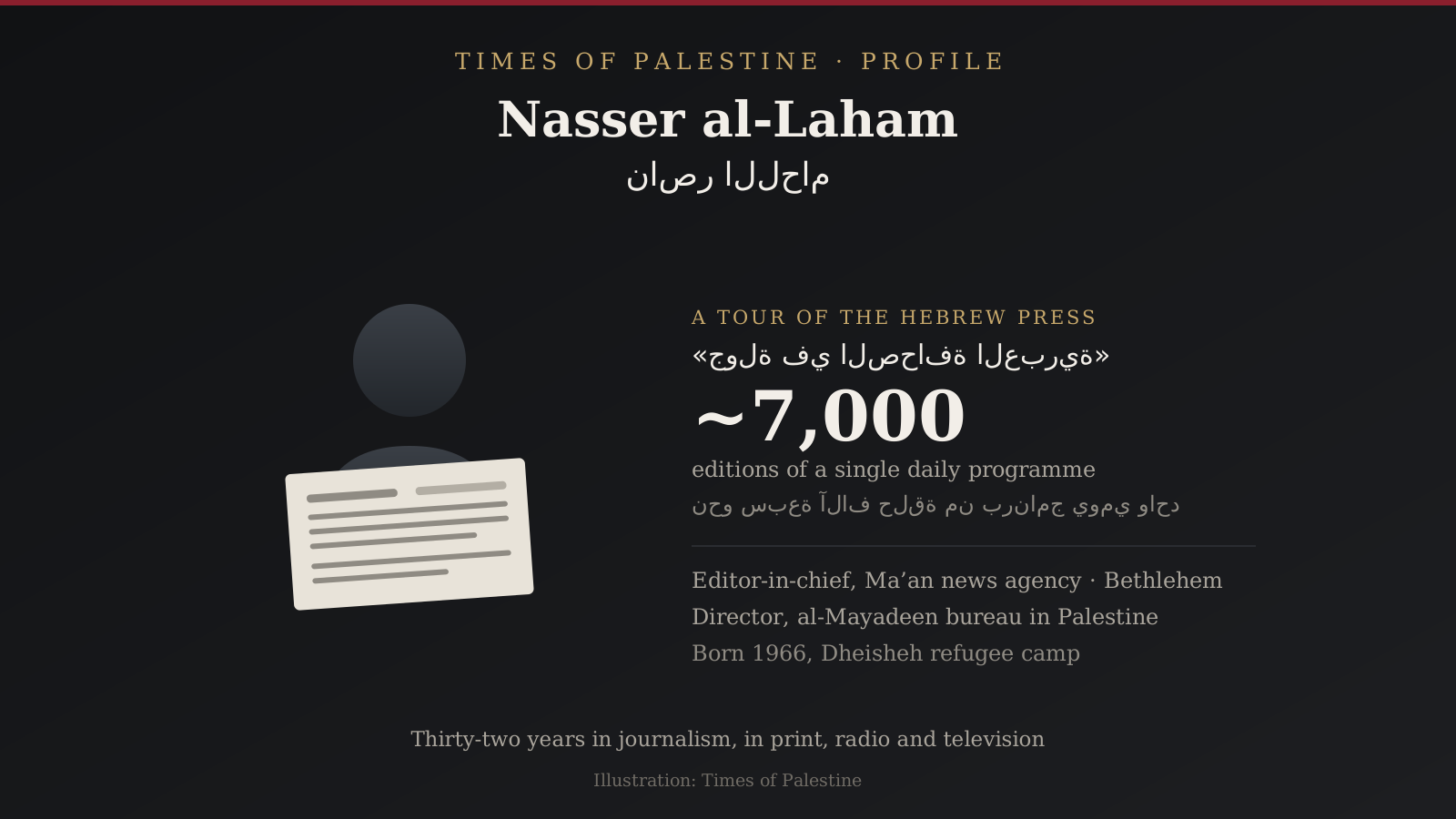
Graphic: Times of Palestine
Original Reporting
The Newsdesk gathers reporting from wire services and primary sources and rewrites every story in-house before publication. How our journalism is made →
Palestinians live under decisions taken in a language most of them cannot read. For more than twenty years, one man has sat down each day and read those decisions back to them.
Nasser al-Laham has now done it some seven thousand times.
His programme, A Tour of the Hebrew Press, takes the morning's Israeli newspapers and broadcasts them to a Palestinian audience — translated, placed in context, and left in their authors' own words. It has led Palestinian audience surveys for two decades.
Some seven thousand editions of a single daily programme
A Tour of the Hebrew Press, running for more than twenty years
Dheisheh, and six years#
He was born in Bethlehem in 1966 and grew up in Dheisheh refugee camp, in a family displaced from al-Ramla in 1948.
He was a communist and an activist during the first Intifada. Arrested as a student, he served a six-year sentence in an Israeli prison.
He had enrolled at Bethlehem University to study biology. The arrest ended that. He came back to English literature, moved on to sociology, and much later took a doctorate in psychology built around the study of body language.
He was already running newsrooms while he was still a student: editor-in-chief of Bethlehem TV and of al-Mahd TV.
Reading the room as well as the page#
The doctorate was not a detour. Al-Laham's subject is not only what Israeli broadcasters say but how they hold themselves while saying it — the pause, the shifted gaze, the sentence that arrives half a beat late.
He turned it into a book, Body Language in the Israeli Media, in 2015. It followed Tel Aviv: A City with No Secrets in 2002 and Media under Hamas in 2007.
He has directed documentaries as well, among them a film on Marwan Barghouti and one on Jericho, which he filmed as the oldest city in the world.
Bethlehem and Beirut#
He is editor-in-chief of the Ma'an news agency, the Bethlehem-based operation that became one of the most widely read independent Palestinian news organisations in both Arabic and English.
He also directs the Palestine bureau of al-Mayadeen, the Beirut channel, and sits on the Palestinian National Council.
In 2010 the Arab League presented him with the Arab Culture Award in Doha.
He is, by temperament, a pan-Arabist, and he argues against Palestinian emigration westward. He has said it is possible to separate religion from the state but impossible to separate religion from life.
Nine days at Ofer#
On 7 July 2025, Israeli forces raided his house in ad-Doha, west of Bethlehem, searched it, and took him away. He was fifty-eight.
He was held for nine days and released from Ofer prison on 15 July without conditions or restrictions. Colleagues had feared he would be moved into administrative detention instead.
Asked about it afterwards, he talked about the conditions of the prisoners he had left behind rather than about himself.
The genre he made ordinary#
Palestinian outlets now run Hebrew-press reviews as a matter of course. Times of Palestine keeps a daily Israeli press desk of its own. The format has become so standard that it is easy to forget somebody had to invent it.
Al-Laham did, and thirty-two years into the work he is still doing it: a man from a refugee camp reading the newspapers of the state that displaced his family, out loud, every day, to the people that state governs.

.jpg?width=640)
