The Diaspora
Ireland's justice minister granted five Gaza dancers visas for Limerick

Image credit: Dabke in the fields of Gaza, Land Day 2009 — ISM Palestine via Wikimedia Commons (CC BY-SA 2.0) · License
Original Reporting
The Newsdesk gathers reporting from wire services and primary sources and rewrites every story in-house before publication. How our journalism is made →
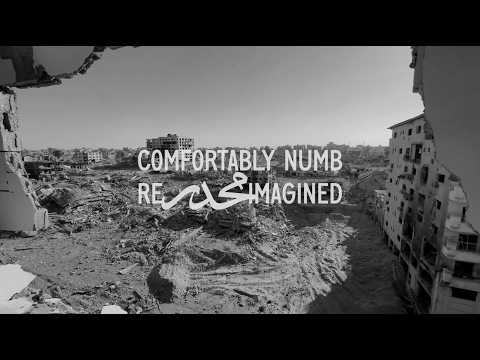
For more than two years, people walking through Dublin on a September evening were stopped by a dancer and asked a strange question: would you dance a duet with someone in Gaza?
Whoever said yes did not dance with the dancer in front of them. They danced a sequence choreographed in Gaza by someone who could not leave it, carried to Ireland and learned step by step by an Irish dancer standing in their place.
The Palestinian choreographers were named publicly by their first names only — Agour, Just, Khaled and Maryam — with surnames withheld for their safety. The Irish dancers called themselves their body avatars.
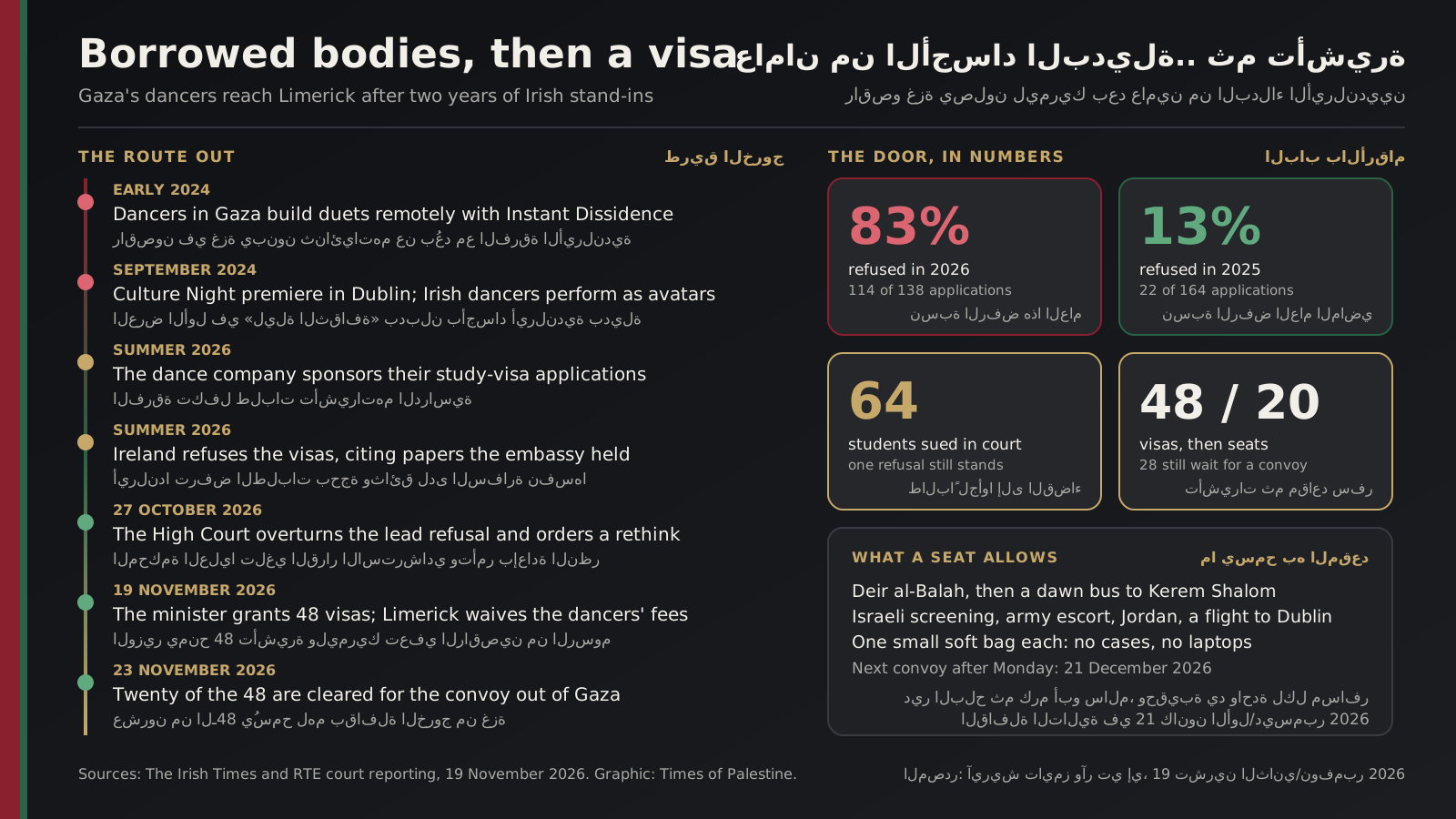
This week the avatars became unnecessary. On Thursday the Irish Times reported from the High Court in Dublin that the minister for justice, Jim O'Callaghan, had granted study visas to 48 students from Gaza, among them five members of the dance troupe, who will study at the Irish World Academy of Music and Dance at the University of Limerick. The university has waived their fees.
A duet made across a closed border#
The project is called Dancing With Strangers: From Palestine to Ireland, and it belongs to the Irish dance company Instant Dissidence, directed by the choreographer Rita Marcalo.
Since early 2024, as the Irish Times set out, dancers in Gaza have made short works about their own experience of occupation and of the war, and dancers in Ireland have performed those works on their behalf.
The method was built out of an older piece. Marcalo's Dancing With Strangers has existed since 2013 as a one-to-one street work, in which a passer-by is invited into a short private duet, and an earlier version made the same exchange with refugees in Calais.
The Palestinian edition kept the intimacy and changed the arithmetic. Marcalo worked with the Gaza artists remotely to build the duets, and because they could not travel, members of the Irish dance community took their part — not performing about them, but performing as them, one body borrowed for another.
It went public at Culture Night in September 2024. The Irish Times described the premiere that week at the Wood Quay Amphitheatre in Dublin, on a programme that also carried a concert of Irish and Palestinian traditional music with the trad group Faró, and lessons in dabke for anyone who wanted them.
By last year the work had become, in the words of the arts magazine Makery, an attempt to make the war visible by amplifying the voices of co-artists inside Gaza through sound and movement. Dancers in Dublin, in other Irish towns, and then on tour abroad kept dancing someone else's choreography on streets those choreographers had never seen.
The company became the sponsor#
What turned an art project into a migration case was an email from an embassy.
According to the account their lawyers gave the High Court, reported by the Irish Times, the Gaza dancers were told by the Irish embassy that they might be included in a possible summer evacuation.
They applied for study visas, with legal work done free of charge by Daly Hempenstall Solicitors and with Instant Dissidence as their sponsor — the dance company guaranteeing the students it had spent two years dancing for.
The applications were refused. Their solicitors told the court the refusals wrongly cited missing documents and missing passports, when the embassy itself was holding the passports, and said the sponsorship and funding arrangements had not been properly weighed.
The refusals were not unusual. The Irish Times reported that about 114 of 138 Palestinian long-stay study visa applications have been refused so far this year, an 83 per cent refusal rate, against 22 refusals out of 164 applications last year.
Around 64 students went to the High Court. On 27 October a judge overturned the refusal issued to Shaymaa Abudalu, finding significant errors in how her file had been decided.
Abudalu holds a fully funded place on a four-year engineering degree at University College Cork, and her mother and two sisters were killed in an Israeli missile strike. Her case was treated as the lead one, and the minister was ordered to look at the rest again.
On Thursday Ms Justice Siobhán Phelan called the 48 grants good news and huge progress. Colm O'Dwyer, senior counsel for the five dancers, confirmed they were among them. Claire Castinel of Daly Hempenstall welcomed what she called a fair and humane outcome, and said access to a fair visa process should not depend on an applicant having the resources and the legal support to go to court.
One small bag to Limerick#
A visa is not a road out. RTÉ, reporting the same hearing, set down what the journey now requires.
Only 20 of the 48 students are permitted by the Israeli and Jordanian authorities to travel on the next scheduled evacuation, on Monday.
The students gather in Deir al-Balah on Sunday evening for an early-morning bus, coordinated by the United Kingdom, to the Kerem Shalom crossing. They pass Israeli security screening, cross Israel under army escort into Jordan, and fly on to Dublin. Irish embassy staff from Amman meet them on the Jordanian side.
Each person may carry one small soft handbag. No suitcases, no backpacks, no laptops. The next evacuation after Monday is set for 21 December, and around 28 students with university places are waiting for it or for something sooner. Their solicitors expect the five dancers to be on Monday's convoy.
The state's own effort is real and has been slow. The minister for foreign affairs, Helen McEntee, said her department has helped roughly 400 people leave Gaza for Ireland since the war began, among them 41 holders of Ireland-Palestine scholarships.
Her department submitted 23 names for Monday's evacuation on 11 November, she said, and was told the following day that no further places were available. Ireland does not decide who boards.
What Limerick can give back#
The gap this answers sits inside Gaza. UNESCO's verified damage assessment, updated in March 2026, counts 164 damaged cultural sites in the territory, among them the Rashad al-Shawa Cultural Centre in Gaza City.
That hall held the auditorium where Gaza's troupes and ensembles performed for decades. A dancer who wants conservatory training in Gaza now has no building to walk into.
The Irish World Academy is one of the few places in Europe built for exactly that kind of transmission — a university department devoted to traditional and contemporary music and dance, where Irish step dance is taught as living practice rather than heritage display, and where students arrive from across the world to study their own forms beside it.
Five Palestinians will now take their places in it on waived fees, a short walk from the river in a city of 100,000 people, in a country whose dance community has spent two years learning their steps by video in order to perform them in public squares.
The duet was always meant to end this way. When the convoy reaches Dublin, the body avatars can stop. The choreographers will dance their own work, in their own bodies, in front of the strangers who have been holding their places.