The Diaspora
Chicago's Palestinians carried Gaza's baseball team to the Asian Games

Image credit: Toyohashi Municipal Baseball Stadium, 2009 — ZACO via Wikimedia Commons (public domain) · License
Original Reporting
The Newsdesk gathers reporting from wire services and primary sources and rewrites every story in-house before publication. How our journalism is made →
On the afternoon of 25 September the scoreboard at the Toyohashi Municipal Baseball Stadium, an hour and a half south-east of Nagoya, carried a line nobody in that ballpark had seen before. Palestine 7, Hong Kong 2.
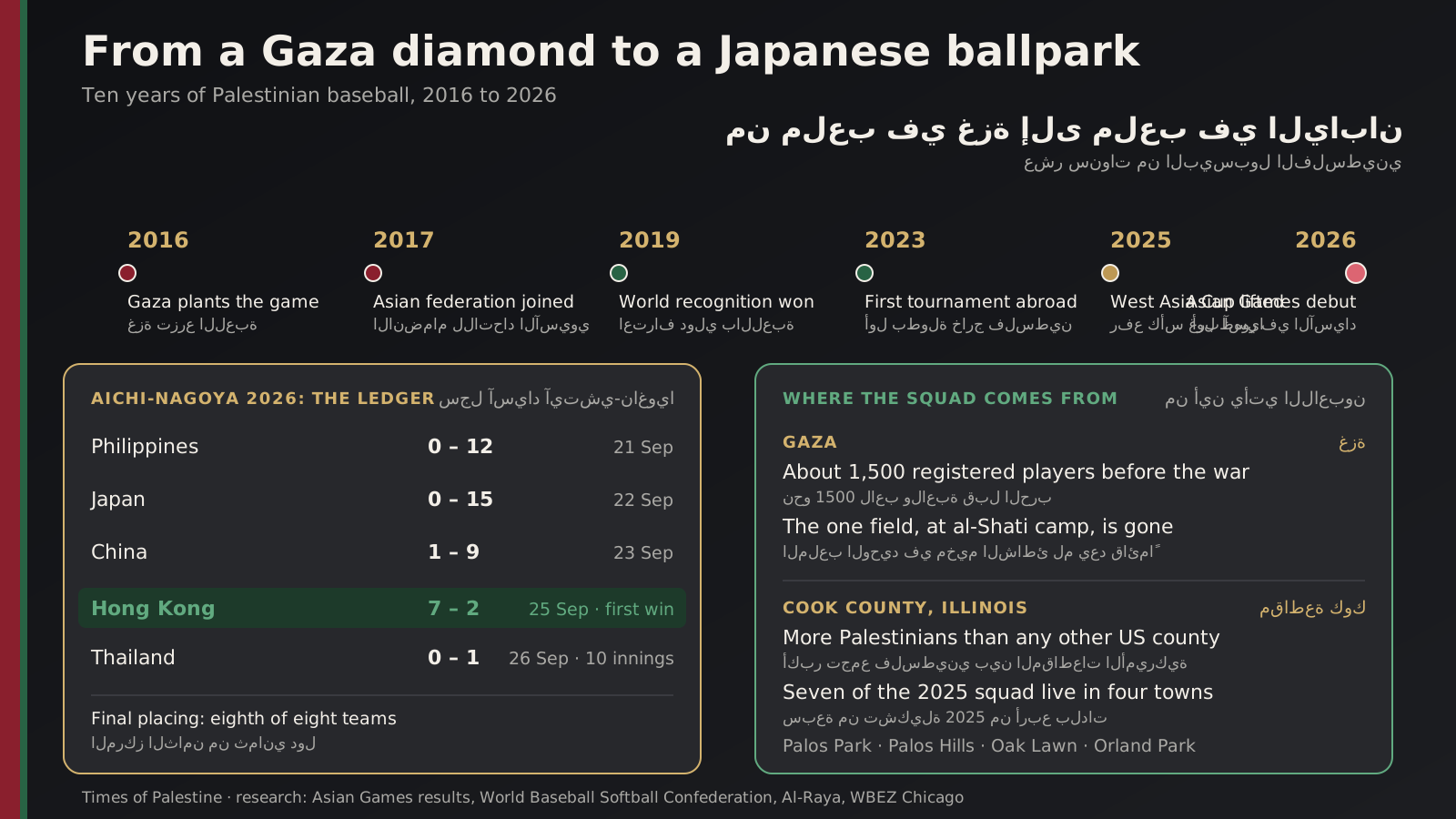
It was the first game of baseball Palestine has ever won at the Asian Games, in the first Asian Games it was ever in a position to enter. The match report of the World Baseball Softball Confederation records a tie at 1-1 after six innings, then three Palestinian runs in the seventh, two in the eighth and one in the ninth, with Ammar Hani driving in three of them.
Most of the men who produced that line live about 9,500 kilometres from Gaza, where the team they play for was founded, in a cluster of suburbs on the southwest edge of Cook County, Illinois.
The suburbs that field a national team#
More Palestinians live in Cook County than in any other county in the United States. WBEZ, Chicago's public radio station, reported the census write-in count at more than 18,000 in the county and over 23,000 across the metropolitan area, and carried the judgement of the sociologist Louise Cainkar that the real figure is between 70,000 and 100,000 once the undercount is allowed for.
They are concentrated in Orland Park, Oak Lawn, Tinley Park and Bridgeview — the stretch of strip malls, mosques and bakeries that people there call Little Palestine.
That is where the roster comes from. Southwest Regional Publishing, which puts out the community papers for those towns, counted seven local men on the squad that won the West Asia Cup in Iran.
They were Adam Musa of Palos Park, a Stagg High School graduate; Ahmad Ghouleh, Omar Shublaq and Ibrahim Shalabi of Palos Hills; Yunis Halim and Yousef Abbasi of Oak Lawn; and Adnan Jaber of Orland Park, at 37 the oldest man in the dugout.
"I swear, before this team, I stopped playing baseball. But playing for my country is bigger than baseball."
Adam Musa, Palos Park, to his hometown paper
Before the Asian Championship the team played a three-night tune-up series against Pakistan at Ozinga Field in Crestwood, a minor-league park eight miles from Musa's house. They called it the Little Palestine Classic.
Gaza drew the first diamond#
The game did not come to Palestine from Chicago. It went the other way.
Mahmoud Tafesh played sixteen years for Palestine's national football team before he met baseball in Egypt and trained as a coach there. New Lines Magazine, in a report on the team last year, described him bringing the sport home in 2016, teaching himself the rest from video, and persuading the youth and sport ministry in Gaza to approve a federation for a game almost nobody in the territory had played.
The Palestinian Baseball and Softball Federation joined the Baseball Federation of Asia in 2017. World recognition followed in 2019, after Tafesh travelled to the confederation's congress in Japan to ask for it in person.
By the eve of the war the federation had about 1,500 registered players, men and women, inside the Gaza Strip. The Palestinian news site Al-Raya published that figure in August, in an interview with the federation's president, Ahmad Tafesh.
The only baseball and softball field in Gaza, at al-Shati refugee camp, was destroyed early in the war, batting cages and all. What the federation has put up since, Al-Raya reported, is made of tent canvas, poles and tarpaulins, and the players have been remanufacturing balls out of whatever the camps have.
Two of the men who learned the game on that first Gaza field never saw Japan. Ashraf Awad Murad, 39, the outfielder who captained the side, was killed in March 2024 near al-Shifa Hospital. Mustafa Tafesh, 21, an infielder and outfielder and the federation president's son, was killed on 12 August last year in Sheikh Radwan.
"They are killing all of our sons, destroying the future generations of Palestinian athletes," Mahmoud Tafesh said in that New Lines account.
A journalist who became a reserve infielder#
The thread that tied the two halves together is a magazine publisher from Chicago.
Nader Ihmoud, who edits the independent magazine Palestine in America, saw the federation's recruitment post on Facebook in 2019 and answered it. "I just reached out, like, 'Hey, I used to play, and I also have a magazine. I want to help in any way that I can,'" he recalled.
He is now the team's media liaison, its colour commentator, the man who livestreams the dugout, and a reserve infielder. The Chicago Reader named him the city's best international baseball coverage by a local journalist in its Best of Chicago awards last year.
Which is roughly the point. For several years the only steady reporting on Palestine's national baseball team came from a man who also carried a glove.
The coaching staff registered for the Games carried two more Chicago names. Ozzie Guillén Jr. and Oney Guillén are the sons of the manager who took the White Sox to the 2005 World Series.
What the results actually say#
Palestine was drawn in Group A with Japan, China and the Philippines — three of the strongest baseball nations on the continent — and lost all three games. The Philippines won 12-0 in seven innings on 21 September, Japan 15-0 in five on the 22nd, China 9-1 on the 23rd. Yunis Halim, the man from Oak Lawn, scored the only Palestinian run of the group stage.
Arab News, reporting from the Games, noted that baseball was the only team sport in which Palestine had anyone at all in Aichi, and found the squad unbothered by the scorelines. "It's way bigger than just a ballgame," said Luke Shahin, 23. "We're playing for the people back home."
The paper also found Tariq Suboh, 34, who has played college and independent professional ball in the United States and came back for this, and Yacoub Rayan, 19, who has worn the shirt since he was 16.
Then came Hong Kong, and the seventh inning, and the first win. Palestine's tournament ended the next day, 26 September, with a 1-0 loss to Thailand that took ten innings to settle. Eighth of eight, and a line in the record books.
The gap a diaspora roster fills#
The federation did not assemble a largely American squad out of preference. It did so because the players it raised cannot leave.
Al-Raya quoted Ahmad Tafesh saying the federation had already withdrawn from two official tournaments this year because of conditions in Gaza, and that the bulk of the Asian Games delegation would come from the American arena. Scouts are now looking at Palestinian players around Washington and Florida for next season.
That is the quiet arrangement underneath the scoreboard. A sport invented nowhere near Palestine was planted in a refugee camp by a retired footballer; the camp's field is gone and its players are besieged; and a few hundred families in the Illinois suburbs keep the shirt in circulation until the field can be rebuilt.
Ahmad Tafesh told Al-Raya the recovery plan for Gaza's baseball exists for a simple reason, and put it in one sentence: the Palestinian people deserve a life. The seventh inning in Toyohashi was an argument for the same thing, made with a bat.