Arab Support
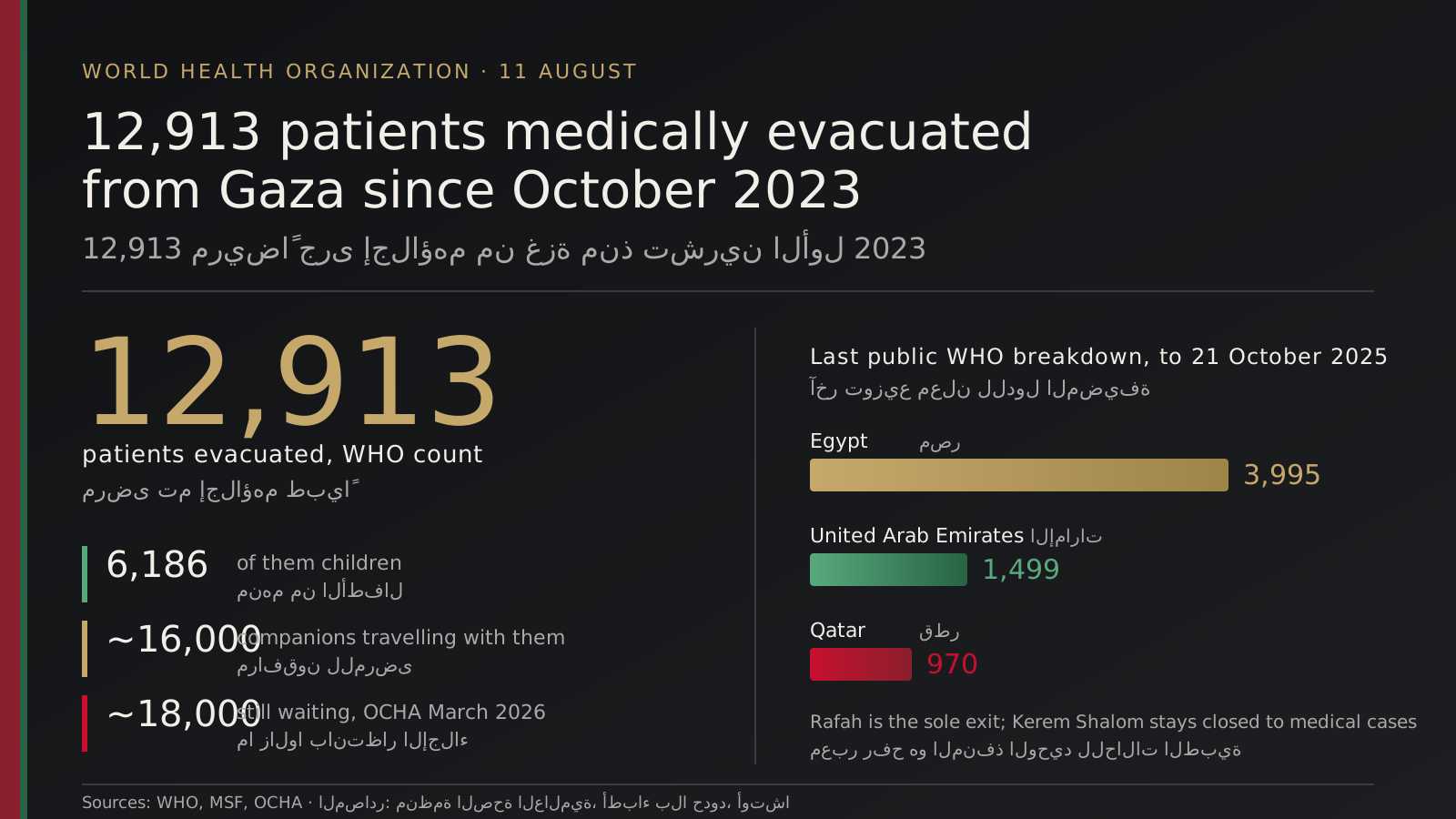
WHO counts 12,913 Gaza patients evacuated since October 2023
Graphic: Times of Palestine
Original Reporting
The Newsdesk gathers reporting from wire services and primary sources and rewrites every story in-house before publication. How our journalism is made →
The World Health Organization put the number of patients medically evacuated from Gaza since October 2023 at 12,913, including 6,186 children, together with roughly 16,000 companions, WHO spokesperson Tarik Jasarevic said on 11 August, in remarks carried by the Palestinian news agency WAFA. He said evacuations were running three to four times a week.
The last country-by-country breakdown to circulate publicly is nearly a year old. Médecins Sans Frontières, citing WHO figures as of 21 October 2025, reported 3,995 patients taken by Egypt, 1,499 by the United Arab Emirates and 970 by Qatar — the three largest Arab receiving states at that point.
Egypt's own count is of a different order, and measures something different. Health Minister Khaled Abdel Ghaffar told the Egyptian cabinet's weekly meeting on 5 February 2025 that Egypt had received about 103,400 Palestinian cases since October 2023, with 164 referral hospitals ready and some 35,000 doctors and 39,000 nurses available.
The Egyptian daily Al-Dostor reported in June 2026 that the health ministry had designated more than 150 hospitals across eight governorates for Palestinian patients. Neither the ministry nor WHO has published a reconciliation of the two counts, which differ by a factor of twenty-five.
WHO's European office said on 25 October 2025 that the Egyptian Ministry of Health and Population, with WHO support, had built a standard procedure for moving patients onward from Egypt to Europe, and that two of every three evacuations run through the EU Civil Protection Mechanism were facilitated from Egyptian territory.
More than 1,000 patients had reached the WHO European Region by that date, with Türkiye taking more than any other country in the region.
The bottleneck is the route, not the beds. The Associated Press reported that Rafah had been closed since Israeli troops seized it in May 2024; a Lancet Global Health article published in March 2026 dated the closure to 24 May 2025.
When the crossing partially reopened on 2 February 2026, WHO confirmed that five patients and seven companions left for Egypt that day. Gaza health officials told the AP that about 20,000 people needed care abroad.
Movement since has been intermittent. WHO suspended evacuations between 23 and 25 March 2026, then moved 17 patients and 30 companions to Egypt on 26 March, the agency said. OCHA reported that Rafah reopened on 27 March after a 20-day suspension, allowing nine adult patients, most with trauma injuries, and 16 companions into Egypt.
Inkstick reported that in the first two weeks of April only 85 patients and 160 caregivers got out.
Jordan runs the one corridor with a published target and a published running total. The Jordan Armed Forces said the 26th group — 81 children with 108 family members — arrived through King Hussein Bridge on 27 April 2026, bringing the total moved since the corridor began in March 2025 to 2,422 people.
Arab News reported on 4 May that the programme had assisted more than 716 children; the 27th batch, 42 children with 75 companions, crossed that day, according to Youm7.
King Abdullah told US President Donald Trump on 11 February 2025 that Jordan would take 2,000 sick children from Gaza; by the army's own arithmetic, roughly a third of that pledge had been delivered fifteen months later.
Jordan also counts what its hospitals do inside Gaza and the West Bank.
Brigadier General Dr Ahmad Al-Sbeihat, commander of field medicine at the Royal Medical Services, told Jordan's Al-Mamlaka in October 2025 that five Jordanian field hospitals were operating — Khan Younis, Tal al-Hawa in Gaza City, Nablus, Jenin and Ramallah — with about 130 staff at Khan Younis.
The army said in April 2026 that the field hospitals had treated more than 700,000 patients and performed over 26,000 surgeries; a year earlier the figure given was 524,248 patients and 24,129 operations. Bed counts are not in the army's public statements, so operating capacity cannot be measured from the published record — only throughput.
The Gulf commitments are stated in patients, not money.
Emirati foreign ministry releases describe a directive to treat 1,000 wounded Palestinian children and 1,000 cancer patients in UAE hospitals; the 24th evacuation flight landed on 28 March 2025 carrying 81 wounded and cancer patients, half of them children, with about 107 relatives, routed from Ramon airport in Israel via Kerem Shalom.
A further 188 patients and companions were flown out in May 2025, the ministry said.
Qatar's ruler directed the treatment of 1,500 injured people and sponsorship of 3,000 orphans, the state news agency QNA reported in September 2024; WHO's October 2025 count of 970 Qatari-hosted patients puts that programme at about two-thirds of its stated quota.
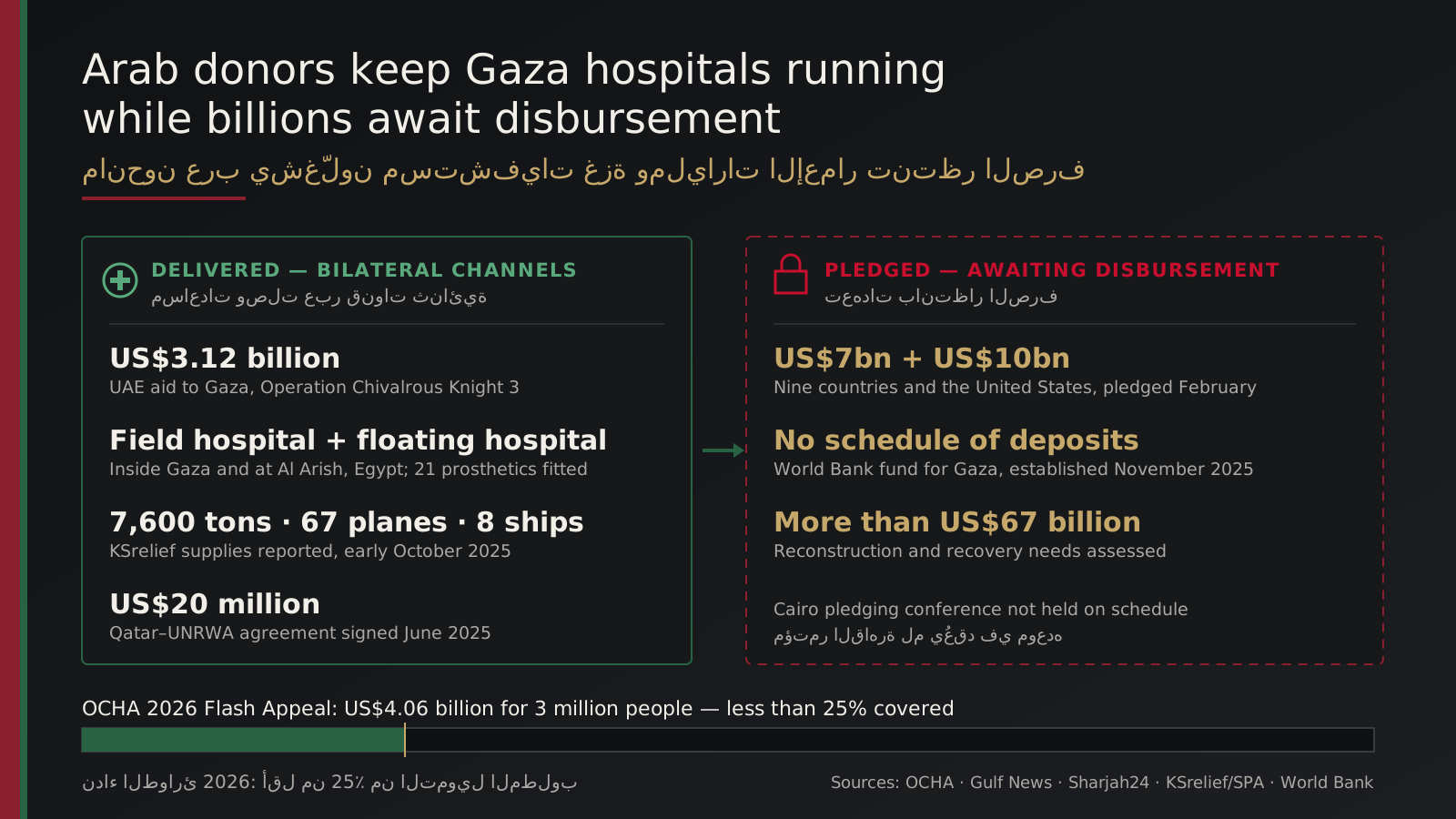
No Arab host in this group has published what the treatment cost, what was pledged in currency, or what has been disbursed. WHO's public breakdown names Egypt, the UAE and Qatar; Saudi-, Kuwaiti-, Algerian- or Yemeni-funded places do not appear in the country figures circulated by WHO or its partners.
WHO says host countries cover healthcare, accommodation and basic supplies for companions of evacuated minors, according to the UN Regional Information Centre, but publishes no per-country expenditure.
The count itself moves. WHO figures for the same end-September 2025 cut-off appear as 7,802 patients, more than 7,800, and 7,841; for March 2026 as 11,209 and 11,124. The waiting list has been given as 15,600 in September 2025, 18,500 including 4,096 children at a mid-December UN briefing, and about 18,000 by OCHA in March 2026 — rising while evacuations continue.
WHO's stated next steps are unchanged since its September 2025 guidance: restore the referral route to the West Bank and East Jerusalem, widen the Egyptian and Jordanian corridors, get more states to accept patients. Kerem Shalom remains closed to medical cases, leaving Rafah the sole exit.
Twenty children returned home through King Hussein Bridge in late August after finishing treatment in Jordan — the first sign in the published record of the corridor working in both directions.


%20(cropped).jpg?width=640)