Arab Support
Israel's exit rules keep admitted Gaza students from their universities
Graphic: Times of Palestine
Original Reporting
The Newsdesk gathers reporting from wire services and primary sources and rewrites every story in-house before publication. How our journalism is made →
The obstacle facing Gaza students entering the 2026-27 academic year is not a university place. It is permission to travel.
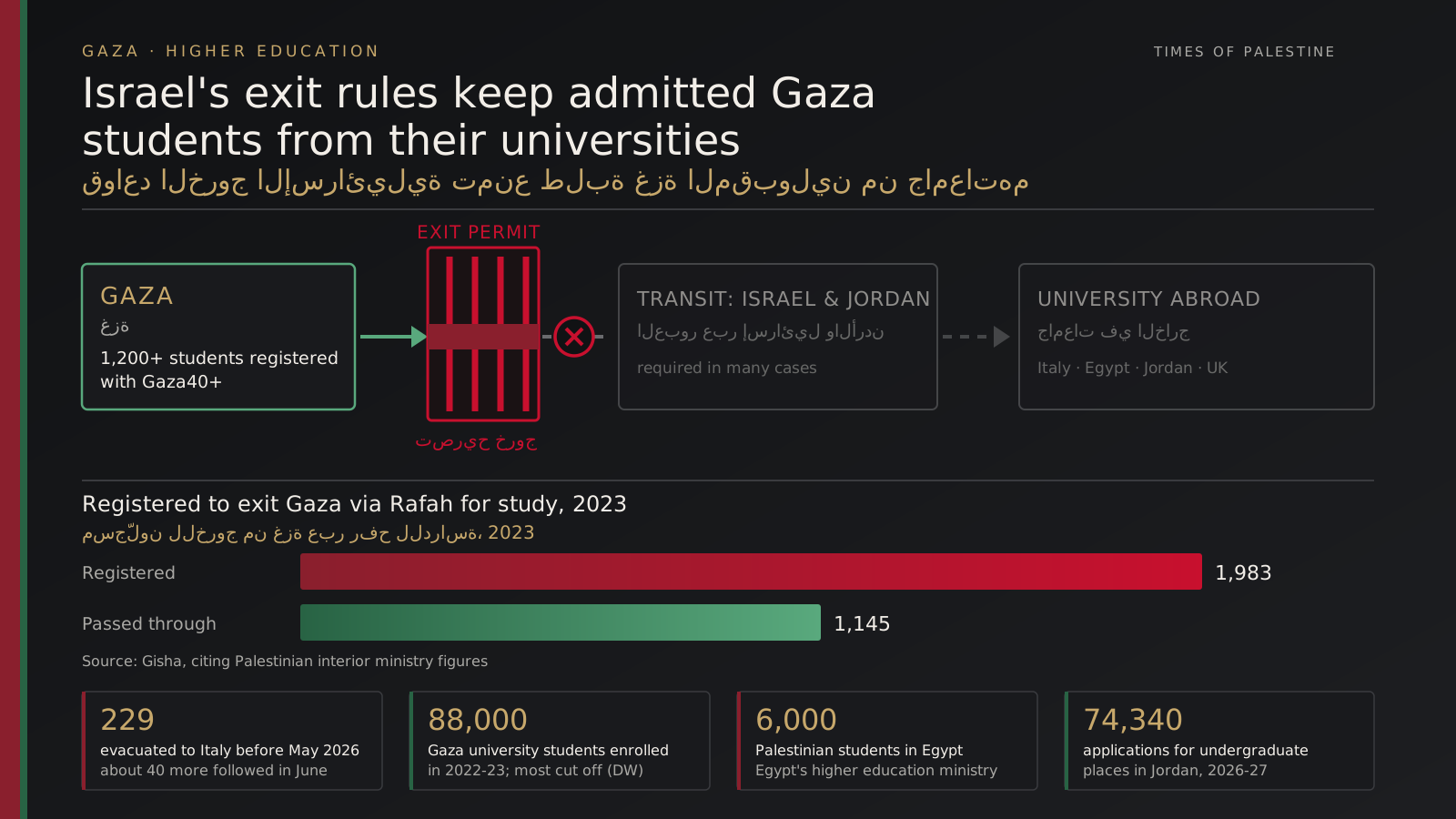
Al Jazeera reported on 6 August that students admitted to universities abroad must obtain authorisation to leave Gaza and, in many cases, transit Israel and Jordan to reach their campuses. A coordinator of one European placement scheme told the network that "obtaining exit permits from Gaza is extremely difficult", and that the difficulty lies in building a reliable route rather than in the students' qualifications.
The same report put the scale of unmet demand at more than 1,200 Palestinian students registered with Gaza40+, an initiative set up to help students continue their studies outside the Strip. Al Jazeera reported that roughly 229 students were evacuated from Gaza to Italy before May 2026, with about 40 more following in June.
An April essay published by Literary Hub, surveying the collapse of Gaza's education system, said around 1,500 students from Gaza had won admission to universities in countries including Pakistan, Turkey, France and Egypt, and that dozens of scholarship holders protested inside Gaza to demand the crossings open.
No official tally matching that figure could be retrieved from the Palestinian Ministry of Education and Higher Education, which has not published a count of students who left for study since the ceasefire took effect on 10 October 2025.
Where Arab-region capacity does exist, it is documented in fragments rather than in a single register.
Egypt's Ministry of Higher Education put the number of Palestinian students studying in Egypt at 6,000, according to the Refugees' Platform in Egypt, which reported in November 2024 that annual tuition for Palestinian students at Egyptian universities ran from $3,000 to $7,000 depending on faculty and on the country that issued the school certificate.
The platform called on the ministry and university presidents to use their legal authority to waive those fees for students from Gaza. No published ministerial decision responding to that call was found.
Specific Egyptian openings have been announced through Ramallah. The Palestinian Broadcasting Corporation reported in February 2025 that the Ministry of Education and Higher Education announced bachelor's scholarships at the Egypt-Japan University of Science and Technology in Alexandria for the 2025-26 year, restricted to students from the Gaza Strip. Al-Fanar Media reported the same offer.
Students should confirm any current round, and its closing date, with the ministry's scholarships office rather than with secondary listings.
In Jordan, the route runs through the unified admission system. The admission coordination unit at the Ministry of Education and Human Resources Development said applications for undergraduate places for 2026-27 closed with 74,340 requests, according to al-Ain.
The unit states that non-Jordanians generally cannot apply through unified admission, with defined exceptions that include students from the Gaza Strip and beneficiaries of the royal grant for camp residents, under conditions set by the competent authorities. Deadlines and minimum averages shift year to year; the unit's own published figures are the operative ones.
British Council Palestine says 12 Palestinian scholars from six universities across the West Bank and Gaza took up HESPAL master's places in the United Kingdom for 2025-26, joining 23 scholars already studying at 13 British universities, and that the 2026-27 round is open to master's applicants only.
Applicants nominated by universities in Gaza follow a separate process set out in the programme's guidance notes, and closing dates should be checked against the British Council's own page.
The corridor that has functioned without travel is online.
The trade journal Chemical & Engineering News reported in June 2024 that a coalition of West Bank universities, coordinated by the ministry in Ramallah, was offering tuition-free enrolment in online courses to students in Gaza, some taught by academics from Gaza's own universities, and that thousands had enrolled — many of them displaced to Egypt, where power and connectivity were steadier.
A separate group of West Bank and Jordanian universities aimed to give students close to graduation access to final examinations. Updated enrolment figures for those arrangements for the current term could not be obtained.
Admission itself has become a documentary problem. Zeteo reported in May that English proficiency certification has turned into a near-impossible requirement, with test centres and stable internet gone.
A computer engineering graduate from Beit Lahia, Samer Labad, told The New Arab that the language centre where he had prepared for two years was destroyed, and asked how requirements can be met when the tools for meeting them no longer exist.
The New Arab reported in January that scholarship funding had risen over the preceding two years and that some 200 applicants had succeeded since the October 2025 ceasefire.
Deutsche Welle, in reporting republished in July, said most of Gaza's 88,000 university students enrolled in 2022-23 had their education broken off, with more than 95 percent of campuses affected.
The permit bottleneck is older than the war. Gisha, the Israeli legal centre for freedom of movement, reported in 2023 that military officials told a Knesset Education Committee hearing exit from Gaza was permitted for exceptional humanitarian and urgent medical cases only, and cited Palestinian interior ministry figures showing 1,983 students registered to exit via Rafah that year against 1,145 who passed.
The New Arab reported that Rafah, under Israeli military control since May 2024, reopened partially in February 2026; Zeteo reported partial operations from 19 March, with departures mostly limited to medical cases. Whether a scheduled student corridor through Jordan will run before autumn registration closes has not been announced by any of the ministries involved.