Politics & Diplomacy
Netanyahu can reach Dahlan through the courts, the police and Gaza

Image credit: Benjamin Netanyahu — Wikimedia Commons · License
Original Reporting
The Newsdesk gathers reporting from wire services and primary sources and rewrites every story in-house before publication. How our journalism is made →
Benjamin Netanyahu has named Mohammad Dahlan as the hidden hand behind the most damaging story of his election campaign, and he has offered no evidence for it. What he holds, seven weeks before Israel votes, is a short list of instruments that can reach a Palestinian exile in Abu Dhabi, and every one of them costs him something.
The story is Haaretz's. On Tuesday the paper published an excerpt from "Hostages: 843 Days of Abandonment", a forthcoming book by Shlomi Eldar and Ruth Yuval, reporting that the UAE president, Mohamed bin Zayed, called Netanyahu on a secure line about ten days before 7 October 2023 and warned him for 45 minutes that Yahya Sinwar was preparing a major operation.
The authors write that Netanyahu answered that Hamas meant to act in the West Bank, and that neither the Shin Bet director of the day, Ronen Bar, nor the army chief, Herzi Halevi, was told of the call.
Netanyahu's office called the report "an absolute lie" and said a check of its own records, the National Security Council's and the military secretary's found no conversation with bin Zayed between the start of September 2023 and the attack.
The UAE foreign ministry said it "does not comment on media stories or speculation regarding conversations between government leaders" and added that "all relevant intelligence has been and continues to be communicated between the relevant parties."
Al Jazeera, citing an Israeli source, reported that the prime minister's office had asked Abu Dhabi for a flat denial and received the intelligence-sharing sentence instead.
Then came Dahlan. In a statement posted on X on Wednesday, Netanyahu said the man behind the "false report" was the former Gaza security chief, who "is interested in toppling the right-wing government led by Netanyahu because he dreams of taking control of the Gaza Strip" and needs "a weak left-wing government" that "would withdraw from Gaza and hand it over to his control."
"He needs a weak left-wing government. Such a government would withdraw from Gaza and hand it over to his control."
Benjamin Netanyahu, statement on X, 9 September 2026
Likud's own statement called the affair "blatant foreign interference in the Israeli elections" and demanded a criminal investigation of Eldar, Yuval, Haaretz, the Democrats party and its leader Yair Golan "on suspicion of attempting to disrupt the elections with foreign entities." The party also said Eldar had been paid by a nonprofit close to Golan. Ynet noted that Likud presented no evidence for Dahlan's involvement and none for the payment.
Dahlan's Democratic Reform Current in Fatah answered the same day. Its spokesman, Dimitri Diliani, a member of the Fatah Revolutionary Council, called the claims "ludicrous and misleading", said Dahlan has never involved himself in Israel's internal party struggles and has no stake in which government sits in Jerusalem, and described the campaign as an electoral cover for Netanyahu's failures before 7 October.
The courtroom#
The first instrument is already in motion, and it does not point at Dahlan.
On Wednesday Netanyahu's lawyers sent Haaretz, Eldar, Yuval and the columnist Uri Misgav a warning letter demanding that the report be removed from the paper's website and social accounts, that a prominent retraction and apology be printed, and that one million shekels be paid within 72 hours, failing which he will sue for at least 2.5 million shekels plus costs, Israel Hayom reported.
Haaretz said it stands behind the publication and that the investigation rests on numerous sources and documents.
A libel suit against Dahlan himself is a different matter. He does not enter Israel, holds no assets there that a court could reach, and lives under the protection of a head of state; an Israeli judgment against him would be a press release with a case number.
Dahlan knows the libel courts from the other side: he sued Middle East Eye in London over a 2016 report and dropped the case in 2019, Al Jazeera reported at the time.
Netanyahu's own record in defamation suits is modest. His family's case against Ehud Olmert, over remarks in a 2021 television interview, ended in November 2022 with the Tel Aviv Magistrate's Court awarding about 18,000 dollars against a demand of roughly a quarter of a million.
A suit against Haaretz that reached trial would also invite the paper to seek in discovery the very call records the prime minister says exonerate him.
The police and the attorney general#
The second instrument is the criminal investigation Likud demanded, and it runs through people Netanyahu does not control. A complaint would land with the police and with the attorney general, Gali Baharav-Miara, whose dismissal by this government the High Court annulled in December, and who told the same court in January that the cabinet's boycott of Haaretz was unlawful.
The law gives her little to work with against a foreigner. Israel's rules on outside money in elections, a 2017 amendment that forces foreign-funded campaign groups to register and disclose, and the ban on foreign donations to parties, bind Israeli bodies, not a Palestinian in Abu Dhabi alleged to have handed a story to a newspaper.
The State Comptroller reported in July that nine years after foreign interference was first identified as a threat, the state has neither a national policy nor a body responsible for it, the Times of Israel reported.
That leaves the Israeli names on Likud's list as the only ones an investigation could touch: two journalists, a newspaper and an opposition party. Golan's reply on X was a taunt: "Bibi, you sound to me like you're in distress, send me a grid reference and I will come rescue you."
The elections committee#
Likud can also petition the Central Elections Committee, chaired for this vote by the Supreme Court's deputy president, Noam Sohlberg.
The committee's writ covers campaign propaganda and party finance, and nothing in it reaches a foreign national who is neither a candidate, a party nor an advertiser. Sohlberg has spent the summer telling the government, in a June ruling on emergency powers, that a postponement of the vote may never become a tool for prolonging its rule.
Abu Dhabi#
The instrument with the longest reach is diplomatic, and it has already been tried once. The UAE is the anchor of Israel's most valuable Arab relationship and the host and employer of Dahlan, who advises bin Zayed.
Its foreign ministry neither confirmed the call nor mentioned Dahlan, and by Al Jazeera's account it declined to give Netanyahu the denial he sought.
Pressing Abu Dhabi to disown its adviser, seven weeks from an election and while Israel sits with the Emirates on the Board of Peace, would cost Netanyahu more than it could cost Dahlan.
Gaza#
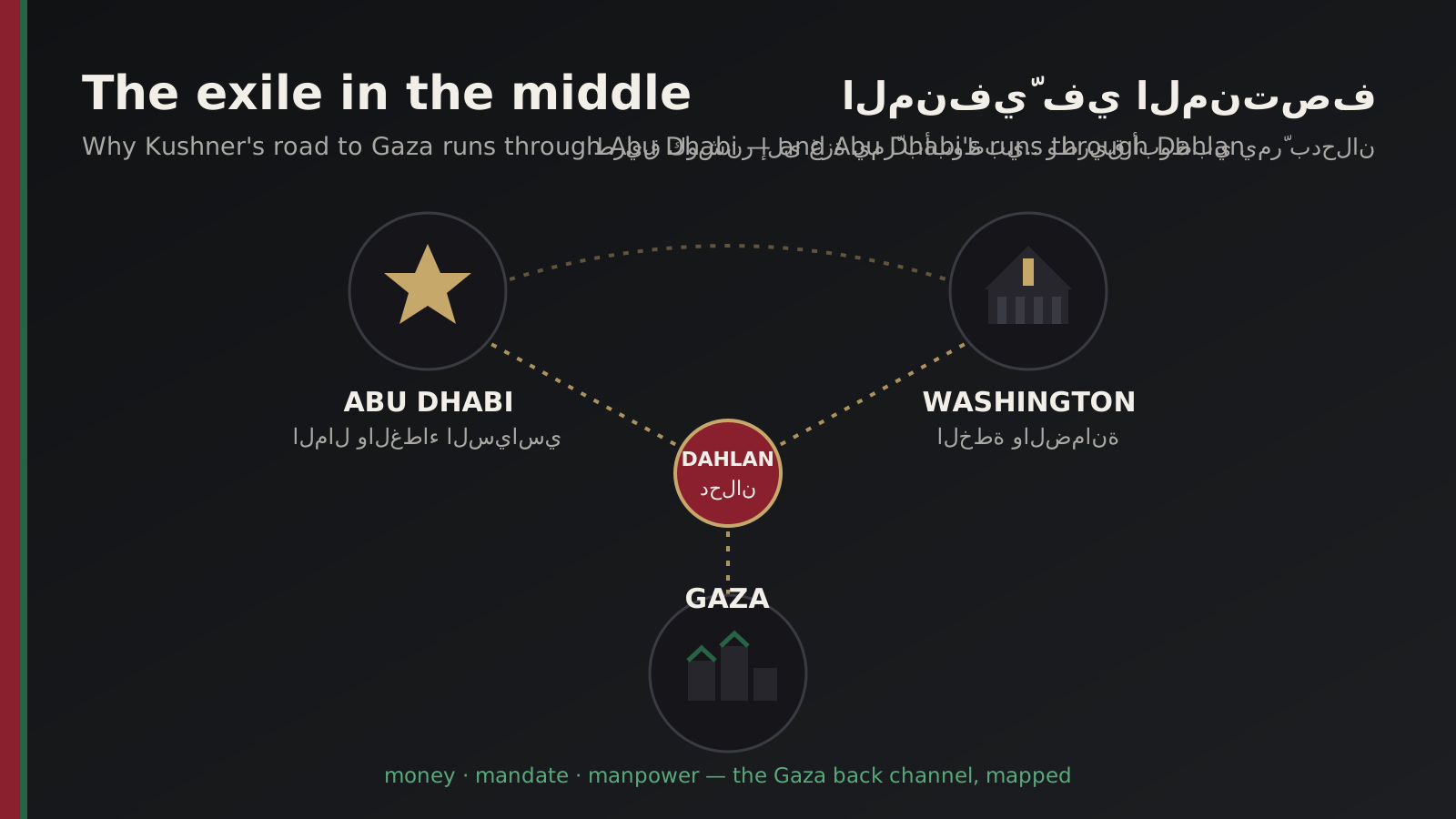
The instrument that can actually hurt Dahlan is the one Netanyahu's statement names as his real concern: Gaza. The theory that Dahlan wants a government that will withdraw and hand him the Strip is an admission of how the exile is seen inside Israel's own security establishment.
Shin Bet director David Zini met Dahlan in the UAE in May to discuss postwar arrangements, Kan reported, and Haaretz wrote that such meetings are brought to the prime minister's attention.
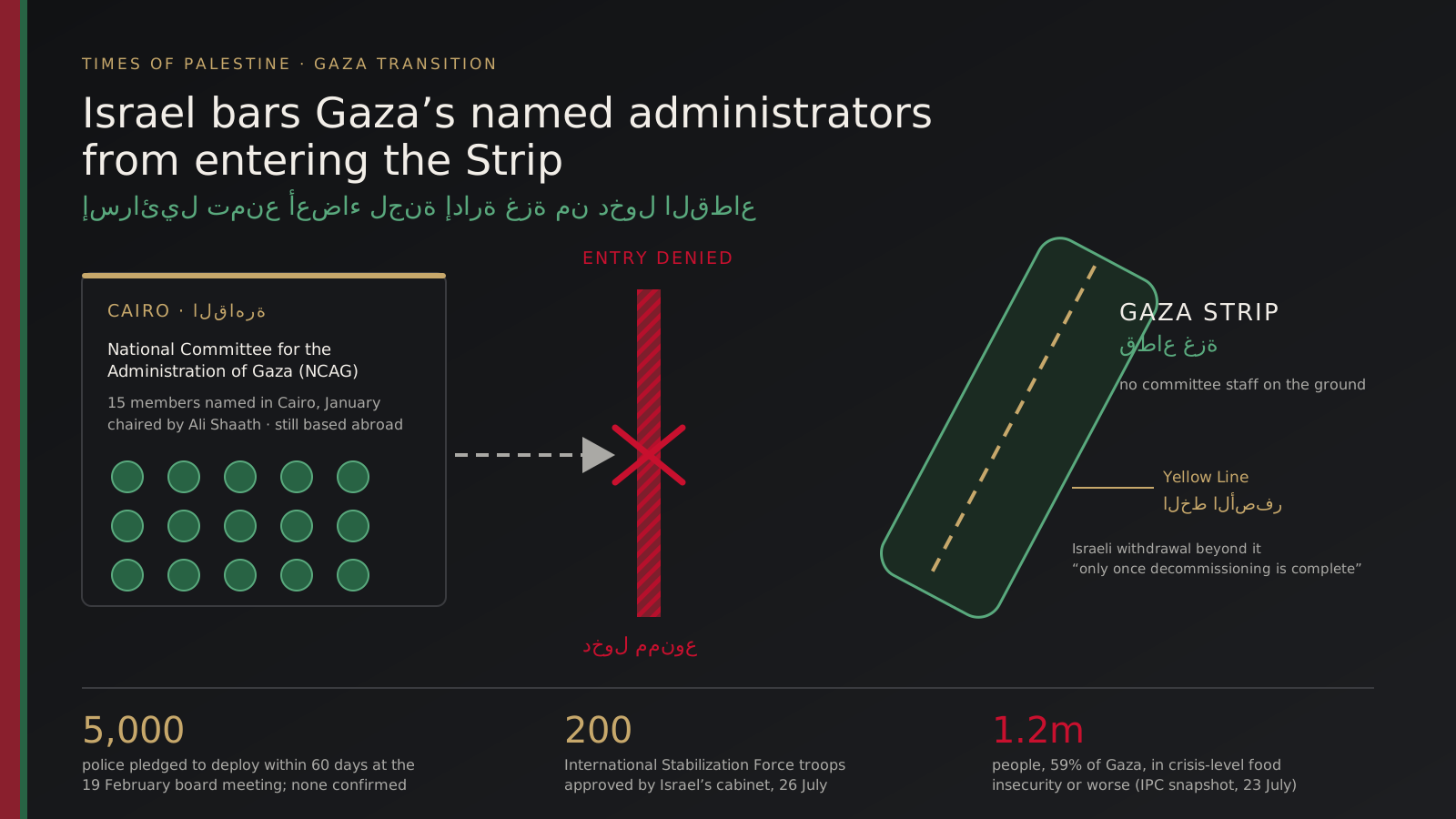
Netanyahu already holds the veto. He rejected the Board of Peace's fifteen-point plan on 9 August, and the Shin Bet has struck most of the names proposed for the technocratic committee meant to run Gaza, among them Amjad Shawa, who was to chair it, and Maged Abu Ramadan, +972 Magazine reported.
The magazine's Palestinian source and a senior British official said half the committee's members had been chosen by the UAE from Dahlan's circle. Keeping Dahlan's people out of Gaza needs no new law, only the refusal Netanyahu has been offering Washington since the summer.
That is also where the instrument turns in his hand. The plan is Donald Trump's, the committee is the Board of Peace's, and the man Netanyahu calls a foreign meddler is the one the Emirati and Kushner channels have relied on since Dahlan carried the ceasefire promise on 1 August. Blocking Dahlan means blocking the president whose endorsement, Axios reported last month, Netanyahu has yet to receive.
The campaign#
The cheapest instrument is the one already in use: the villain. The Knesset speaker, Amir Ohana, said the Israeli public "is already immune to the lies that emerge before elections from Mohammed Dahlan, the man who wants to succeed Abu Mazen and understands that it will be easier for him to take control of the Palestinian Authority if Netanyahu is not elected."
A Palestinian in Abu Dhabi, expelled from Fatah in 2011 and convicted in absentia by Palestinian courts, cannot answer inside an Israeli campaign; he can only deny, and he has.
The opposition has answered on the substance rather than the messenger. Gadi Eisenkot, Naftali Bennett, Avigdor Liberman and Golan issued a joint statement demanding "an immediate and thorough investigation" into what Netanyahu knew, when he knew it, why he did not brief the security establishment and why he did not act.
Bennett called the alleged disregard "criminal negligence", and Eisenkot pledged a state commission of inquiry as soon as the next government is formed.
For Palestinian readers the shape of the week is familiar. The exile Ramallah expelled has become at once Israel's election bogeyman and the Emirati-American candidate for Gaza, and the question of what Netanyahu knew ten days before 7 October has been turned, in Likud's telling, into a question about a Palestinian.
Whether an Israeli court, police station or elections committee ever examines the first question is now Netanyahu's choice, and every instrument he holds against Dahlan drags the call records back into the room.


%20(cropped).jpg?width=640)
