Politics & Diplomacy
Israel bars Gaza's named Palestinian administrators from entering Gaza
Graphic: Times of Palestine
Original Reporting
The Newsdesk gathers reporting from wire services and primary sources and rewrites every story in-house before publication. How our journalism is made →
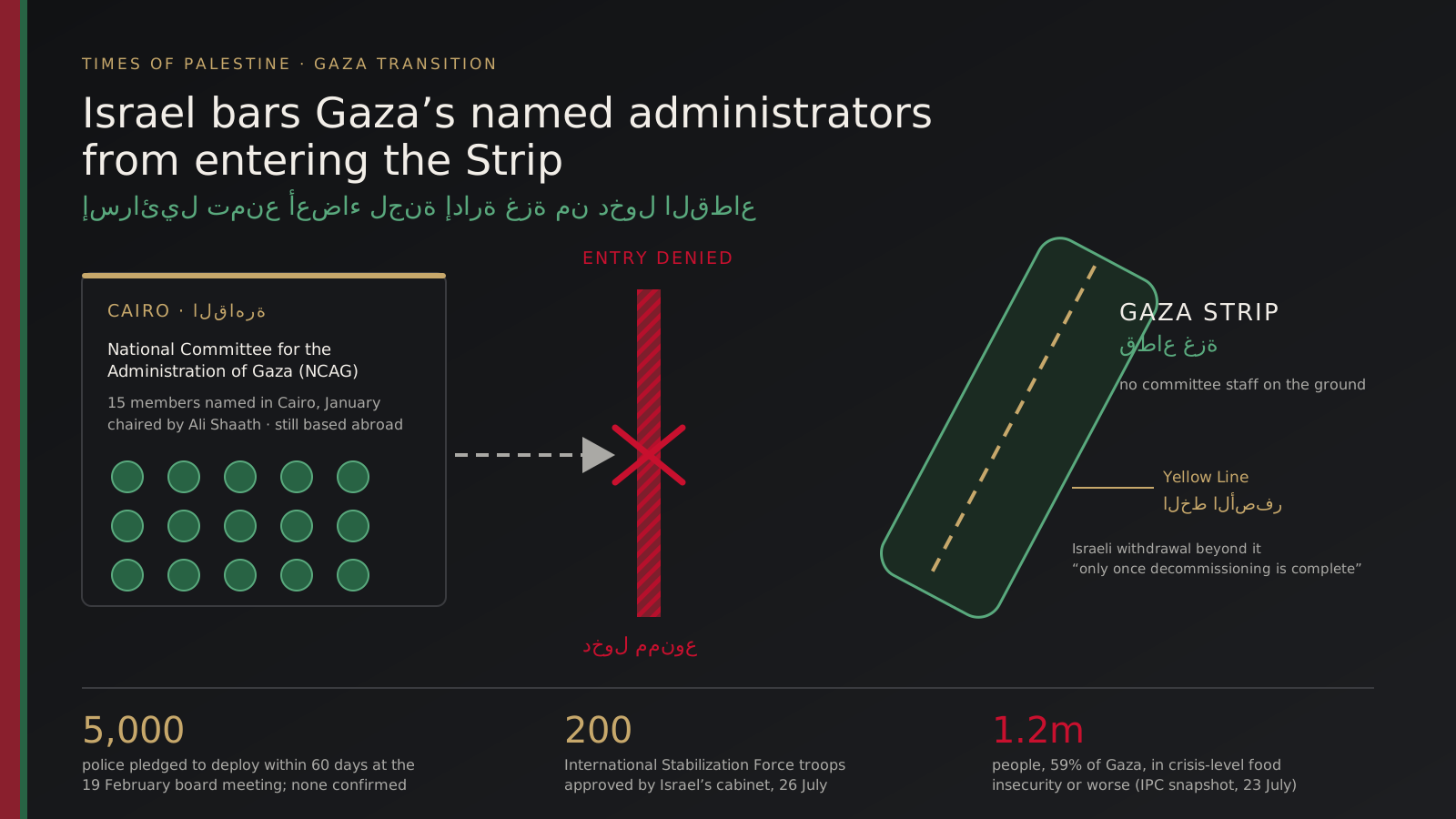
The Palestinian committee designated to run Gaza is still running it from Cairo. Al Jazeera reported on 7 July that Israel had not allowed members of the National Committee for the Administration of Gaza to enter the Strip, and that the body remained temporarily headquartered in the Egyptian capital.
The Arab Center Washington DC recorded the same position that month, noting that despite months of preparation the committee's members had been unable to enter amid Israeli objections to its deployment.
The two structures created to govern Gaza's transition were named in January. Both continue to operate almost entirely outside Gaza.
Security Council Resolution 2803, adopted on 17 November 2025 at the Council's 10046th meeting, endorsed the Comprehensive Plan to End the Gaza Conflict of 29 September 2025 and required the Board of Peace to report to the Council in writing every six months. The first such report, covering 17 November 2025 to 14 May 2026, was circulated on 15 May as document S/2026/418, transmitted by the United States' permanent representative.
Presenting it to the Council on 21 May, Nickolay Mladenov, the High Representative for Gaza, told members it was his second appearance before them and said of the report: "It records what has been done."
The House of Commons Library briefing published in July describes the board as chaired by President Donald Trump and composed of invited heads of state, with some 35 states reportedly having accepted an invitation, and states that the United Kingdom, like many European states, has not confirmed it will join.
The board met for the first time on 19 February in Washington.
NPR reported that Trump announced member states had pledged $7 billion for reconstruction and that the United States would contribute $10 billion, with representatives of more than 40 countries attending at the US Institute of Peace, a building the board's own account calls the Donald J. Trump Institute of Peace.
Newsweek reported that Germany, Italy, Norway, Switzerland and the United Kingdom sent observers rather than joining. How much of the pledged money has been disbursed is not established in the published record.
Ali Shaath, chief commissioner of the NCAG, spoke at that meeting. According to a summary by the Foundation for Defense of Democracies, he announced that some 5,000 Palestinian police officers would deploy to Gaza within 60 days and said a new governing authority was in place with a clear mandate. Nearly six months later there is no confirmation in the public record that such a deployment has taken place.
What the board has decided is largely sequencing. AP reported on 13 May that Mladenov acknowledged the truce was stalled and that deadlock over disarming Hamas had paralysed reconstruction, and that the board had translated the original plan into a 15-point implementation roadmap discussed repeatedly with Hamas representatives in Cairo.
The Jerusalem Post reported on 23 May that Mladenov published the roadmap in a series of posts on X, and that it did not require Hamas to surrender immediately or disarm unilaterally.
Al Jazeera reported on 4 August that after Mladenov met Prime Minister Benjamin Netanyahu in West Jerusalem, the board stated that withdrawal of the Israeli military beyond the Yellow Line would take place "only once decommissioning is complete." Days later, according to The Times of Israel, Netanyahu announced he was rejecting the roadmap, and Mladenov used a Channel 12 interview to argue that full, verified implementation was the only guarantee against a repeat of 7 October.
The Egyptian outlet Vetogate reported that Mladenov said talks were continuing, and cited an Israeli political source telling the public broadcaster that Israel would not withdraw from its current line of control.
The NCAG is a 15-member body of unelected technocrats chaired by Shaath that reports to Mladenov, according to the Arab Center Washington DC. Its own website describes it as a "transitional, technocratic, and apolitical Palestinian committee" responsible for everyday public services. Anadolu reported that Shaath named its members in Cairo in January and said the committee had adopted the Egyptian reconstruction plan, thanking Egypt, Qatar and Turkey.
+972 Magazine reported in January that Israel was blocking the committee from employing civil servants from either Hamas or the Palestinian Authority, leaving the 15 members without staff on the ground. Israel has not published a response to that account.
Hamas dissolved its Emergency Committee on 6 July and declared "full readiness" to transfer authority, NBC News reported. Time reported the following day that the handover timeline remained uncertain and quoted Ismail al-Thawabta of the Hamas-run Government Media Office saying service-provision employees were state employees prepared to work under the NCAG.
The force meant to secure the transition is barely formed. Israel's security cabinet approved on 26 July the entry of up to 200 International Stabilization Force troops, The Times of Israel reported, with National Security Minister Itamar Ben Gvir voting against; Al Jazeera reported no timeframe was given.
Bloomberg reported on 7 August that Uganda's parliament approved a deployment, joining Morocco, Kazakhstan, Kosovo, Indonesia and Albania in pledging soldiers to a force that has struggled to attract commitments. Anadolu reported that the force's commander, Maj. Gen. Jasper Jeffers, said in February that Egypt and Jordan would train police.
Conditions have worsened while the structures negotiate. The Security Council Report's July preview cited an IPC snapshot of 23 July finding 1.2 million people, 59 percent of Gaza's population, in crisis-level food insecurity or worse between mid-April and 30 June, projected to rise to 1.4 million. Bloomberg cited the Hamas-run health ministry's toll of more than 70,000 Palestinians killed.
Briefing the Council on 21 May, the UN's deputy special coordinator said delays in implementing Resolution 2803, daily violence and a continuing humanitarian crisis had replaced the early post-ceasefire momentum.
No date has been announced for the committee's entry into Gaza. The board's next written report to the Council falls due in November.