Politics & Diplomacy
Palestine's election commission registers West Bank voters, delays Gaza mechanism
Running file Palestine Votes 2026 →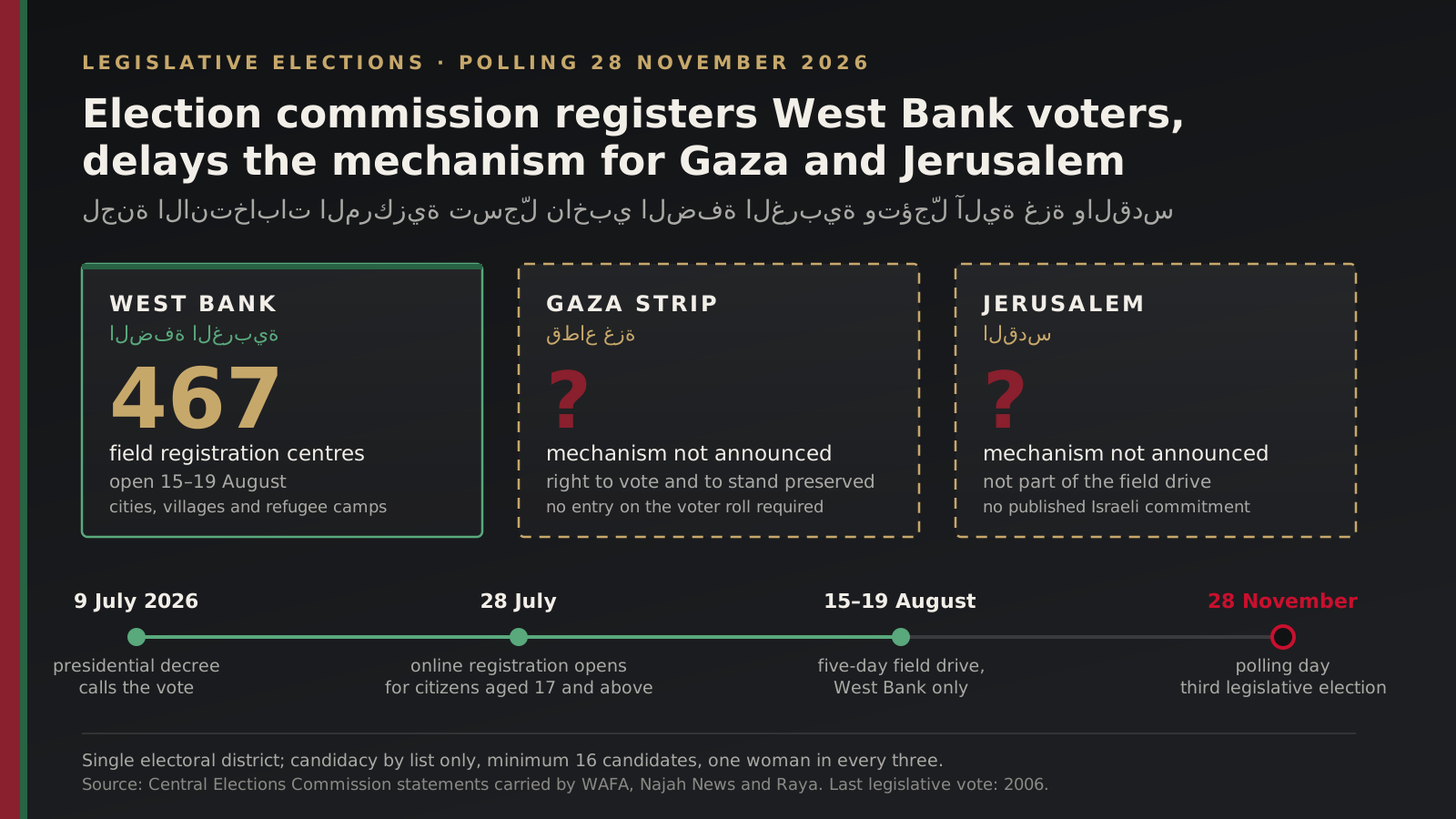
Graphic: Times of Palestine
Original Reporting
The Newsdesk gathers reporting from wire services and primary sources and rewrites every story in-house before publication. How our journalism is made →
The Central Elections Commission closed a five-day field registration drive on 19 August that operated in the West Bank alone. The commission said the drive ran through 467 centres in cities, villages and refugee camps, according to the CEC statement carried by the official news agency WAFA on 15 August and reported the same day by Xinhua.
Voters in the Gaza Strip and in Jerusalem were not part of it.
The commission said their right to vote and to stand is preserved and that they are not required to enter the voter roll, and that it would announce the mechanisms and procedures for their participation at a later date, according to the CEC statement published by Najah News on 28 July and by the Palestinian outlet Filastin Post.
That announcement has not come. It is the single largest unknown in the machinery now being assembled for 28 November, and it is the same fault line on which the last cycle collapsed.
The vote was called by presidential decree on 9 July 2026, addressed to Palestinians in the West Bank including Jerusalem and the Gaza Strip, with polling set for 28 November, the CEC states on its legislative elections page. The commission says the ballot will be run under Decree-Law No.
1 of 2007 on general elections and its amendments, and that this is the third legislative election held in Palestine. The last was in 2006.
The system is territory-wide. Palestine forms a single electoral district and candidacy is only through lists, with a minimum of 16 candidates per list and at least one woman among every three candidates, the Ramallah outlet Raya reported on 16 August as registration opened.
Registration itself was narrower than the electorate. Online registration, opened on 28 July, was for citizens not already on the roll, aged 17 and above, the CEC said in the statement reported by WAFA. Updates to personal data, changes of address and transfers between polling centres could be done only in person, at the West Bank centres open from 15 to 19 August.
Two categories were singled out.
Gaza residents living in West Bank governorates could register at the nearest electoral district office by showing proof of where they live, and anyone entered on the roll before 2021 using a foreign passport was told to visit a CEC office before 19 August to update their file or risk their right to vote and to stand, according to the commission's statement carried by the Palestine Broadcasting Corporation.
Staffing began weeks earlier. The commission opened its training programme for registration teams in early August, starting with 28 trainees drawn from the Jenin, Tubas, Nablus, Qalqilya, Tulkarem and Salfit districts, Raya reported.
The commission has one recent full-scale rehearsal behind it. Local elections were held on 25 April 2026 for 403 local authorities across the West Bank and Gaza, with 4,097 council seats at stake; the CEC announced that 3,697 candidates won seats, 25 per cent of them women.
Voting took place in Gaza, including in Deir al-Balah, where Bloomberg photographed a polling station on election day.
WAFA reported that the local vote ran under a new election law issued on 19 November 2025, which set proportional open-list voting for municipal councils and individual majority candidacy for smaller councils, and that the commission published turnout every three hours.
For dispute adjudication, the framework already exists on paper. The election court for the local cycle was formed under Presidential Decree No. 7 of 2025, with a separate decision constituting its panels and fixing their territorial jurisdiction, both listed among the CEC's published instruments.
The local law itself drew a constitutional challenge: the High Constitutional Court's docket records case No. 4 of 2026, heard on 23 March, contesting the constitutionality of parts of Articles 16 and 19 of Decree-Law No.
23 of 2025 on local council elections and of the decree-law as a whole, on the argument that it conflicts with the 2003 Basic Law. The ruling is not among the court's published summaries.
Observation rules for November have not been issued. For the April local elections, Palestinian civil society organisations, individual citizens and international journalists were permitted to apply for accreditation as observers, according to the compiled public record of that cycle.
What broke in 2021 was not the administration. By 2 March that year the CEC reported that 2.6 million of 2.8 million eligible voters in the West Bank and Gaza had registered, 93 per cent, and 36 electoral lists were filed by the 31 March deadline.
Then-chairman Hanna Nasir had put the eligible electorate at roughly two million in January 2021. Fatah, Hamas and other factions had agreed on 9 February 2021 on election mechanisms that included an electoral court.
On 29 April 2021 President Mahmoud Abbas postponed the vote indefinitely, saying Israel had not confirmed that Palestinians in East Jerusalem could vote, CNN reported at the time. Axios reported the same day that a split within Fatah had opened the way to a possible Hamas win; the Washington Post cited both the Jerusalem dispute and weak polling for Abbas's faction.
Outlets differ on what follows the legislative vote. An analysis published by Ynet on 15 August said the 9 July decree deferred presidential elections to early 2027 and that a corrective decree-law was issued on 11 August.
Moment magazine reported in June that Abbas ratified the legal framework for Palestinian National Council elections on 2 June, with 200 members to be elected from the West Bank, Gaza and East Jerusalem under territory-wide proportional representation.
The European Council on Foreign Relations lists the PLC vote for 28 November in the West Bank, East Jerusalem and Gaza.
Israel has issued no published commitment on voting in Jerusalem. Nor has the commission said how ballots will reach a Gaza population that voted in April from a territory in ruins. The next fixed point is the CEC's promised announcement on Gaza and Jerusalem procedures, and the registration of electoral lists that must follow it.