US Press
House keeps $3.3 billion for Israel, bars UNRWA funding
Graphic: Times of Palestine
Original Reporting
The Newsdesk gathers reporting from wire services and primary sources and rewrites every story in-house before publication. How our journalism is made →
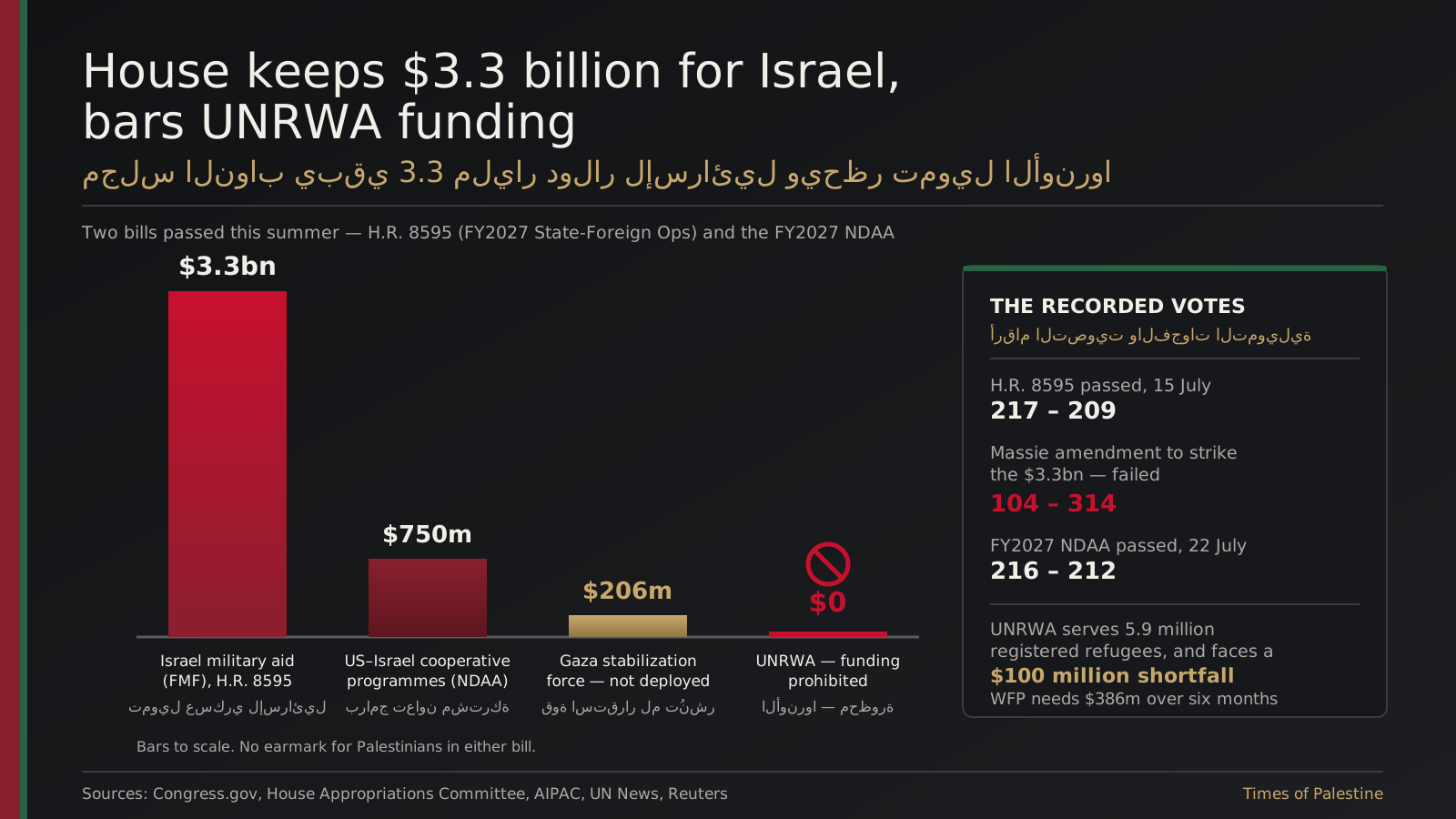
The two bills the US House passed this summer keep Israel's military aid line whole at $3.3 billion, prohibit any money going to the UN agency for Palestine refugees, and carry no earmark for Palestinians — while the only new American money moving toward Gaza is $206 million for a security force that has not deployed.
The House approved H.R. 8595, the National Security, Department of State and Related Programs Appropriations Act for 2027, on 15 July by 217 to 209. The House Appropriations Committee's own summary of the bill lists among its provisions "Prohibiting funds for the United Nations Relief and Works Agency for Palestine Refugees in the Near East (UNRWA)."
An amendment by Representative Thomas Massie, Republican of Kentucky, to strike the $3.3 billion Foreign Military Financing account for Israel failed on 15 July by 104 to 314, with 10 members voting present, according to the roll call recorded in the Congress.gov action log for the bill.
The Republican Cloakroom's amendment list describes the Massie text as prohibiting funds for Israel and reducing the Foreign Military Financing account by $3,300,000,000.
“Prohibiting funds for the United Nations Relief and Works Agency for Palestine Refugees in the Near East (UNRWA)”
Representative James Walkinshaw, a Democrat who opposed it, said in a statement from his office that the amendment "would have eliminated $3.3 billion in Foreign Military Financing for Israel and barred funds for humanitarian aid, refugee resettlement, peace-building efforts, and U.S. Embassy operations" — a wider reading than the amendment summary carries.
Representative Seth Moulton, a Massachusetts Democrat who voted for it, said in his own statement that "we simply cannot continue to condone Netanyahu's actions."
The Foundation for Middle East Peace, a Washington foundation that tracks Israel-Palestine legislation, recorded that the House's earlier FY2026 version of the same bill contained a total ban on funding to UNRWA and did not earmark any funds for the Palestinians. That bill passed the House on 14 January by 341 to 79, JNS reported, with $3.3 billion for Israel under Foreign Military Financing.
The prohibition rests on a contested factual claim.
The House committee report accompanying the FY2026 bill asserts that United Nations reforms must address accountability for "mass atrocities carried out by staff of UNRWA and supported by UNRWA leadership." Al Jazeera reported that the United States cut funding in January 2024 after Israel alleged, without producing evidence, that a small number of UNRWA staff took part in the 7 October 2023 attack, and that Secretary-General António Guterres denounced what he called disinformation and smear campaigns against the agency.
What the ban withholds is measurable. UN News reported on 30 June that UNRWA, which serves 5.9 million registered refugees, faced a record $100 million shortfall going into a pledging conference, with reduced service delivery and cost-saving measures already in place. Guterres said of the agency: "They cannot keep going like this without urgent backing and financial support from member states."
The World Food Programme told Al Jazeera on 1 September that it was cutting food assistance in Gaza and the West Bank and needed $386 million over six months to reach roughly two million food-insecure people, with WFP official Hughes urging donors to "step up support for Palestinians." The UN launched its 2026 appeal seeking half what it said was required.
On the defence side, the House passed the $1.15 trillion FY2027 National Defense Authorization Act on 22 July by 216 to 212, according to Arab Center Washington DC, a policy institute focused on Arab affairs.
AIPAC, the pro-Israel lobby, said the bill authorises $750 million for US-Israel cooperative programmes — a $65 million increase over FY2026 — including $500 million for missile defence, $100 million for counter-drone systems, $100 million for tunnel detection and $50 million for a further category.
The Times of Israel reported the bill also provides $73 billion for the armed forces and intelligence agencies, including operations tied to the war against Iran.
The most disputed text is Section 219 in the House bill and Section 1217 in the Senate version, the Israel FUTURES Act. Military.com reported it would require the defence secretary, in consultation with Israel's defence minister, to establish a permanent initiative for bilateral defence research, testing, industrial coordination and integration.
Arab Center DC reported the House kept the section despite an attempt by Massie and Representative Ro Khanna, a California Democrat, to remove it.
The Quincy Institute, which argues for military restraint, published a study in June titled "Cooperation without Oversight," noting that the FY2026 NDAA already directed the Pentagon to convene a US-Israel defence industrial base working group and that a draft Senate intelligence bill would require the president to expand intelligence sharing with Israel.
The Senate has not advanced its version. The motion to proceed failed 50 to 46 on 14 July, short of the 60 votes required, Military.com reported.
Competing for the same floor time is the White House request of 24 June for $87.6 billion in supplemental funding, which CNBC reported covers the Iran war along with farm aid and unrelated programmes.
CSIS calculated in July that about a third of the request stems from war costs, and noted that budget director Russ Vought told Congress on 30 June that the war had cost roughly $30 billion. The Cipher Brief counted three defence requests before Congress totalling more than $1.5 trillion.
For Gaza itself, Reuters correspondent Humeyra Pamuk reported on 19 August that the administration notified Congress of more than $206 million for the proposed International Stabilization Force — $200 million plus about $6.3 million in armoured personnel carriers redirected from Nepal, with Albania and Kosovo the first recipients. The State Department said the money covers equipment, vehicles and infrastructure; when the force deploys is not known.
Reconstruction money remains a pledge. Military.com reported in February that the $10 billion promised by President Trump requires congressional appropriation, against an Associated Press estimate of roughly $70 billion in rebuilding costs. Reuters reported that member states pledged $17 billion and that only a fraction had arrived; the Board of Peace has not disclosed how much it holds.
Government funding expires on 30 September. Senate Appropriations leaders Susan Collins and Patty Murray announced a stopgap on 3 August to run to 11 December, NBC News reported — which would carry Israel's aid lines and the UNRWA ban forward at existing levels without a Senate vote on either.