US Press
Washington think tanks split over what recognition delivered Palestinians
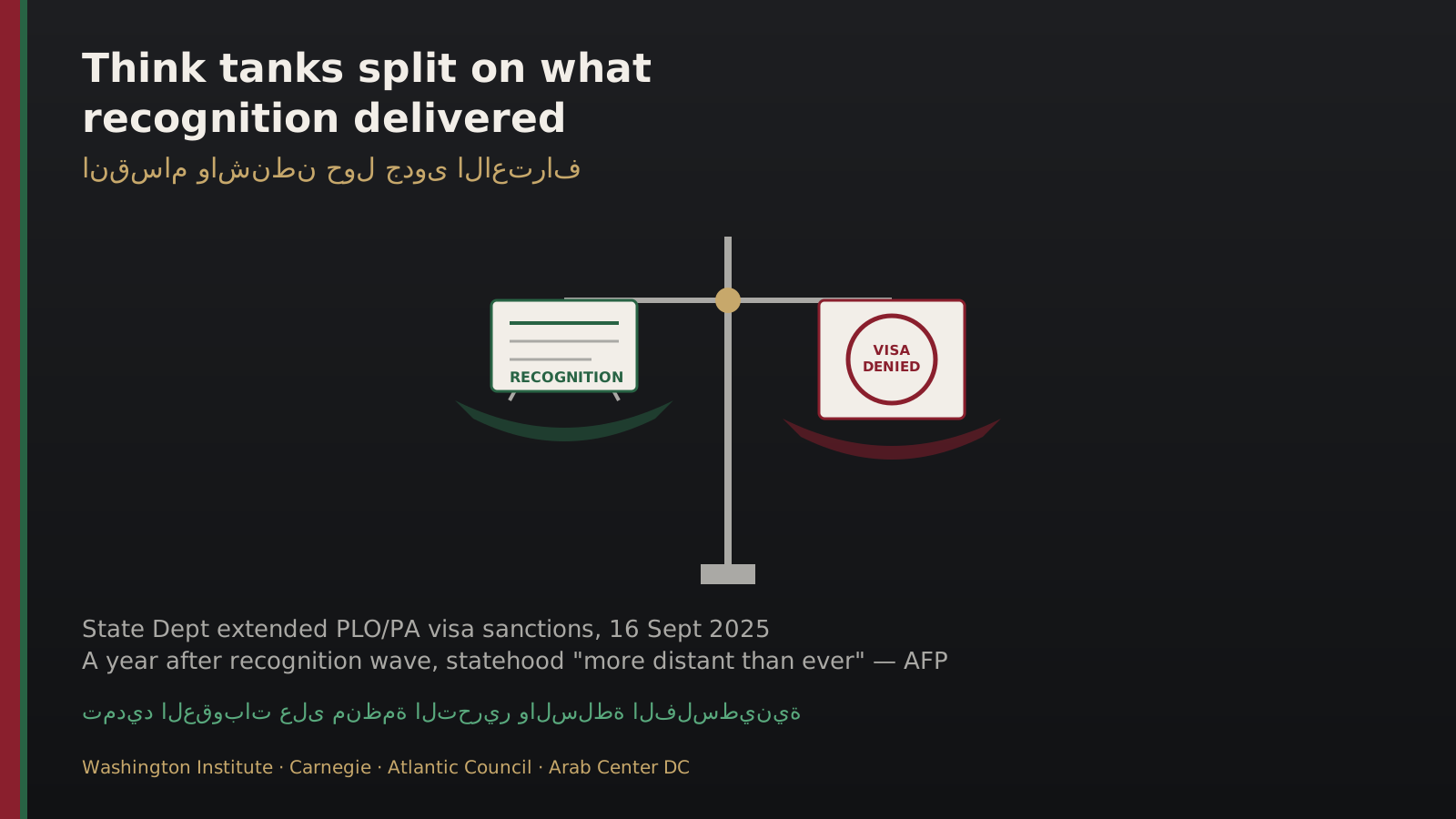
Graphic: Times of Palestine
Original Reporting
The Newsdesk gathers reporting from wire services and primary sources and rewrites every story in-house before publication. How our journalism is made →
Washington's policy institutes entered UN General Assembly week this month divided over whether the September 2025 recognition wave produced anything, and the one concrete American action of the period cut against it: the State Department announced on 16 September that it would extend sanctions denying visas to members of the Palestine Liberation Organisation and officials of the Palestinian Authority.
The department said the extension followed "their failure to reform, contrary to their commitments to the United States, and their ongoing activities that undermine the prospects for peace," and said it was acting under the Middle East Peace Commitments Act of 2002, adding that it was in the national interest "to impose consequences and hold the PLO and PA accountable for glorifying terrorism." The department cited actions at international organisations, including recourse to the International Criminal Court and the International Court of Justice.
UPI reported that the announcement came amid reports the United States had denied PA President Mahmoud Abbas a visa for a second consecutive year, and the General Assembly was due to vote on allowing Abbas to submit a video statement.
On the ground, the assessments converge. Agence France-Presse reported on 18 September that a year after recognition, Palestinian statehood looks more distant than ever, with Israeli settler violence soaring and Palestinians pushed into less space.
“their failure to reform, contrary to their commitments to the United States, and their ongoing activities that undermine the prospects for peace”
The analyst Ines Abdel Razek told the agency that recognition amounted to little without measures to support the state's existence, and that the two-state solution had become "a diplomatic refrain to avoid looking at reality in the face."
UN Secretary-General António Guterres, speaking on 22 September to a high-level meeting convened by Canada, France, Saudi Arabia and the United Kingdom, said conditions for a viable Palestinian state were being "systematically erased" and that Israel's E1 settlement plan would deal a "deathblow" to Palestinian statehood.
In the same remarks he called Israeli settlements in the occupied territory "a flagrant violation of international law." In his General Debate address the same day he said settlement expansion and displacement in the West Bank were "bulldozing the path to peace" and raising "the spectre of ethnic cleansing."
The institutional arguments were set a year earlier and have not moved much. Robert Satloff of the Washington Institute for Near East Policy wrote in August 2025 that France, Britain and Canada had been "paving (separate) roads to nowhere".
Souhire Medini, writing for the same institute on the eve of recognition while in residence from the French foreign ministry, argued the opposite: that recognition was an attempt to strengthen the PA rather than Hamas, and that Paris had been clear Hamas must be disarmed and barred from governing.
The Carnegie Endowment for International Peace published two readings in September 2025. One held that by recognising Palestine, several states had challenged US domination of the negotiations with Israel. The other held that the moves neither end the occupation nor halt the war, but open a diplomatic window and build on a new balance internationally.
Jean-Loup Samaan, a nonresident senior fellow at the Atlantic Council's Scowcroft Middle East Security Initiative, noted that recognising capitals had taken "minimal punitive measures (yet)" against Israel. The Council on Foreign Relations recorded the Israeli reply: several ministers in Prime Minister Benjamin Netanyahu's government called for annexation of parts of the West Bank in response to the recognitions.
At Arab Center Washington DC, a collective analysis published on 28 September argued that UNGA 2026 exposed Israel's mounting isolation and the divergence between the US-Israel axis and the global majority, with dozens of delegates walking out before Netanyahu's speech while Washington withheld visas from Abbas.
At the centre's conference on 23 September, executive director Tamara Kharroub said polls showed at least 55 per cent of Americans believe military aid to Israel should be stopped or reduced, and that net approval of Israel had fallen by 67 points over eight years, according to The New Arab's account.
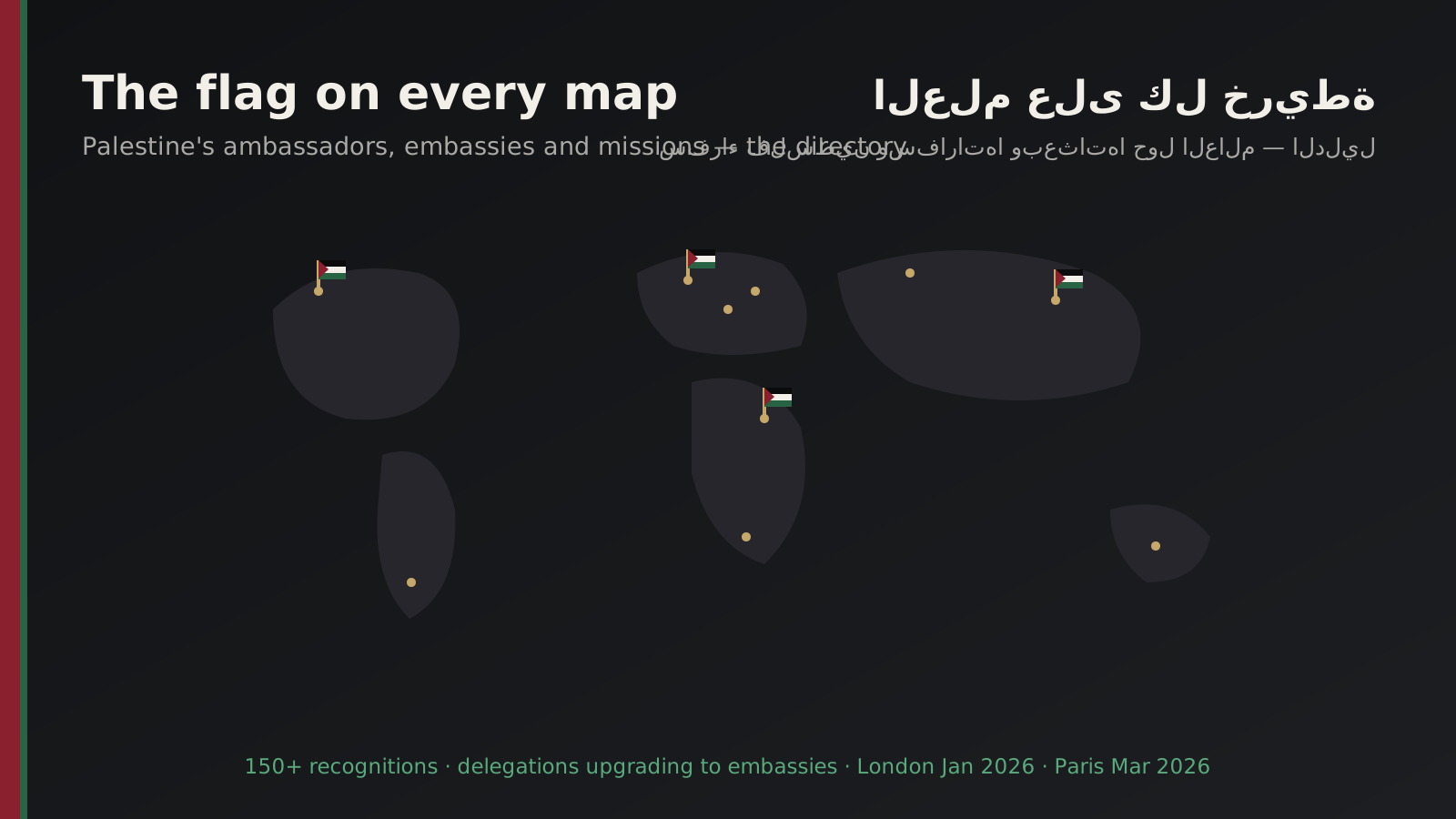
In the embassies column, the ledger is short but real. The Palestinian mission in Hammersmith, west London, which had served as diplomatic headquarters for more than thirty years, was upgraded to full embassy status, with ambassador Husam Zomlot unveiling the plaque at an opening ceremony in January 2026. At that ceremony Zomlot called for "immediate, concrete, and consequential measures" to halt the war.
On aid, Belgium coupled its recognition with money: Prime Minister Bart De Wever said Belgium had pledged €600 million in support and over €190 million in humanitarian aid. Delivery remained the problem.
Tom Fletcher, who heads OCHA, described charities banned by Israel as "essential allies and partners" in delivering aid to Gaza, a ban the UK and other governments called "unacceptable" while pressing for predictable access. Trade conditionality tied to recognition does not appear in the UNGA-week material from any of these institutions.
Opinion pages remain the widest gap. On 26 September Al Jazeera published an argument that the British government is moving to translate rhetoric into policy; two days earlier JNS carried a piece by Shane Shmuel asking what Australian recognition achieved, noting that Prime Minister Anthony Albanese had said recognition rested on commitments from the Palestinian Authority.
The conditions attached at the time are now the measuring stick. The House of Commons Library records that France, Canada and the UK were the first G7 states to recognise, and that Keir Starmer reiterated Hamas could play no future role in Gaza.
Writing for Chatham House in London, Zizette Darkazally noted that Canada's recognition statement listed defined actions, including holding general elections in 2026. Whether those elections happen is not established in the record from UNGA week.
What comes next sits in the Knesset. A letter sent by US senators on 16 January 2026 noted the Knesset's preliminary approval of two draft bills to impose Israeli sovereignty, and said tangible steps were needed to back up American statements opposing annexation.
Writing for the International Peace Institute's Global Observatory in September, Yehezkel Lein and Rami Dajani set the test for recognising states as translating formal recognition into concrete measures that expand Palestinian sovereignty. None of the Washington institutions published evidence that this has yet occurred.