Real Lives
Amed Khan feeds Gaza's children and got Hind Rajab's family out
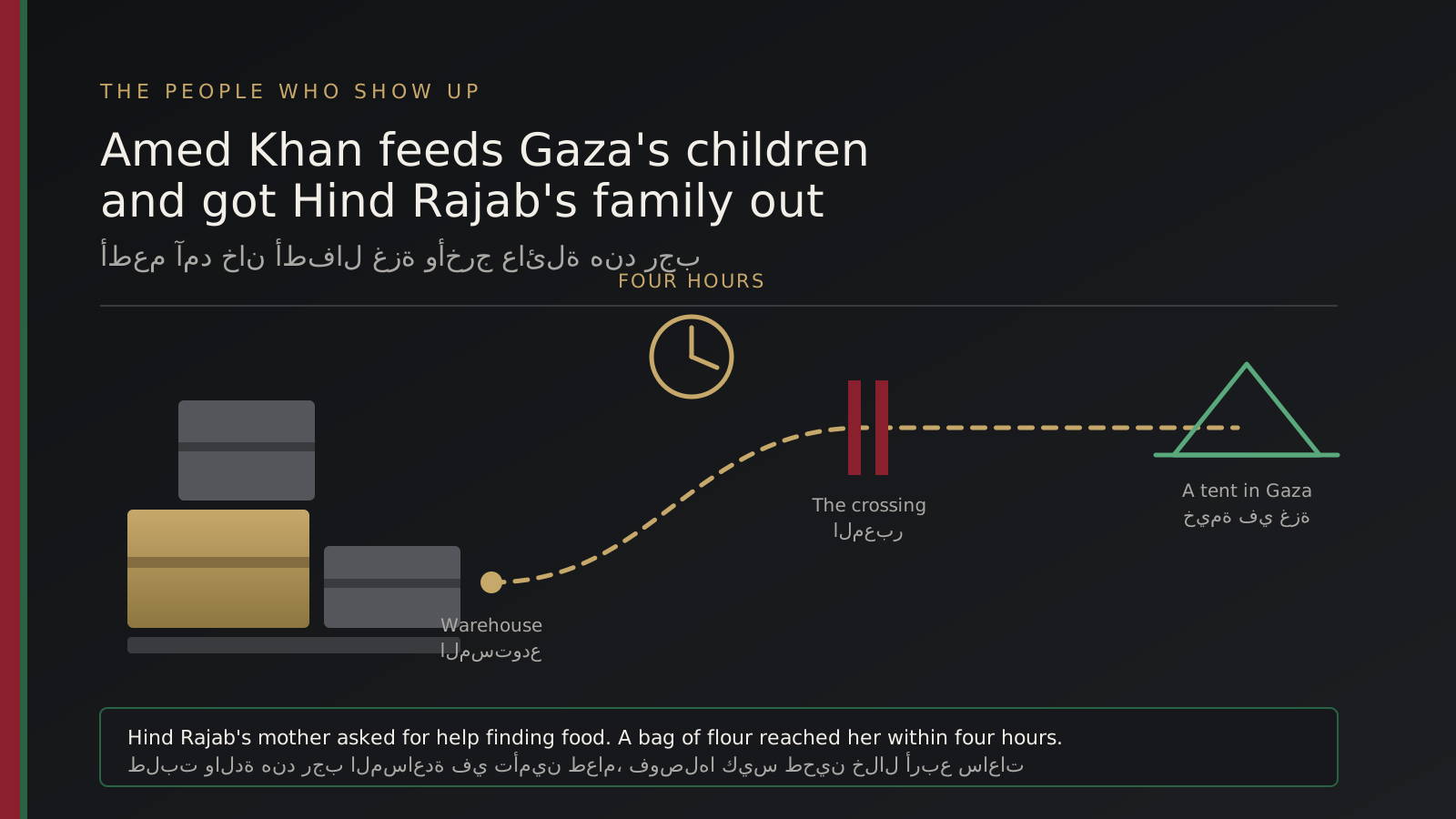
Graphic: Times of Palestine
Original Reporting
The Newsdesk gathers reporting from wire services and primary sources and rewrites every story in-house before publication. How our journalism is made →
In early 2025, while a Tunisian director was making a film about her daughter, Wissam Hamada sent a message from Gaza City asking for help finding food.
Hind Rajab, her five-year-old, had been killed in a car in Gaza in January 2024 with her aunt, uncle and cousins, and the recording of her voice on the phone to the Red Crescent had travelled the world. Her mother was still in the city, and still hungry.
One of the film's producers, Odessa Rae, passed the message to a man she knew was running a supply operation inside the Strip. Variety reported that within four hours his team had got Wissam Hamada a bag of flour.
The man was Amed Khan, a New York financier who spends his own money on other people's emergencies, and who had by then been working the Gaza crossings for well over a year.
A bag of flour, then a family of eight#
The flour was the beginning. Khan went on to arrange and oversee what Variety described as an exceptionally complicated mission to get Hamada and her family of eight out of Gaza altogether.
It did not happen quickly. When "The Voice of Hind Rajab" premiered at Venice and the hall stood and applauded for twenty-two minutes, the family the film is about was still in Gaza City, trying to leave.
They are out now. Wissam Hamada and her family live in Greece, in the care of Elpida Home — the refugee shelter in Thessaloniki that Khan founded a decade ago for Syrians, Iraqis and Afghans who had nowhere to go.
Khan is credited as an executive producer on the film, which took the Silver Lion at Venice and was nominated for the Academy Award for best international feature as Tunisia's entry.
Within four hours his team had gotten her a bag of flour
Variety, on the first thing Amed Khan's foundation sent Hind Rajab's mother
Where the money comes from#
Khan's philanthropy is financed from his own pocket, through Paradigm Global Group, the private international investment firm he leads.
He grew up toward it rather than into it. He took a B.A. in American foreign policy and American history at the University of Wisconsin-Madison, then worked the 1992 Clinton campaign and transition, the Peace Corps director's office, the 1996 campaign, the 1997 inaugural committee and, that same year, the G-7 summit as director of operations.
The turn came after the Rwandan genocide. Khan went to work for the International Rescue Committee as chief administrator and logistician at the Ngara camps on the Tanzanian side of the border, and by his own account spent about eighteen months living in a tent with no running water or electricity.
"I really thoroughly got a lot out of helping people," he told the magazine Service95 in May 2025. "That's literally it."
What the foundation does#
The Amed Khan Foundation states its method plainly: deliver aid directly, on the ground, to the people who need it, rather than through the layers that usually stand between a donor and a household.
Its record before Gaza is the reason the method is taken seriously. After the fall of Kabul in 2021 Khan's team coordinated the evacuation of more than 1,500 Afghans — women legislators, judges, journalists, people who had worked for the US government — and then housed, fed, treated and resettled them.
Since Russia's invasion in 2022 he has worked in Ukraine on frontline civilian aid, medical relief networks and the evacuation of Holocaust survivors. In Iraq the foundation helped rebuild churches and homes in Christian villages destroyed by ISIS.
In Gaza the work has been food, medicine, emergency child nutrition and getting sick children out. The foundation says it has bought and delivered Ready-to-Use Therapeutic Food for malnourished children, funded medical access, and supported evacuation for the critically ill and injured.
Khan's own accounting of the early months is on the record. He told the UN Dispatch newsletter Global Dispatches in February 2024 that he had been in and out of Sinai roughly fifteen times since 10 October 2023, that he was sending food and medicine to hospitals and the Palestinian Red Crescent, and that his spending ran to "several million dollars between donations and delivered supplies."
When Washington suspended funding to UNRWA at the end of January 2024, he began donating to the agency himself. "I was doing my own thing in Gaza as I usually do around the world," he said, "but the unfair and unjust hit on UNRWA compelled me to donate to them."
The cold medicine in the warehouse#
Khan's clearest public account of what the work costs in patience appeared in the Los Angeles Times on 5 March 2026, under the headline "Blocking aid, Israel escalates its cruelty in Gaza."
For more than five months, he wrote, 15,000 boxes of children's cold medicine and other essential medicines had been sitting in a warehouse awaiting an Israeli approval that never came.
The objection was glycerin. Israeli officials feared the small amounts in the bottles could be turned into explosives, he wrote, with no evidence that armed groups in Gaza had done or could do it — and Israel would not say what percentage of glycerin it would accept, so no substitute could be sourced either.
The same logic reached the tents. Metal tent poles were treated as suspect dual-use items; shipments of green jackets were held on the theory that they could serve as uniforms. Khan called the rules arbitrary, overreaching and seemingly intentionally unclear, with an approvals process too slow to answer what people actually needed.
He wrote that he had been able to see all this because so few independent humanitarians were left doing it — partly because Israel had suspended the licences of 37 aid organisations, among them CARE, Oxfam and Doctors Without Borders.
He writes it down#
Khan is unusual among private donors in that he publishes, under his own name, and has done so since well before Gaza.
In August 2020 he argued in Responsible Statecraft, with Lora Lumpe, that Democrats should pledge to stop creating refugees. In January 2021 he wrote there again that US interests in the Middle East do not run through Abu Dhabi.
On 23 March 2024 The Intercept ran his essay "Organizing Aid to Gaza Led Me to a Harsh Truth: Biden Is on Board for Ethnic Cleansing." He had hosted fundraisers for Joe Biden in 2020, and wrote that trying daily to move food and medicine into Gaza had brought him to that conclusion about the president he helped elect.
In The Nation on 16 August 2024 he explained the break itself — "I Left Biden's Campaign Over Gaza. Here's How Harris Can Earn My Trust Again." Then came the Los Angeles Times in March 2026. He sits on the board of the Quincy Institute for Responsible Statecraft and of the International Refugee Assistance Project.
These are his arguments, made in his own voice, and they are contested in Washington. What is not contested is that the man making them has spent the period since October 2023 buying food and medicine and trying to get it through.
The gap he keeps measuring#
What Khan supplies most consistently is arithmetic — the distance between what world leaders announce and what reaches a child.
He told Service95 that roughly 10,000 children in Gaza needed immediate medical evacuation and that fewer than 1,000 had been moved. When Jordan's King Abdullah pledged in February 2025 to evacuate 2,000 children with cancer, Khan said 65 were actually taken; France had taken perhaps 20 or 30, Italy 30 or 40. "These are ridiculous numbers," he said.
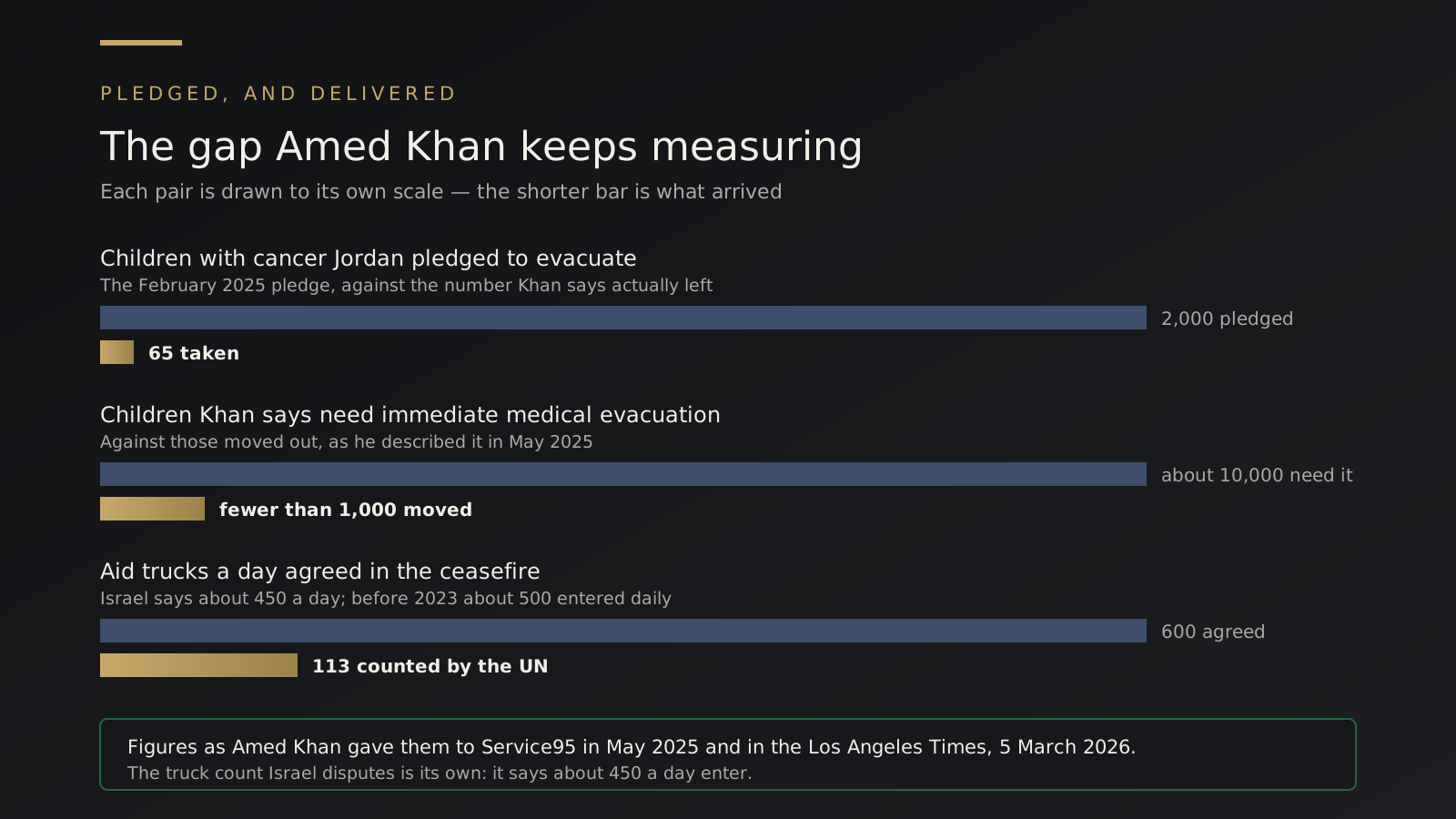
In the Los Angeles Times he set the ceasefire's terms against its practice: 600 aid trucks a day agreed, Israel claiming about 450, the UN counting closer to 113, against roughly 500 a day before 2023.
He wrote that Israel had allowed about 200 medical patients out since the Egyptian border reopened in early February. Caregivers — usually the mothers of sick children — were often refused permission to travel with them, on unspecified security grounds.
The failure, he insists, is not logistical. The World Food Programme, UNICEF and Anera know exactly how to do this, he told Service95; what is missing is political will.
He keeps going back anyway. Asked what stays with him, he described a child in a tent, displaced more than fifteen times, who had not eaten a proper meal in over a year, looking up at him and telling him not to cry.
It's going to be OK, the child said. Khan cried anyway.


.jpg?width=640)

