The Diaspora
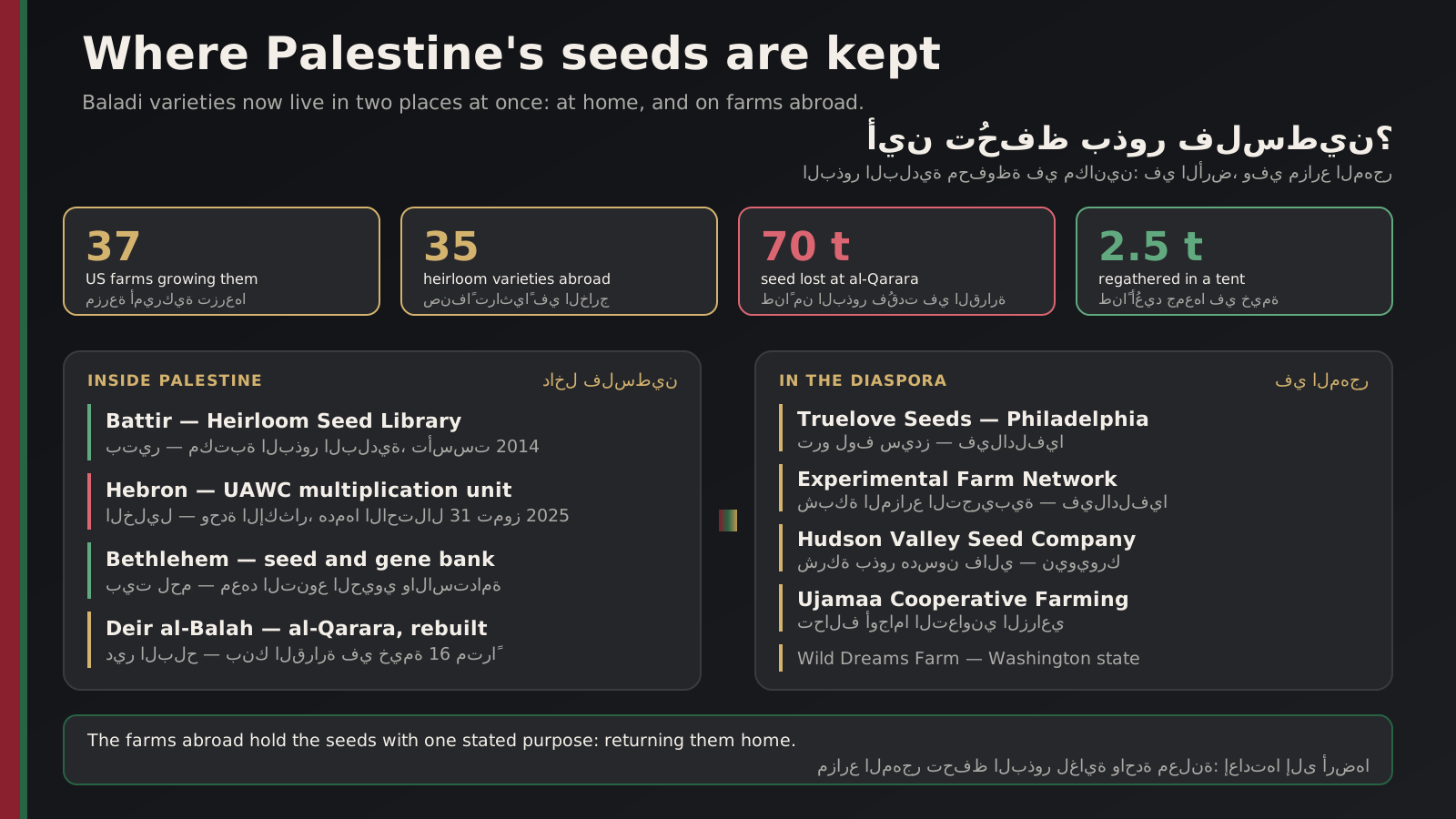
Vivien Sansour sends Palestine's heirloom seeds to 37 American farms

Image credit: Battir from the south-west, 2018 — יעקב via Wikimedia Commons (CC BY-SA 4.0) · License
Original Reporting
The Newsdesk gathers reporting from wire services and primary sources and rewrites every story in-house before publication. How our journalism is made →
The seed bank Salama Muhanna built on his family's land east of al-Qarara now fits inside a tent of sixteen square metres, west of Deir al-Balah. He runs it with his daughter Hanadi.
Before the war the family's fifteen dunams carried the bank's building, and inside that building sat seventy tonnes of seed. The Palestinian network Nawa reported that the land was bulldozed and the building destroyed with everything in it.
What the two of them have rebuilt since is counted differently. About 2.5 tonnes of seed have been gathered back out of other farmers' fields, the Guardian reported this month — carried in by hand, one harvest at a time.
During the war, they've been our lifeline.
Salama Muhanna on Gaza's baladi seeds, speaking to the Guardian
Nawa put the rebuilt collection at 32 varieties against 42 before the war. The Guardian, reporting from the same tent in September, counted about 28. Either way the archive is smaller than it was, and it is being reassembled inside a displacement camp.
The library that asks for its seeds back#
The al-Qarara bank, founded in 2017, has never sold anything. It lends. A farmer takes the quantity he needs and returns the same quantity after the harvest, keeping the rest to eat or to sow again — the arrangement the Arabic service Monte Carlo Doualiya described in August.
Before the war it supplied roughly 200 farming families, according to the Guardian's account. Nawa counted about 42 farmers working with the bank in its tent today.
The seeds are worth the trouble for reasons that have nothing to do with sentiment. "Heirloom seeds give continuity. They provide 80 to 90 percent of the same yield," Muhanna told the AFP news agency in August, describing wheat, barley, chard, spinach, parsley, courgette and okra that resist drought, fungus and pests without inputs no one in Gaza can buy.
The International Committee of the Red Cross backs the project. Osama al-Mukhalalati, an economic security officer with the committee, called it "a ray of hope amid the complete darkness" — a small, delivered piece of support rather than a reconstruction plan.
Why the copies moved abroad#
The case for keeping Palestinian seed outside Palestine is not theoretical, and it was made again this summer in the southern Hebron hills.
On 31 July 2025, Israeli bulldozers demolished the storage facilities of the seed multiplication unit belonging to the Union of Agricultural Work Committees, taking the equipment and materials the unit used to reproduce indigenous seed. The Anadolu news agency reported the demolition. The union's seed bank, established in 2010, holds more than seventy varieties of baladi seed.
Fouad Abu Seif, the union's director-general, called the demolition "a direct targeting of the Palestinian people's attempts to recover their agricultural and food decision-making". Neither the Anadolu report nor the union's own account carried any comment from the Israeli military. La Via Campesina and Friends of the Earth International both condemned the destruction.
That is the arithmetic the diaspora network answers: an archive held in one place can be bulldozed in one morning.
Thirty-seven farms, thirty-five varieties#
Vivien Sansour founded the Palestine Heirloom Seed Library in 2014 in Battir, the village of stone terraces and a Roman-era spring outside Bethlehem that sits on the UNESCO World Heritage list. In 2024 she launched the Seed Protectors Project.
Organic Seed Alliance, the Washington-state seed organisation, reported the project's shape in September 2025: 35 Palestinian heirloom varieties stewarded across 37 farms in the United States, with about 40 growers and organisations taking part, and further participants in Latin America, Jamaica and Europe. Places are by invitation only.
The stated purpose is precise about what it is and is not. The seeds are being kept, in the alliance's words, for "safeguarding Palestinian heirlooms beyond their homelands for the Palestinian diaspora — and with the hope of one day returning them home." The return is an aspiration. The growing is the part that already works.
The growers, by name#
In Philadelphia, Owen Taylor's Truelove Seeds grows molokhia, kusa and za'atar varieties for a demand that comes from Palestinian and wider Arab households in the city. Nate Kleinman's Experimental Farm Network, also in the Philadelphia area, works on desert-adapted okra and drought-resistant wheat across a range of regional climates, and lists the small Jadu'i watermelon in its seed store.
That watermelon is the clearest example of what the network is carrying. It comes from Jenin, and it was once exported to Lebanon, Syria and Jordan — a Palestinian export crop that most Palestinians under forty have never tasted.
Al-Bustan Seeds of Culture, the Philadelphia arts organisation, mapped the network last September in a piece by Gawhara Abou-eid, which reported that the seed library's coordinator, Melina Roise, runs the American side from Catskill, New York. Jen Williams grows for the project at Wild Dreams Farm in Washington state. Hudson Valley Seed Company and the Ujamaa Cooperative Farming Alliance are the other institutional partners.
When institutions are under threat, the community becomes the institution.
Al-Bustan Seeds of Culture, Philadelphia
A third container, in Bethlehem#
The third holding is academic. Mazin Qumsiyeh, who returned to Palestine in 2008 after years teaching at American universities, founded the Palestine Institute for Biodiversity and Sustainability at Bethlehem University in 2014, and runs it with his wife largely on volunteer labour and local donations.
Alongside its herbarium, laboratories and botanical garden, the institute keeps a seed and gene bank, and works to add at least a hundred species a year. It is a slow, funded, functioning operation, and it is deliberately not in Gaza or Hebron.
The wall in Washington#
On 17 September the Jerusalem Fund published an essay by MacKenzie DeBruhl for its Gallery Al-Quds in Washington under the title "Baladi, Palestinian Heirloom Seeds as a Subversive Archive", putting all three institutions — al-Qarara, the Bethlehem institute and the seed library — inside one frame.
The exhibition lists thirteen varieties with their lore, history and medicinal profiles: Abu Samara wheat, bamyeh okra, bandura baladiye tomato, bitinjan battiri eggplant, fakous, Jadu'i watermelon, jarjeer, kousa, molokhia, sabanikh, Sahl Arraba coriander, silq baladi chard and yakteen gourd. Read as a list of names, it is a gazetteer as much as a catalogue — Arraba, Battir, Jenin, each seed still carrying the place that selected it.
Back in the tent west of Deir al-Balah, the bank still lends on the old condition: take what you need, bring the same amount back after the harvest. On thirty-seven farms an ocean away, the condition is the same one on a longer horizon, and nobody has yet named the season when it comes due.