Real Lives
Khalil Shikaki built the longest record of what Palestinians actually think

Graphic: Times of Palestine
Original Reporting
The Newsdesk gathers reporting from wire services and primary sources and rewrites every story in-house before publication. How our journalism is made →
For thirty-three years a political scientist in Ramallah has been sending interviewers to Palestinian doors on a stubborn proposition: that the only way to know what a people think is to ask a properly drawn sample of them, and to publish the answer whoever it embarrasses.
Khalil Shikaki directs the Palestinian Center for Policy and Survey Research, and the archive he has built is the longest continuous record of Palestinian public opinion there is. The centre's own Arabic pages count more than 200 polls across the West Bank and Gaza, and dozens more run jointly with Israelis.
He was born in Rafah in September 1953, into a family displaced in 1948 from Zarnuqa, a village where the Shikakis had farmed wheat, apricots and oranges for generations. His grandfather was the village imam and his father called the prayer.
He began university at Birzeit in 1971, took his degrees at the American University of Beirut, and finished a doctorate at Columbia in the mid-1980s. He taught there, then in Kuwait and Bahrain, then returned to Nablus and An-Najah University, where he served as dean of scientific research.
In 1992 he started training interviewers. The first survey went into the field in 1993, run out of a centre he had founded in Nablus. When the Palestinian Authority settled in Ramallah he moved the centre there to sit nearer the people making the decisions, and it took its present name.
The number that got his office ransacked#
In July 2003 he published a survey of refugees that asked something almost nobody had put to them directly. Not whether they held the right of return, but what they would actually choose if a settlement put options in front of them.
The great majority insisted on the right. Around one in ten said they would move to Israel and take Israeli citizenship. The rest chose compensation, a Palestinian state, or somewhere else.
The finding was read, immediately and widely, as Palestinians giving up return. Dozens of people ransacked the centre's Ramallah office and marched on Yasser Arafat's compound a few streets away. Shikaki has said the demonstrators were sending a message that return was not negotiable.
He spent the months that followed insisting on a distinction the coverage had collapsed. A right is not the same as the exercise of a right, and a refugee who says they would not personally move has surrendered nothing. Critics pressed him on the wording of the options and on the inferences drawn from them, and he defended the instrument in public.
A right is not the same as the exercise of a right.
The distinction at the centre of the 2003 refugee survey
Polling a war from inside it#
The surveys that carried his name furthest were the ones taken after October 2023, and they were the hardest he has run.
Each quarterly poll reaches between 1,200 and 1,580 adults, interviewed face to face rather than by telephone — across seventy or eighty residential locations in the West Bank, and as many as seventy-five in Gaza.
In Gaza those locations had largely ceased to exist. Interviewers worked in what the centre calls counting areas: the pre-war districts, mostly destroyed, where people were found in damaged homes or in tents pitched among the rubble. Where whole areas were unreachable, Rafah and most of the north among them, respondents were interviewed in shelters.
Nobody knew how many people were where. The centre's answer was to nearly double the Gaza sample to hold the error down, then reweight the whole survey so each territory entered the total at its real relative size. The published margin of error runs between three and three and a half per cent.
What Gaza said, and what the West Bank said#
The most consequential thing the numbers caught is a divergence almost no outside commentary predicted.
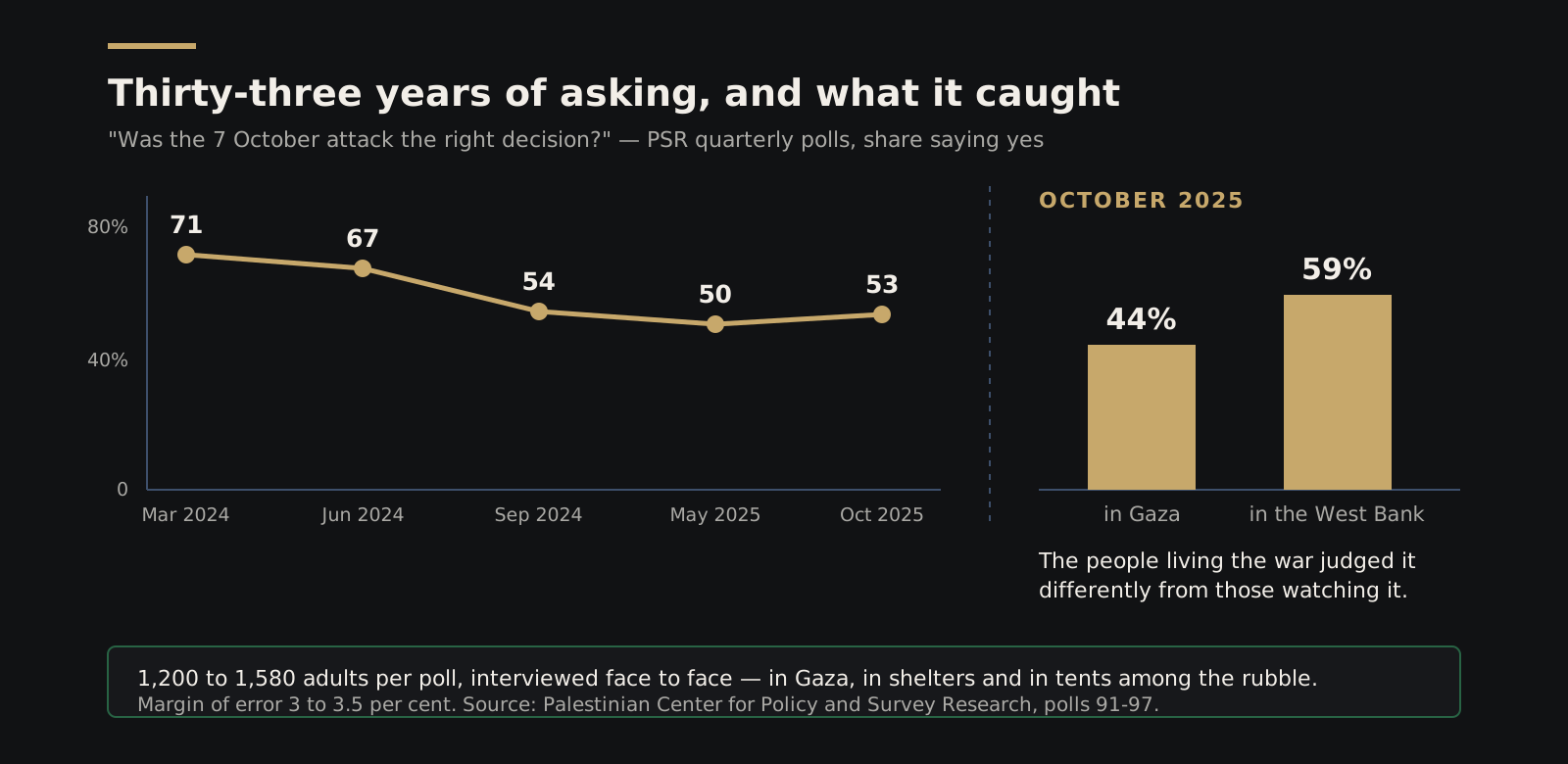
Asked whether the 7 October attack had been the right decision, support across both territories stood at 71 per cent in March 2024 and fell steadily: 67 in June, 54 by September, 50 by May 2025, 53 in October.
Underneath the average sat a split. In the October 2025 poll 44 per cent in Gaza called the attack the right decision, against 59 per cent in the West Bank. A year earlier 28 per cent of Gazans expected Hamas to win the war; among West Bankers it was 65.
The people living the war judged it differently from the people watching it, and only a survey taken inside both places could have shown that. Over the same stretch his polls recorded rising support for a two-state settlement and a falling preference for armed struggle over negotiation.
Asking both publics the same question#
Since 2016 he has run the Palestinian-Israeli Pulse, putting matched questions to both populations at the same moment — with Tel Aviv University's Evens Program in Mediation and Conflict Management, the researcher Dahlia Scheindlin, and earlier Tamar Hermann of the Israel Democracy Institute's Guttman Center.
The September 2024 round found support for a two-state solution at 40 per cent among Palestinians and 72 per cent among Palestinian citizens of Israel, against 21 per cent among Israeli Jews — the lowest Jewish-Israeli reading since the Pulse began.
The argument the archive makes#
Shikaki has been a senior fellow at the Crown Center for Middle East Studies at Brandeis University since 2005, and he co-founded the Arab Barometer, which carried the same method across the Arab world.
The through-line of the career is narrower than any single finding, and more demanding. In a conflict where a great many people speak on Palestinians' behalf, he has spent thirty-three years arranging for Palestinians to answer for themselves — in numbers, on the record, published whether or not the answer suits anyone.


.jpg?width=640)
