Real Lives
OCHA finds nine in ten Gaza households short of water
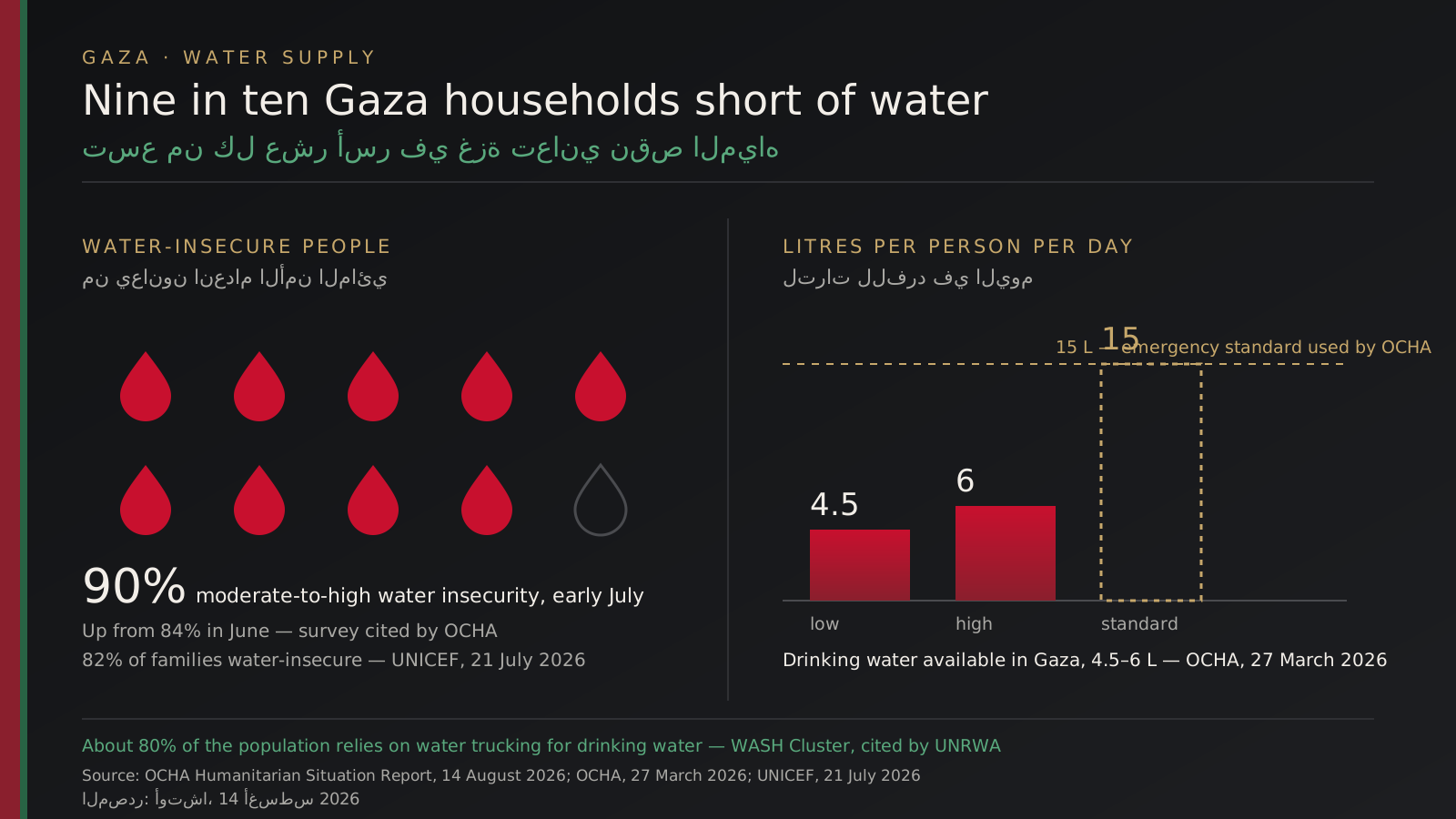
Graphic: Times of Palestine
Original Reporting
The Newsdesk gathers reporting from wire services and primary sources and rewrites every story in-house before publication. How our journalism is made →
Nine in ten people in Gaza were living with moderate-to-high water insecurity in early July, up from 84 per cent in June, according to a survey cited in OCHA's Humanitarian Situation Report of 14 August 2026 — ten months into a ceasefire that has restored some pipelines but not the network that carried water to houses.
The most recent per-capita figure OCHA has published is older. Its report of 27 March 2026 put drinking water available in the Strip at between 4.5 and 6 litres per person per day, and added that families living far from services faced worse.
OCHA has used 15 litres per person per day as the emergency standard in its Gaza reporting; the March figure is under half of that, and the agency has not published a newer per-capita estimate since.
UNICEF's mid-year update, issued on 21 July 2026, put the share of water-insecure families at 82 per cent and said up to 70 per cent of households cannot collect even 6 litres per person per day for drinking and cooking.
The German agency arche nova, describing a project it began in July in three camps in Al Mawasi near Khan Younis, cited UN data showing 84 per cent of households water-insecure in June, with 62 per cent naming drinking water as their most urgent need.
The three figures come from different surveys and different weeks; taken together they describe a summer in which the share of families short of water rose rather than fell.
Almost all of it moves by road. WASH Cluster data cited in UNRWA's situation report puts the share of Gaza's population relying on water trucking for drinking water at about 80 per cent.
OCHA's report of 3 July 2026 said trucking would remain the main channel for 74 per cent of drinking water for the foreseeable future, and that partners were shifting towards network repairs and chlorination to reduce the cost of hauling it.
Production has not recovered. The director general of the Palestinian Water Authority in Gaza, Munther Salem, told Al Jazeera in July that daily output across the Strip fell from about 300,000 cubic metres before the war to under 120,000 in February 2026, a shortfall he put at more than 60 per cent.
OCHA reported in March that the three Mekorot supply lines from Israel were delivering about 42 per cent of what they carried before October 2023, and that the flow was undependable.
The lines break and are patched.
OCHA's 27 March report recorded the Bani Suhaila line to Khan Younis back in service on 22 March, the Bani Saeed line in Deir al-Balah repaired and running at half capacity in a testing phase, and the Al Muntar line into Gaza city functional since a repair on 15 March.
Its 10 April report said a desalination plant returned to full output of roughly 15,000 cubic metres a day after repairs on 4 April to an electricity line hit by an airstrike on 25 March.
What is produced does not all arrive. OCHA reported in March that an estimated 70 per cent of water is lost to damaged distribution networks before reaching people. That is the reason the jerrycan queue exists: the last stretch of pipe is gone, so the water waits at a filling point and someone walks to it.
The scale of that daily walk is documented. WASH Cluster figures cited in February 2026 counted partners delivering just under 20,000 cubic metres of drinking water a day through 126 distribution points in North Gaza, 728 in Gaza city, 453 in Deir al-Balah and 839 in Khan Younis.
In Al Mawasi, arche nova says its project supplies 6 litres of drinking water per person per day to 4,770 people across 900 households, trucked from desalination plants to distribution points.
Storage has become a household expense. A displaced woman in Al Mawasi, quoted by the Palestinian outlet Ultra Palestine this month, described carrying her water tank with her when she fled northern Gaza in September 2025; the report cites siblings who paid 2,000 shekels for a tank, and says securing somewhere to keep water now comes before other needs.
What a cubic metre costs in August 2026 is not on the public record.
The most recent prices found in published material are more than a year old: a truck driver told UN News in April 2025 that a cubic metre cost 90 to 100 shekels and that he waited about five hours at the plant to fill, while the Palestinian news agency WAFA reported in February 2025 that the Water Authority credited 13 mobile desalination units with cutting the cost from 250 shekels to 80.
OCHA noted in March 2026 that UNICEF and the WASH Cluster had completed a review of pricing for private desalination plants in the subsidised water scheme. The resulting price schedule has not been published.
The queue takes the hours a school day would take. A mother in Gaza told Al Jazeera in February that her children's days are now built around fetching water, collecting meals from a charity kitchen and finding fuel to burn, leaving little time to study. A 12-year-old girl in Deir al-Balah, quoted by UNICEF, said the hardest thing after displacement was finding safe water.
Collection has also killed. OCHA reported that two UNICEF contractors were killed in April while delivering drinking water in northern Gaza, prompting the suspension of operations at a key filling point; UNICEF said in May that a critical trucking route remained inaccessible, cutting off a station from which two million litres a day had been drawn.
OCHA has warned since April that shortages of engine oil, lubricants and spare parts threaten the generators keeping wells and desalination units running. Whether the network repairs that would end the daily carry can begin depends on materials entering Gaza, and OCHA has not said when.