Politics & Diplomacy
Treasury brands Palestine Action and Masar Badil global terrorists
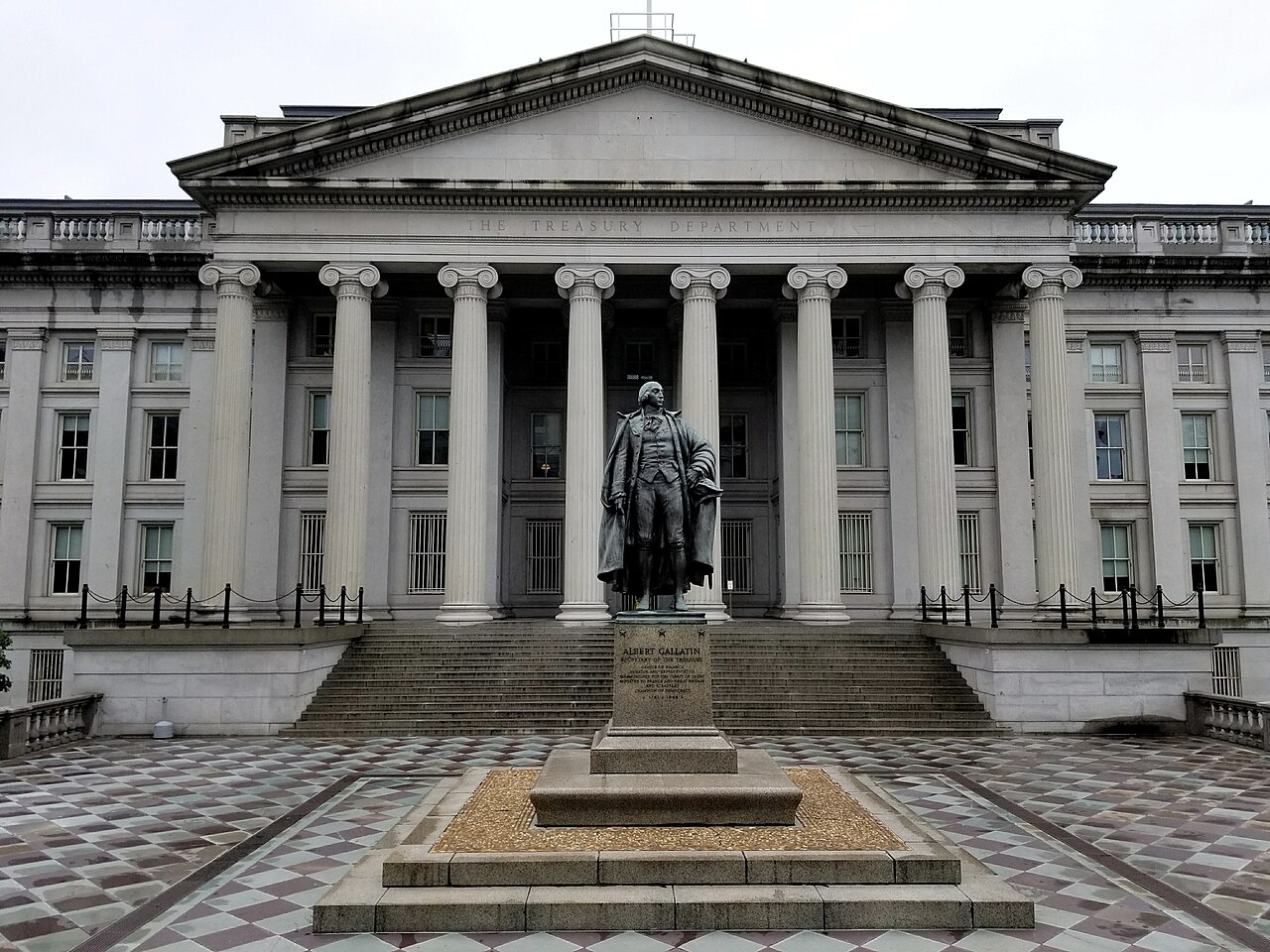
Image credit: The US Treasury Building and the Albert Gallatin statue, Washington DC, 2 September 2017 — Sealy j / Wikimedia Commons, CC BY-SA 4.0 · License
Original Reporting
The Newsdesk gathers reporting from wire services and primary sources and rewrites every story in-house before publication. How our journalism is made →
The American sanctions list that holds al-Qaeda financiers and Hezbollah money changers acquired two new entries on Wednesday. Both are organisations whose declared purpose is Palestine advocacy.
The Treasury Department's Office of Foreign Assets Control designated Palestine Action, a British direct-action group, and Masar Badil, a transnational Palestinian movement, as Specially Designated Global Terrorists. It designated two Masar Badil officials by name: Zaid Abdulnasser, who lives in Germany, and Rawa Alsagheer, who lives in Brazil. An Italian technology collective, Autistici Inventati, was listed alongside them.
The authority is Executive Order 13224, signed by President George W. Bush in the weeks after 11 September 2001 and used since against groups the United States accuses of terrorism.
The framing was new. Treasury headed its announcement an action against violent far-left terrorist networks.
"Far-left extremists, their fronts, and their enablers should be on notice," Treasury Secretary Scott Bessent said. "We will bring the full weight of our economic tools to bear."
For a Palestinian this is not a story about Britain or Italy. It is a story about which American filing cabinet Palestine advocacy is now kept in, and what a person risks by putting money in an envelope.
The category came first#
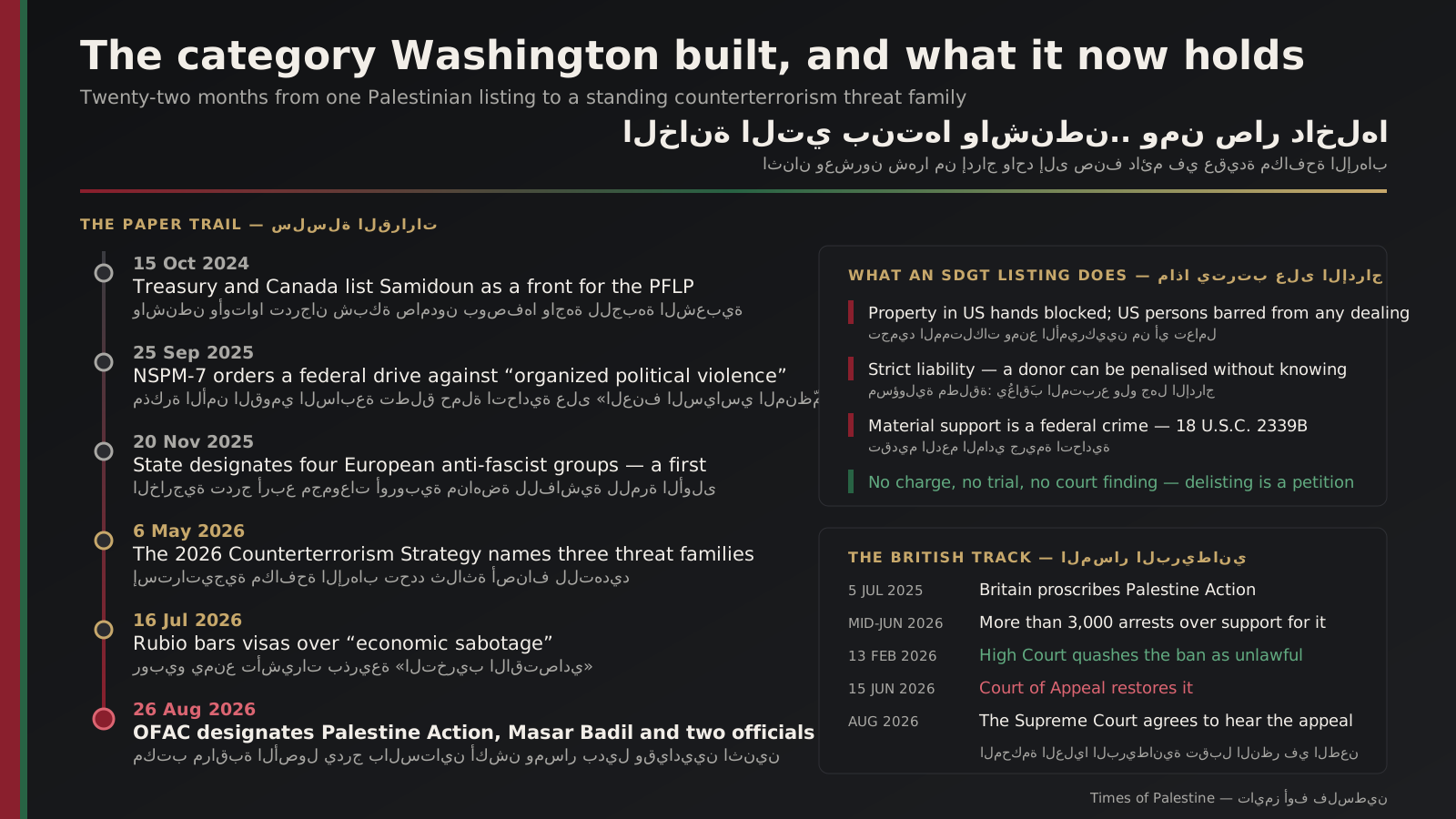
Wednesday's listing was the last step in a sequence Washington built over twenty-two months, and the sequence is what matters.
President Trump issued National Security Presidential Memorandum 7 on 25 September 2025, directing federal agencies against what it called organised political violence. The American Civil Liberties Union, which opposes it, notes that the conduct it sweeps in includes trespass, property damage and doxxing, not only violence against people.
On 20 November 2025 the State Department designated four European groups — Antifa Ost in Germany, the Informal Anarchist Federation and International Revolutionary Front in Italy, and Armed Proletarian Justice and Revolutionary Class Self-Defense in Greece. It was the first time the United States had applied terrorism designations to organisations tied to anti-fascist activism abroad.
Then the category was written into doctrine. The White House released its 2026 Counterterrorism Strategy on 6 May, and it names three principal threat families: cartels and narcoterrorists, Islamist groups with the capacity to strike the United States, and violent left-wing extremists, including anarchists and anti-fascists. Treasury's announcement on Wednesday cited that document.
Secretary of State Marco Rubio announced the enforcement arm on 16 July, after a conference in Washington that drew representatives of more than sixty governments. "For far too long, however, our counterterrorism doctrine has had a blind spot," he said, "a blind spot when it comes to extremist violence from the political left."
The policy denies American visas to foreign nationals who have, in the State Department's words, participated in economic sabotage, or financed, recruited or provided logistical support for violent or criminal actions.
That phrase is the one Palestinian readers should mark. The department has not published a definition of economic sabotage.
Peter Margulies, a national security law professor at Roger Williams University, told The Intercept this month that it is "a term broad enough to get a tank through, and so that would really be problematic under the First Amendment, because of course people in this country have a right to criticize corporations as well as government."
Carrie DeCell of the Knight First Amendment Institute at Columbia University said the wording could reach supporters of boycott and divestment campaigns. "The vagueness is the point," she said.
What Treasury alleges, and what it has not proved#
Treasury's case against each organisation is set out in its own words, and the two cases are not alike.
Against Palestine Action the department cited material support for an act of terrorism, and pointed to break-ins at defence plants and British military installations. The group was founded in 2020 and built its campaign on forced entry and property damage at Elbit Systems UK and its suppliers, among them Thales and Instro Precision.
Against Masar Badil the department made a structural claim: that the movement is a front for the Popular Front for the Liberation of Palestine, which the United States designated a Foreign Terrorist Organization in 1997.
Treasury said Masar Badil shares fundraising channels and executive committee members with the Samidoun Palestinian Prisoner Solidarity Network, which the United States and Canada listed jointly on 15 October 2024, naming Khaled Barakat, Mohammad Khatib and Jaldia Abubakra.
Masar Badil was founded in 2021 and, in its own literature, sets out a programme of armed resistance and the liberation of historic Palestine within an anti-colonial frame. The Program on Extremism at George Washington University records that the movement describes Samidoun as one of its foundational pillars.
An OFAC designation is an executive determination. No criminal charge accompanies it, no court has weighed the evidence, and the route out is an administrative petition to the same office that made the listing.
Khaled Barakat rejected the action. "The Trump administration is the primary perpetrator of terror in the world," he said, "along with its closest friend, Benjamin Netanyahu."
Huda Ammori, who co-founded Palestine Action, answered in personal terms. "As a Palestinian and Iraqi, the fact the country which destroyed both my homelands is calling me a terrorist, is beyond hypocritical," she said, adding that the designations "should be a wake-up call to anyone who cares about free speech and civil liberties".
What a listing does to an ordinary person#
The practical weight of an SDGT listing falls well beyond the organisation named, and the mechanism is worth setting out plainly.
Treasury blocks property in American hands and bars United States persons from transactions. That prohibition carries strict liability under the International Emergency Economic Powers Act.
A note the law firm Arnold & Porter published in December for tax-exempt organisations warned that an entity can incur civil liability "even without knowing that the counterparty was sanctioned", including through commingled funds or a co-hosted event.
Knowingly providing material support is a separate federal crime under section 2339B of the criminal code, and the statute counts money, training and expert advice as support.
The quieter consequence is banking. The same note recorded that banks, payment processors and crowdfunding platforms routinely flag, freeze or close the accounts of organisations they perceive as connected to a designated party, and that designations bring donor attrition and a chilling effect on protected speech.
Palestinians know that machinery from the other end. A transfer from Chicago to Ramallah or a fundraiser for a clinic in Khan Younis passes through compliance systems that resolve doubt by refusing, and every widening of the designated universe widens what those systems treat as doubt.
Tariq Kenney-Shawa, the US policy analyst at the Palestinian think tank Al-Shabaka, made that argument when Samidoun was listed in 2024, warning then that the designation could become a precedent for reaching Palestinian civil society more broadly. Wednesday extended the list by two organisations and two named individuals living in Germany and Brazil.
Britain is still arguing about it#
The British authorities that Washington followed have not settled the question themselves.
Britain proscribed Palestine Action under the Terrorism Act on 5 July 2025, a fortnight after activists entered RAF Brize Norton and damaged aircraft.
Membership or support became a criminal offence carrying up to fourteen years. By the middle of June this year British police had made more than three thousand arrests connected to support for the group, many of them of people holding placards.
The courts have moved in both directions. The High Court in London quashed the ban as unlawful on 13 February, in the first successful challenge to a proscription under those powers. The Court of Appeal reversed that judgment on 15 June. In early August the Supreme Court agreed to hear Ammori's appeal, and she has said she will go to the European Court of Human Rights if she loses there.
The American listing does not wait for any of that. It attaches now, and it reaches Palestinians in the diaspora who have never set foot in Britain.
That is the measure of the day for readers in Gaza and Ramallah. Trump revoked Washington's instrument for punishing settlers who seize Palestinian land in January 2025 and no administration has rebuilt it, while the instrument for punishing people who organise on Palestine's behalf abroad grew again on Wednesday.