Politics & Diplomacy
Palestinian election commission delays Jerusalem voting rules as registration opens
Running file Palestine Votes 2026 →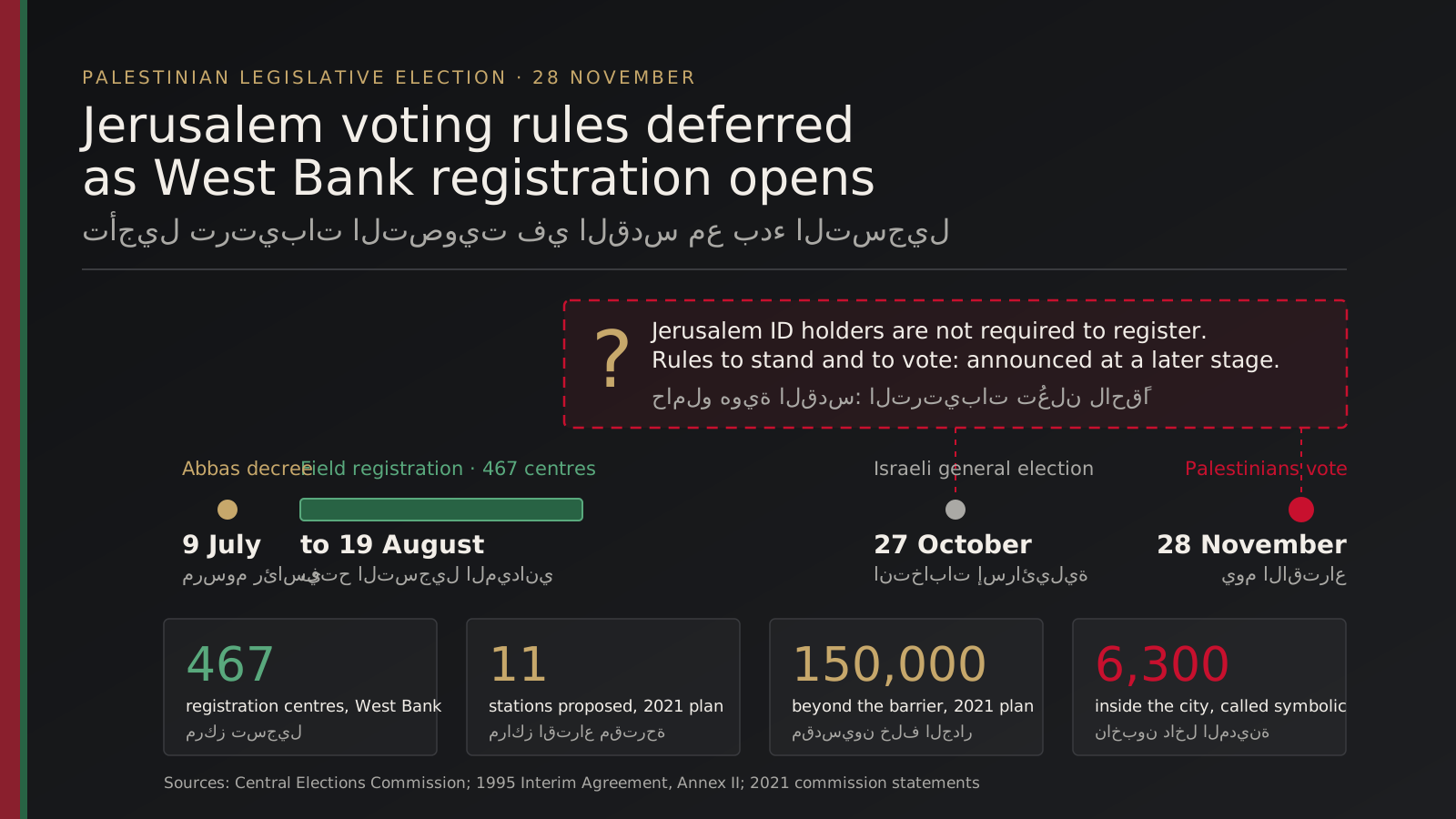
Graphic: Times of Palestine
Original Reporting
The Newsdesk gathers reporting from wire services and primary sources and rewrites every story in-house before publication. How our journalism is made →
The Central Elections Commission opened field registration for the 28 November legislative election on Saturday at 467 centres across West Bank governorates, and said that holders of Jerusalem identity cards are not required to register, with the arrangements allowing them to stand and to vote to be announced at a later stage.
The registration period runs until 19 August, according to the commission's announcement carried by Palestinian outlets including Raya and the Palestinian Broadcasting Corporation.
That single sentence about Jerusalem is the unresolved core of the vote. The commission's spokesman, Farid Taamallah, launched the drive at a registration centre in Qalandia refugee camp, north of Jerusalem — inside the Jerusalem governorate as the Palestinian Authority defines it, but on the far side of Israel's separation barrier.
President Mahmoud Abbas issued the decree setting the date on 9 July, calling on Palestinians in Jerusalem, the West Bank and the Gaza Strip to elect a new Legislative Council, Al Jazeera reported.
“in accordance with the capacity of such post offices”
The same report noted that Israel had yet to comment publicly on the announcement, and that voting in occupied East Jerusalem would require Israel to permit it. No Israeli government position on the November ballot has been published since.
The mechanism at issue dates to 1995.
Article VI of Annex II of the Israeli-Palestinian Interim Agreement provides that a number of Palestinians of Jerusalem will vote through services rendered in post offices in the city, "in accordance with the capacity of such post offices", and that international observers will be present in those post offices on polling day.
The same annex routes campaigning in Jerusalem through a joint subcommittee: candidates apply for permits through the elections commission, which obtains them from the Israeli side, and the commission may disqualify candidates whose Jerusalem campaigning breaches the agreement.
Israel's Foreign Ministry summary of the interim agreement described the arrangement differently in emphasis: voting would take place in localities outside Jerusalem, while a number of the city's Palestinian residents would vote by means of special envelopes sent from post offices to the elections commission.
The commission's own account of how this worked in practice is on its website.
For the 2006 legislative election, it says, the two sides agreed that the commission would open three centres to distribute voter cards to blue-identity-card residents of Jerusalem so they could vote at post offices, with cards allocated to each post office according to its stated capacity; Jerusalemites beyond that quota obtained cards elsewhere.
The Palestinian Center for Policy and Survey Research, in a 2023 policy brief, describes the same episode as a curtailment — Israel allowed East Jerusalemites to vote only from the city's outskirts and at post offices.
In 2021 the arrangement did not hold. Israel never gave a guarantee that voting could take place in the city, and Abbas postponed the elections in April, citing that refusal — the formulation used in the US State Department's country report on the West Bank and Gaza.
Speaking in Ramallah at the time, Abbas said the Palestinians had asked Washington and European capitals to press for the 2006 formula and received no position in reply, according to CNN's account of his remarks.
The commission had prepared a fallback. Days before the postponement it said 11 polling stations would be provided in Kufr Aqab and Shuafat refugee camp, allowing roughly 150,000 Jerusalemites living beyond the barrier to vote without prior registration and without Israeli approval, The Times of Israel reported in April 2021.
A further figure of about 6,300 voters inside the city itself, under Israeli supervision, was described by the commission as symbolic. A BICOM briefing published the following month recorded other proposals in circulation — electronic voting, or ballot boxes placed in consulates and international institutions — and said the Palestinian Authority had rejected them.
The objection is not logistical. An analysis published by the Palestinian think tank Vision for Political Development argues that confining Jerusalemites to post-office ballots concedes the question of sovereignty in the city, which is precisely what the leadership refuses to do.
Campaigning is a separate constraint from voting. In 2006 Israeli police detained Mustafa Barghouthi while he was meeting residents near Damascus Gate and ordered Hanan Ashrawi to stop canvassing in East Jerusalem, Al Jazeera reported at the time.
In April 2021 Israeli forces arrested Fatah's East Jerusalem director, Adel Abu Zneid, and the legislative candidate Ghada Abu Rabi during a meeting at the Ambassador Hotel on the election, according to Middle East Eye.
The Institute for Palestine Studies noted that Israel has consistently barred the Palestinian Authority from holding political events in the city.
Jerusalem is not the only unsettled district. Al Jazeera reported that Gaza's population registry has not been updated because of Israel's assault and that more than 90 percent of the Strip has been destroyed.
Time reported in July that just under 16,000 people voted in the Deir al-Balah municipality in this year's local elections, the only part of Gaza where a vote was held; the same report cited UN figures of more than 1,000 settler attacks in the West Bank this year, about six a day.
Sequencing may decide the question. Israel's own general election is scheduled for 27 October, according to Arabic-language coverage in Majalla — thirty-two days before Palestinians are due to vote, with the composition and position of the next Israeli government unknown when the elections commission must finalise its Jerusalem arrangements.
The commission has not said whether it will seek the post-office formula, rely on the suburbs beyond the barrier, or attempt something else, nor when it will announce. Registration in the West Bank closes on 19 August.