The Diaspora
Hani Almadhoun says US screening flagged him at every step
Graphic: Times of Palestine
Original Reporting
The Newsdesk gathers reporting from wire services and primary sources and rewrites every story in-house before publication. How our journalism is made →
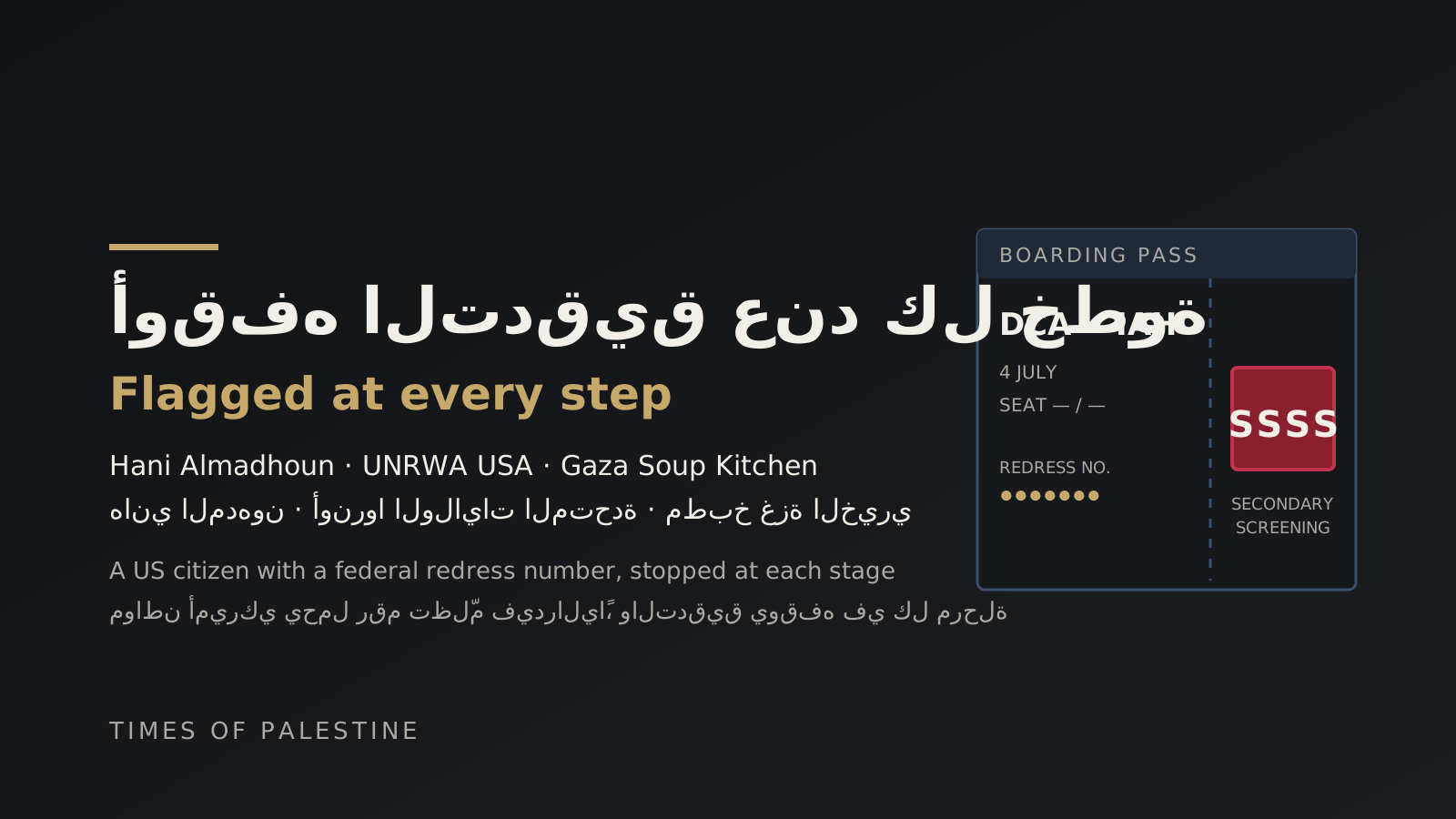
Hani Almadhoun raises money in Washington to feed people in Gaza. He is a US citizen, vice-president of philanthropy at UNRWA USA, and co-founder of the Gaza Soup Kitchen — the operation his brother Mahmoud ran out of Beit Lahia until an Israeli drone killed him thirty yards from the shelter where his seven children were waiting, in November 2024.
On 4 July, Almadhoun set out from Reagan National airport with his wife, their children and his in-laws, on a family trip to Houston. He had a Department of Homeland Security redress number attached to the reservation, sent to him by his congressional office after he asked for help.
He wrote that he walked into the terminal feeling almost light. "We thought that piece of paper meant no more of this." Instead, he wrote, "the system found us at every single step."
What he says happened in the terminal#
It began at the check-in kiosks. His wife's boarding pass slid out, then his in-laws', then his children's — paper after paper, easy, instant, normal. His own screen sat blinking. To keep the children moving, his family went ahead toward security, and he stood alone at the machine watching them get smaller down the hallway.
Thirty minutes of agent calls and special clearances produced a single boarding pass. An agent asked whether he was carrying weapons. A Transportation Security Administration officer walked him to bag screening and went through his belongings out of his sight, and an agent let slip that there had been a "panic" behind the counter, because the rest of his family had already checked their bags and moved on without him.
His family was by then deep in secondary screening. His wife texted that they had been pulled into a separate lane for what an agent called "VIP treatment" — full body scans, agents swabbing their devices, hands running over them in a pat-down.
His mother-in-law, he wrote, was searched along her waistband and had every item she had packed dug through. When the family reached Houston, the first thing she did was not unpack. She washed and sanitised everything in that suitcase, piece by piece.
Instead, the system found us at every single step.
Hani Almadhoun, in his published account of the 4 July trip
Times of Palestine has not independently verified the episode beyond Almadhoun's own published account, which he describes as one instalment in a continuing series about his travel.
Why the redress number did not help#
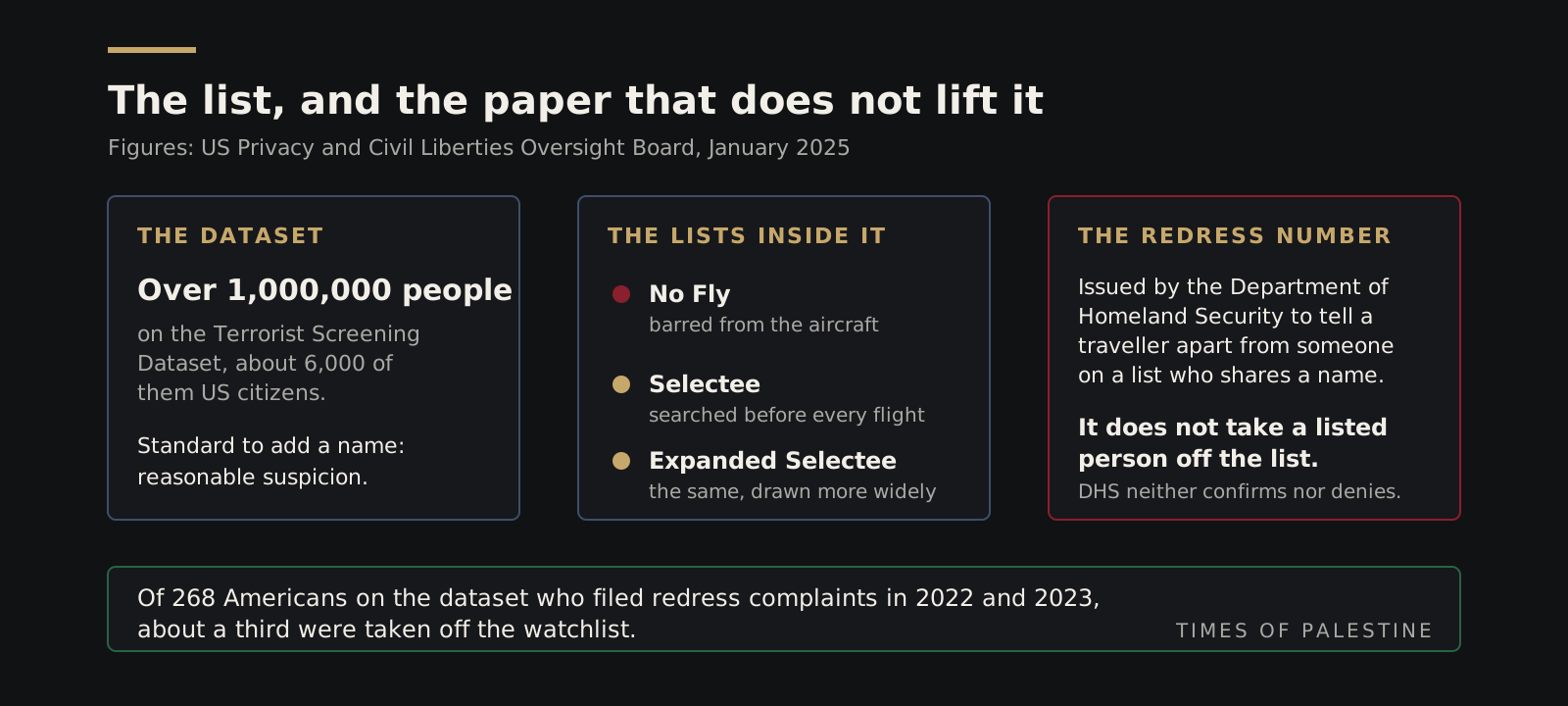
A redress number is not a clearance certificate. Homeland Security issues one through its Traveler Redress Inquiry Program to travellers repeatedly delayed because their name resembles a name on a watchlist, so that airline and screening systems can tell the two people apart.
It is a remedy for mistaken identity. It is not a mechanism for taking a listed person off a list, and the department's practice is to neither confirm nor deny whether any individual is listed at all.
That is why a redress number in a reservation and a kiosk that will not print a boarding pass are not a contradiction.
In the case the Council on American-Islamic Relations filed in August 2024, one of the two Palestinian-American plaintiffs, Mustafa Zeidan, learned he was on the No Fly List only because he had submitted a redress inquiry. The process told him he was listed; it did not take him off.
What the lists are, and who is on them#
The Privacy and Civil Liberties Oversight Board — the independent federal body that reviews counter-terrorism programmes — published its review of the watchlists in January 2025. It reported that the Terrorist Screening Dataset held more than a million people, roughly 6,000 of them Americans, and that the threshold for adding a name is reasonable suspicion: no charge, no conviction.
The board also found that people contesting their placement are hampered by having no access to the classified material used to put them there.
Its own figures show how often the government gets this wrong. Of the 268 Americans on the dataset who filed redress complaints with Homeland Security in 2022 and 2023, about a third were taken off the watchlist.
Inside the dataset sit the No Fly list, whose members are barred from boarding, and the Selectee and Expanded Selectee lists, whose members are searched before every flight but still fly. Almadhoun flew. No agency has told him which list, if any, carries his name.
The courts left this traveller the fewest remedies#
American courts have looked at watchlist redress twice and reached opposite conclusions for the two kinds of traveller. In June 2014, Judge Anna Brown of the federal district court in Oregon ruled in Latif v. Holder that the procedures offered to people on the No Fly List were wholly ineffective and violated the Fifth Amendment. The government produced a revised notice process the following April.
In March 2021 the Fourth Circuit went the other way for everyone else. In Elhady v. Kable, a unanimous panel led by Judge J. Harvie Wilkinson III held that travellers on the Selectee and Expanded Selectee lists had no due-process claim, because delays and searches at airports and the border fall within the executive's long-standing authority to regulate travel.
So the traveller who is searched but never stopped — Almadhoun's position, on his account — has the least recourse of anyone the system touches.
Twelve days later, a court in his own district drew a line#
On 16 July, twelve days after Almadhoun stood at that kiosk, US District Judge Michael Nachmanoff of the Eastern District of Virginia — the district that covers Reagan National and the Washington suburbs where Almadhoun lives — ruled that Customs and Border Protection had violated the Fourth Amendment rights of another Palestinian-American, Osama Abu Irshaid, by forensically searching his phones twice at Washington Dulles International airport in 2024.
Abu Irshaid is the executive director of American Muslims for Palestine. After a bench trial in May, the court found that a letter from Representative James Comer, and the House Oversight Committee's earlier accusations against Abu Irshaid's organisation, did not amount to the reasonable suspicion a non-routine forensic search of a US citizen's phone requires.
The same ruling declined to find that the searches were retaliation for his speech, so the First Amendment question stayed open. What it settled is narrower and still substantial: a congressman's letter and a committee's accusations are not a basis for searching an American's phone, and a court will say so.
A documented pattern, and a reason nobody will give#
Abu Irshaid was also one of two Palestinian-American citizens named when the Council on American-Islamic Relations and its Los Angeles chapter sued the FBI on 12 August 2024 over watchlist placement.
Neither he nor the other plaintiff, Mustafa Zeidan, had been charged with or convicted of a violent crime, and the complaint alleged they were listed over their advocacy on Palestine. Abu Irshaid had been on and off the list for close to fifteen years.
CAIR has been issuing travel advisories since October 2023, after reports from Palestinian, Arab and Muslim Americans questioned and delayed at US airports and border crossings, a number of whom connected the attention to that same advocacy.
One mechanism can be ruled out. Quiet Skies, the TSA programme that assigned federal air marshals to shadow selected travellers, was shut down in June 2025 by Homeland Security Secretary Kristi Noem, who said it had never stopped an attack and had been applied inconsistently. Whatever flagged Almadhoun's reservation the following summer, it was not that.
What remains is the part nobody will answer. His employer is the American charity that raises private money for UNRWA — the agency Congress barred from US funding in March 2024, which the administration cut off entirely in February 2025, and which it has since been weighing designating a foreign terrorist organisation, a step it has not taken.
UNRWA USA is a registered American charity operating lawfully. Almadhoun has never been charged with an offence, and no agency has said his screening has anything to do with his work, his brother's kitchen or his name.
That silence is the design rather than an oversight. Homeland Security, the TSA and the FBI's Terrorist Screening Center do not discuss individual screening or watchlist status, so a citizen in his position cannot be told what he is suspected of, cannot see the material, and cannot answer it. Any statement those agencies make will be added to this report.
The oversight board's recommendations point at the way out: real notice, and a real opportunity to contest an entry. Judge Nachmanoff's ruling shows a court will draw the line when someone finally gets in front of one.
Until then the cost keeps falling where it has fallen — on a man whose working life is spent raising money to feed his neighbours, and on a grandmother who landed in Houston and washed a suitcase, piece by piece, before she would open it.