The Diaspora
Israel's cash blockade takes half of every Gaza transfer
Graphic: Times of Palestine
Original Reporting
The Newsdesk gathers reporting from wire services and primary sources and rewrites every story in-house before publication. How our journalism is made →
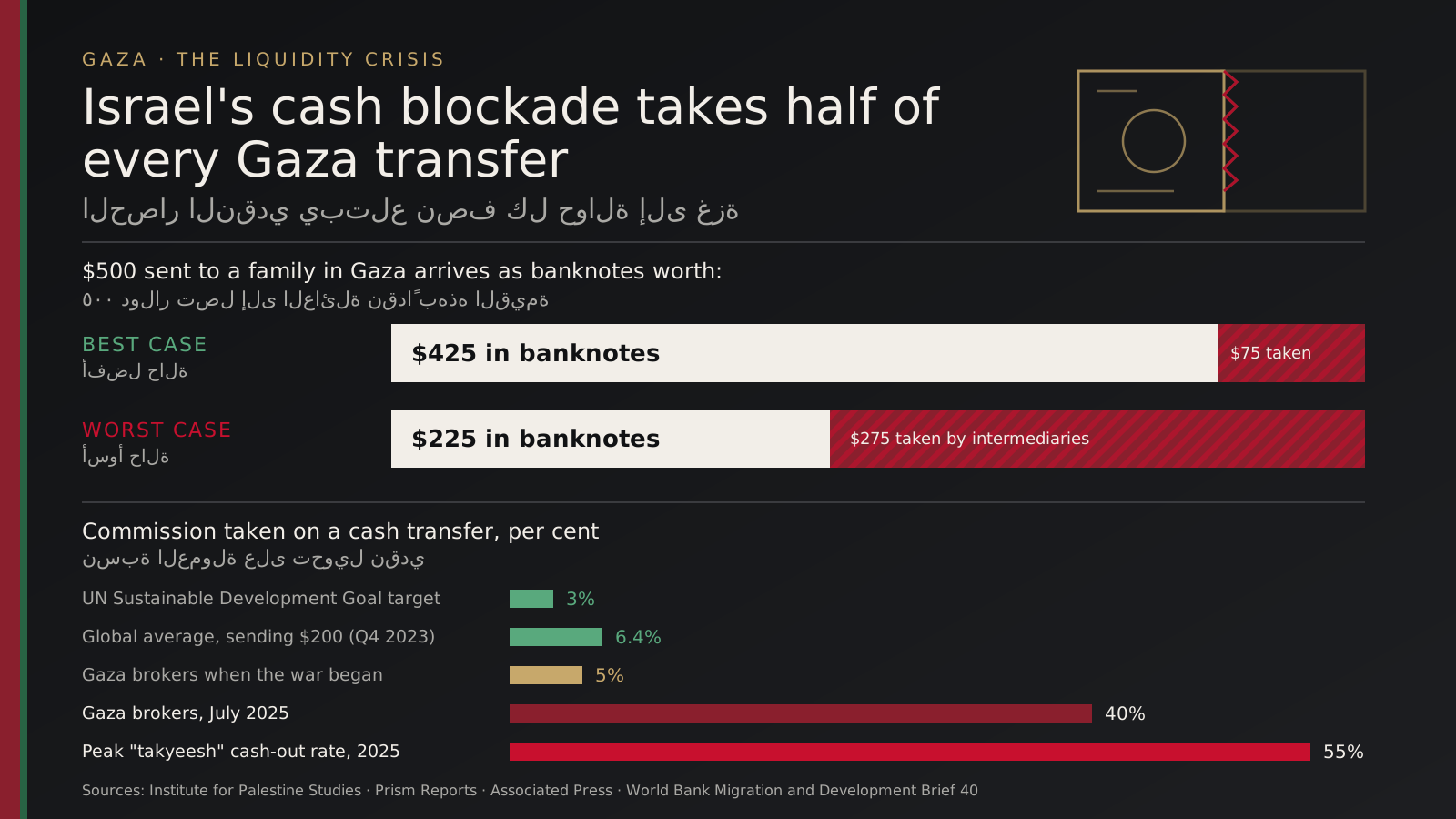
A family in Gaza that receives $500 from a relative abroad this year can expect to hold somewhere between $225 and $425 of it in banknotes. The rest goes to the intermediaries who have replaced the banking system.
The Institute for Palestine Studies, in its account of the liquidity crisis, describes two separate charges: brokers who receive a bank transfer and hand over cash take between 15 and 50 percent, and people receiving transfers from outside Gaza pay a further 15 to 20 percent simply to receive them.
The condition of the notes matters too — worn or torn bills carry lower commissions than clean ones, according to the same account.
Prism Reports, publishing in March, cited local and international reporting that cash-out commissions known as takyeesh reached as high as 55 percent during 2025, and quoted a resident describing transfers of 100 shekels that came back as 50 to 80 in cash.
Set against the global benchmark, the scale is unusual. The World Bank's Migration and Development Brief 40 put the worldwide average cost of sending $200 at 6.4 percent in the last quarter of 2023, already more than twice the UN Sustainable Development Goal target of 3 percent.
The rate has moved with the war. The Associated Press reported in July 2025 that broker commissions had been around 5 percent when the war began and had climbed to roughly 40 percent.
Mada Masr reported that rates fell to 15 to 30 percent during the short ceasefire in early 2025, then rose again after Israel resumed its offensive in March that year.
An investigation by Daraj in February 2025 documented a Palestinian Authority employee in Gaza who paid 23 percent of a 2,700-shekel salary to convert it into cash.
The cause is not in dispute among the institutions that have published on it. The Palestine Monetary Authority confirmed to Daraj that bank branches and headquarters had been destroyed by airstrikes; by October 2024, according to Mada Masr, the last working ATMs were out of service. Truthout reported in April that Israel continues to prevent the Monetary Authority from bringing banknotes into the Strip.
Banks began reopening on 16 October 2025 under the ceasefire, Reuters reported, and customers found no cash in them. Truthout reported that the Bank of Palestine's partial reopening on 19 October 2025 covered administrative transactions only.
What has grown instead is a digital workaround.
The Institute for Palestine Studies reported that after the October 2025 ceasefire some merchants began accepting payment through banking applications and digital wallets, and that the Monetary Authority allowed Gaza branches to open for customers wanting to create accounts — though weak and intermittent internet frequently defeats the apps, and people without accounts must route money through relatives or intermediaries.
On 16 January 2026, according to Truthout, the Palestinian Chambers of Commerce, the Monetary Authority, UNDP and UNICEF launched a national campaign, Cash Belzmanash, to promote electronic payments in Gaza.
The published national accounts show a household economy that has lost its main pillar and not recovered it. World Bank development indicators, compiled by TheGlobalEconomy.com, record personal remittances received in Palestine falling from $3.24 billion in 2023 to $736 million in 2024, against a peak of $4.6 billion in 2022.
The World Bank's own definition of that indicator, published in its DataBank glossary, includes compensation of employees — the wages of cross-border workers — alongside transfers between households. Most of what vanished was wages, not family gifts.
Quarterly figures from the Palestinian Central Bureau of Statistics and the Monetary Authority track the same collapse. Compensation of Palestinian workers in Israel stood at $952 million in the first quarter of 2022 and $911 million in the second quarter of 2023, the two agencies reported at the time.
In the first quarter of 2026, released on 29 June, it was $196 million — up 14 percent on the previous quarter, but roughly a fifth of pre-war levels.
Estimates of how many workers lost permits differ by outlet. The Intercept reported around 130,000 West Bank Palestinians held permits before October 2023; the Jerusalem Post, citing labour force data, put revocations at 140,000; Mondoweiss reported permits revoked for about 150,000 workers with a further 50,000 estimated to have been working without them.
Palestinian labour data reported by the Jerusalem Post this month put second-quarter unemployment at 27.9 percent, about 284,000 people.
Transfers from abroad have been volatile rather than steady.
The two agencies reported net current transfers of $387 million in the first quarter of 2025, down 25 percent; $262 million in the third quarter of 2025, down 38 percent; and $893 million in the first quarter of 2026, up 21 percent, of which $462 million went to the government sector.
In the first quarter of 2025 the agencies noted that donor-state money made up around 41 percent of all current transfers from abroad.
The releases split recipients between government and non-government, but do not isolate money sent by families from grants routed to institutions. On the published record, the size of the diaspora household lifeline cannot be separated from aid.
The channel through which any of it clears is temporary. The Times of Israel reported last month that Israel's finance minister signed a waiver permitting Israeli banks to transact with Palestinian banks until the end of 2026, and that Israeli financial institutions remain wary of continuing the correspondent relationships the West Bank economy depends on.
Cash brokering is criminalised under Palestinian law and the Monetary Authority has said it will penalise those exploiting customers, Worldcrunch reported in May 2025; no measures against brokers had been announced, and one broker said he had received no notification from any authority.
Who ultimately profits from the commissions has not been established: the head of the Gaza think tank PalThink told the Associated Press it is difficult to determine who controls economic activity in the territory.


.jpg?width=640)