The Diaspora
PLO opens diaspora council seats to appointment where voting fails
Running file Palestine Votes 2026 →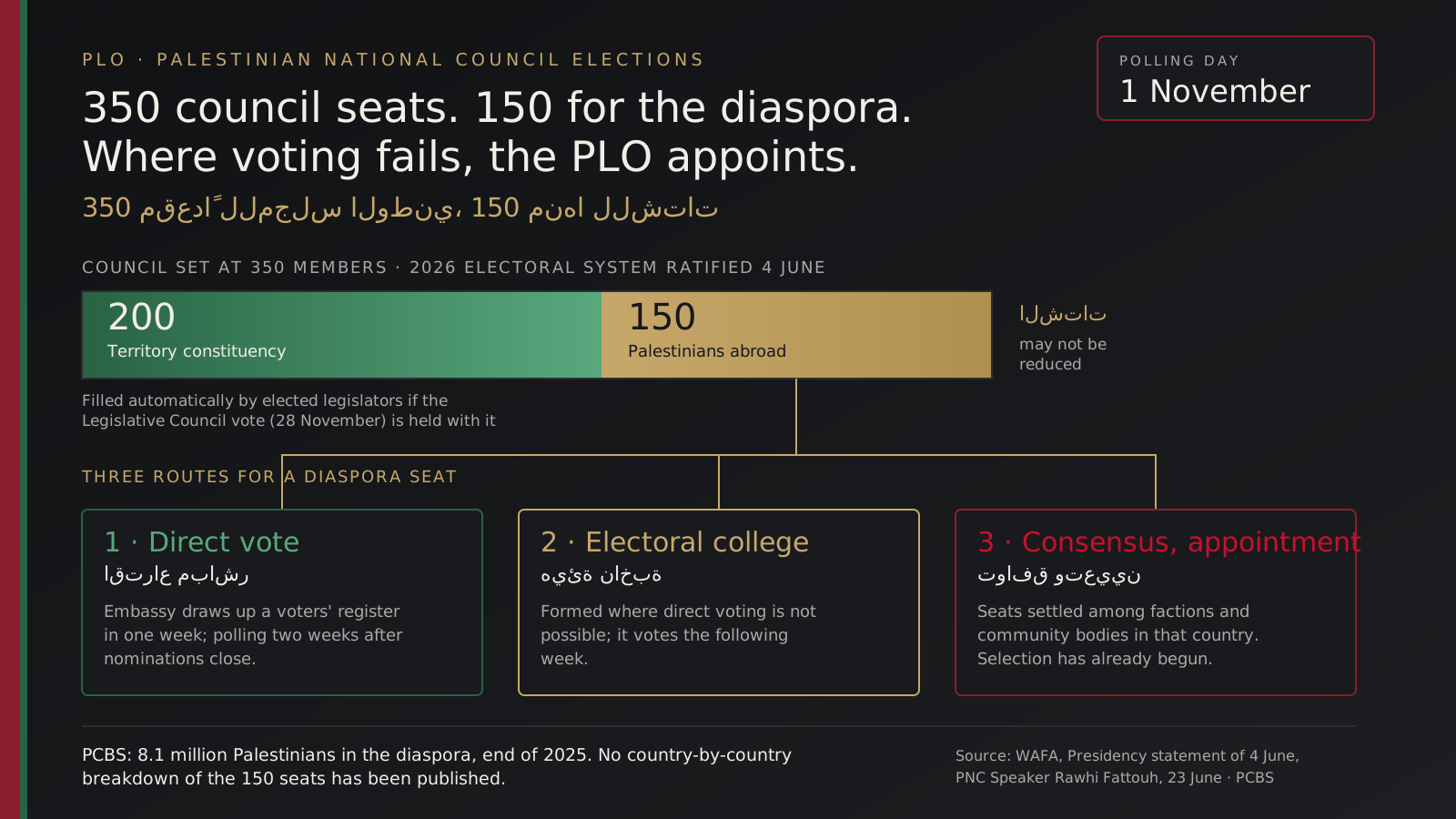
Graphic: Times of Palestine
Original Reporting
The Newsdesk gathers reporting from wire services and primary sources and rewrites every story in-house before publication. How our journalism is made →
The committee organising the Palestinian National Council vote set for 1 November has already begun selecting diaspora members rather than waiting to see whether they can be elected, according to remarks by PNC Speaker Rawhi Fattouh carried by the official Palestinian news agency WAFA on 23 June.
Fattouh said a circular had gone out in the name of the Follow-up Committee for the PNC elections, through the Ministry of Foreign Affairs and Expatriates, instructing embassies of the State of Palestine to begin preparations ahead of the arrival of delegations tasked with completing the selection of council members in diaspora countries.
He said the committee, at its most recent meeting under Vice-President Hussein al-Sheikh, had approved proceeding directly with that selection.
The sequence Fattouh described is compressed. Where a host state permits direct voting, embassies are to draw up a voters' register within one week, candidacy then opens, and polling follows two weeks after nominations close. Where direct elections are not possible, an electoral college is formed and votes the following week. Where neither is possible, seats are settled by consensus among Palestinian factions and community bodies in that country.
The rules come from the 2026 PNC electoral system, approved by the PLO Executive Committee and ratified by President Mahmoud Abbas on 4 June. According to the Presidency statement published by WAFA, the council is set at 350 members, 200 for the Palestinian territory constituency and 150 for Palestinians abroad.
Members are to be elected by secret ballot under full proportional representation with closed constituencies: the territory counts as one district, and each diaspora area where elections are held counts as a separate district.
The same statement contains the clause that now governs most of the diaspora file. Where elections cannot be held in a diaspora area, members are chosen through an electoral college or by consensus among the components of the Palestinian scene in that area, or by consensus and appointment under the system's provisions. The Presidency said the 150 diaspora seats may not be touched or reduced for any reason.
The share itself is contested. A commentary in the Lebanese paper Al-Manar asked why the diaspora allocation had been cut from 200 seats to 150, whether 150 reflects the real weight of a population that is more than half the Palestinian people, and on what criteria the seats were divided between countries.
No published breakdown of how the 150 seats are distributed among Jordan, Lebanon, Syria, the Gulf, the Americas or Europe has appeared in the Presidency's statements or in WAFA's reporting.
Inside the territories, the PNC vote has been folded into another election. The Doha Institute's Arab Center for Research and Policy Studies noted in an analysis published this month that amendments to the General Elections Law appeared in the Official Gazette on 18 June, and that a decree of 9 July scheduled legislative elections for 28 November, with a presidential vote deferred and expected in the first quarter of 2027.
The Presidency's June statement said that if Legislative Council and PNC elections are held together, the 200 territory seats are filled automatically by the elected legislators. On that reading, the diaspora ballot is the only PNC-specific vote there is.
The numbers involved are large and imprecise. The Palestinian Central Bureau of Statistics put the world Palestinian population at 15.5 million at the end of 2025, with 8.1 million in the diaspora, of them 6.8 million in Arab countries, in its Nakba anniversary release of 12 May.
Its own end-of-2025 status brief gives the diaspora figure as 8.82 million, including 6.82 million in Arab states. The bureau has not reconciled the two.
Much of that population is not in a position to walk into an embassy. UNRWA recorded 487,869 registered Palestine refugees in Lebanon as of 30 June 2025 but estimated that around 222,000 Palestinians actually reside there, and reported that Palestinian refugees from Syria in Lebanon have had no access to legal residency since May 2024, with over 80 per cent of the refugee population living below the poverty line.
In Syria, UNRWA said some 438,000 of the 560,000 refugees registered before 2011 remain, 40 per cent of them internally displaced.
Whether Jordan, Lebanon or Syria will allow Palestinian embassies to register voters and open polling stations is not on the public record. No statement from any of the three governments setting out a position has been published.
Writing for the Carnegie Endowment, Nathan Brown and Zaha Hassan argued that it is difficult to imagine states such as Jordan cooperating with such a vote, or Palestinians holding their citizenship risking their legal status to take part.
Hamas said on 20 June that national consensus must precede the PNC elections, called for an urgent national meeting of all factions, and rejected what it called unilateral decision-making over the process and its outcomes. A group of factions followed on 28 June with a demand that Abbas convene a comprehensive dialogue and reconsider the electoral mechanism.
The Central Elections Commission, which is administering the process, opened online registration for new voters aged 17 and above on 28 July, and Al Jazeera reported on 11 August that field registration would begin on 15 August for five days. Those announcements concern the roll inside the West Bank and Gaza. No parallel registration figures for any diaspora country have been published.
Eleven weeks remain before 1 November. It is not known which communities will be given ballots, which will be handed an electoral college, and which will receive a list of names agreed in a room.