Politics & Diplomacy
Kushner and Netanyahu put an American general over Gaza's disarmament
Running file The Gaza Roadmap →
Image credit: Maj. Gen. Jasper Jeffers III, commander of US Special Operations Command Central — William J. Seifert / US Army via SOCCENT · License
Original Reporting
The Newsdesk gathers reporting from wire services and primary sources and rewrites every story in-house before publication. How our journalism is made →
The plan Palestinians were asked to sign said their weapons would go to Palestinian hands. After four hours in Jerusalem on Monday, an American general stands where those hands were.
Jared Kushner met Prime Minister Benjamin Netanyahu with the Board of Peace envoys Nickolay Mladenov and Tony Blair, the Times of Israel reported, a day after Kushner sat with Hamas's leader Khalil al-Hayya in Egypt.
The two men agreed, NBC News reported, citing a source with knowledge of the meeting, that an American general should oversee the demilitarisation of the Gaza Strip.
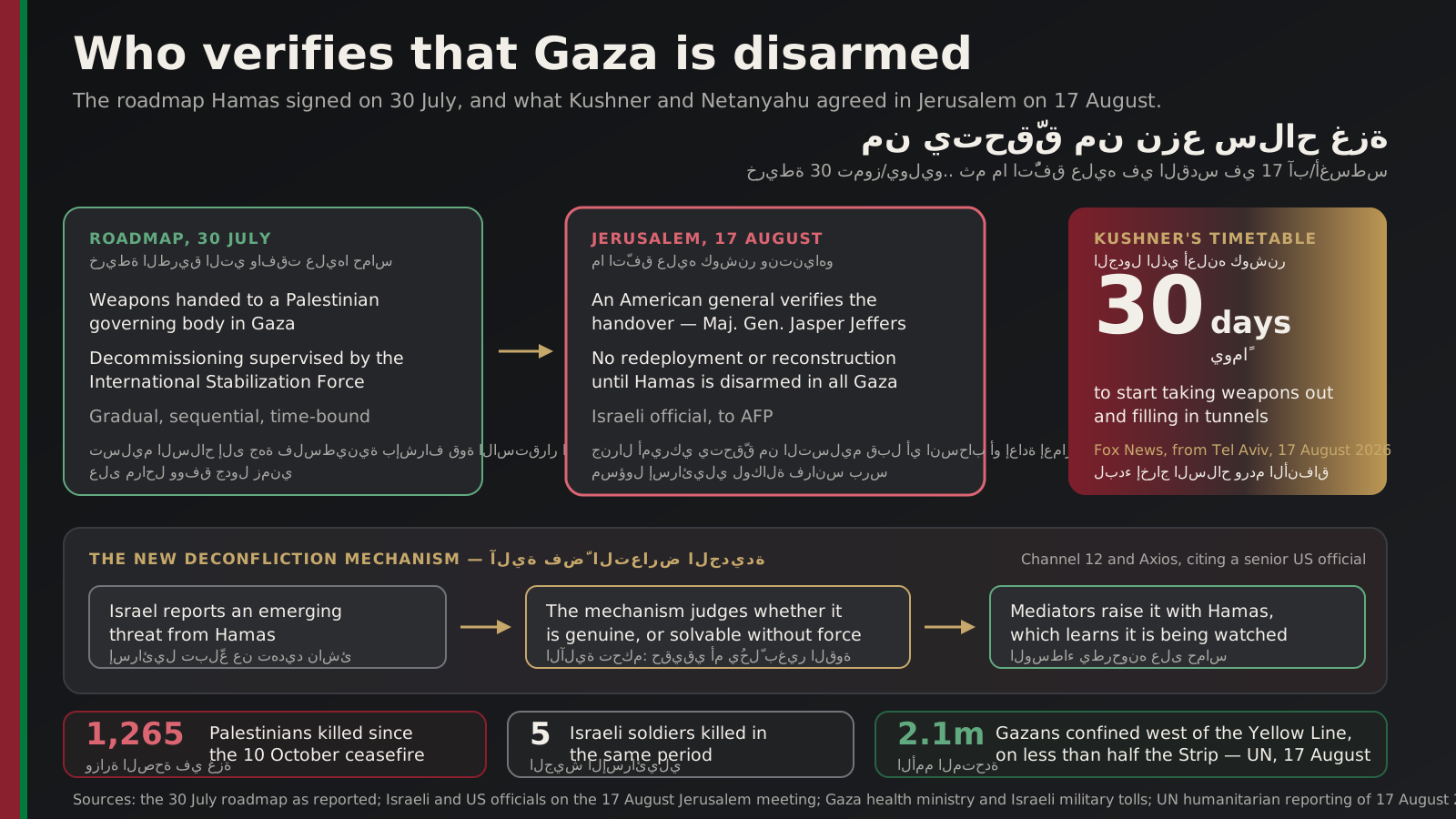
An Israeli official put it more precisely to Agence France-Presse: the first step towards demilitarisation would be for Hamas to hand over all of its weapons for decommissioning "under the supervision of an American general."
The general is not hypothetical. Al-Monitor identified him as Major General Jasper Jeffers, the commander of United States Special Operations Command Central who took charge of the International Stabilization Force in January.
The custody question, and who answers it#
The roadmap Hamas accepted on 30 July answered the same question differently.
Under that text, as Reuters reported its terms, Palestinian factions would disarm in a "gradual, sequential, and time-bound manner", and the surrendered weapons would pass to a Palestinian body — the committee of technocrats formed to administer Gaza — with the stabilization force supervising the decommissioning.
Jeffers commands that force, so the American role is not new. What changed on Monday is the order of the sentence. Verification by an American officer now comes before any Israeli movement, rather than alongside a handover to Palestinians.
Netanyahu had made no secret of his objection to the Palestinian half of it. A senior Israeli official summarised his position after the meeting: "The agreement was that there would be no redeployment or reconstruction until Hamas is disarmed throughout Gaza."
An official of the Board of Peace, the body President Trump chairs, described the destination of the weapons and the limit of the bargain in the same breath. Every weapon collected, the official said, "will be fully decommissioned so it cannot be used again" — and Israel "retains its full right of self-defence."
Thirty days, announced on television#
Kushner then gave Gaza a timetable, in an interview with Fox News from Tel Aviv.
"We could be seeing progress… in as little as 30 days, hopefully starting to take some of the weapons out, and hopefully, you know, filling in some of the tunnels as well," he said.
What he asked of Israel is smaller than what he promised. Kushner told Netanyahu that Washington wants Israel to take "small steps" in Gaza to test whether Hamas's commitment to begin disarming is genuine, Axios reported, citing an American official, and described a conversation held in deep Israeli scepticism.
Netanyahu's office confirmed two working groups: one on disarmament and demilitarisation, one on Gaza's humanitarian condition — sanitation, water and public health.
The timing sits inside an Israeli election. Israelis vote on 27 October, Likud held its primary on Monday with turnout at 53 per cent, and Al-Monitor noted that Netanyahu has grown more willing this year to defy Trump outright.
Who decides what counts as an imminent threat#
The most consequential thing agreed in Jerusalem was not the general. It was a mechanism for the word Israel uses before it strikes.
Channel 12, citing a senior American official, reported that Netanyahu and Kushner agreed to establish a deconfliction mechanism to assess whether Israeli claims of emerging threats in Gaza are genuine, or could be resolved by means short of force.
Kushner's framing, according to the same account, granted the principle and narrowed it: the Board of Peace supports Israel's right to act against imminent threats from Hamas, but Israel should not define "imminent threats" too broadly.
That phrase carries the ceasefire's death toll. Gaza's health ministry counts at least 1,265 Palestinians killed since the ceasefire took effect on 10 October, almost all of them in strikes Israel has justified as pre-emption against emerging threats. The Israeli military has reported five soldiers killed in the same period.
Axios described how the mechanism is meant to work: Israel reports a suspected emerging threat, the mechanism raises it with Hamas through the mediators, and Hamas learns it is being watched.
For a family in Gaza City the arrangement is an improvement on nothing and less than a protection. It slows a strike by adding a conversation. It does not give any Palestinian a veto over the judgement, and no Palestinian sits in the room where the judgement is made.
A model that sidelines Palestinians guarantees long-term resistance, instability, and blame.
Carol Daniel-Kasbari, Quincy Institute for Responsible Statecraft, December 2025
Writing for the Quincy Institute in December, Daniel-Kasbari warned that the architecture built by Security Council Resolution 2803 risks becoming "Oslo with helmets" — a securitised interim regime run by outside powers that settles nothing.
The war Washington has not ended#
The administration extending its authority over Gaza spent Monday failing to close the war it started elsewhere.
The 60-day window opened by the memorandum of understanding signed with Iran in mid-June expired on Monday with no agreement, and the naval blockade of Iran's ports still in place.
Iran's foreign ministry spokesman Esmail Baghaei said Tehran had reached an understanding with Oman on "the map of the transit route" through the Strait of Hormuz. Parliament speaker Mohammad Bagher Ghalibaf said the strait stays closed until Washington complies with the memorandum it signed.
Trump answered the mediator by threatening it. "If Oman gets in the way, we'll bomb the s--- out of them," he told Fox News, in remarks reported by NBC News and the Washington Post. On Tuesday he posted an image on Truth Social showing the Strait of Hormuz as American territory, with no caption.
Senator Tim Kaine of Virginia said on Monday he would file a war powers resolution barring military action against Oman. "President Trump is increasingly deranged in his one-man campaign to threaten and initiate wars all over the globe," Kaine said, noting that the United States holds a free trade agreement with the country the president had just threatened.
Kaine cannot file until the Senate returns on 14 September. The House comes back on 31 August for a single week. Congress has tried this before: the House passed Representative Pramila Jayapal's Iran war powers resolution on 23 July by 214 votes to 208, with four Republicans crossing over, and a Senate companion failed 47 to 49.
Al Jazeera counted 17 American service members killed since the war began at the end of February, and at least 420 wounded.
The West Bank answer was words#
Washington's response to the settler siege at Qusra, south of Nablus, stayed verbal.
United Nations teams reached the besieged families on Monday, UN News reported, delivering water, food and medicine, with three families still surrounded by settlers and Israeli forces. Municipal workers repairing water and electricity lines were attacked by settlers, and some were detained by Israeli forces.
House Democratic leader Hakeem Jeffries called the siege unacceptable and said the administration "must compel the Israeli government to protect the lives, property and livelihood of innocent Palestinian civilians."
Compulsion is the one instrument nobody in Washington has picked up. The settler sanctions of the previous administration remain revoked, and the letter from senators asking Secretary of State Marco Rubio to restore them is still unanswered.
The United Nations reported the scale underneath the diplomacy on Monday: Gaza's 2.1 million people are confined west of the Yellow Line on less than half the Strip, fewer than 30,000 tents have been bought against a need of 80,000 to 130,000, and under 40 per cent of the four billion dollars sought for humanitarian work has arrived.
Palestinians are left holding two American clocks that do not agree. One runs 30 days to the start of disarmament, announced on Fox News. The other runs to 14 September, when the Senate returns to argue about a president's power to bomb a country he needs.
The general who will certify that Gaza is safe answers to the first clock, and to nobody Palestinian at all.