The Diaspora
Madison stitchers hang Hebron women's tatreez beside their own
.jpg?width=640)
Photo: Ma'moun Othman / Wikimedia Commons, CC BY-SA 4.0 · License
Original Reporting
The Newsdesk gathers reporting from wire services and primary sources and rewrites every story in-house before publication. How our journalism is made →
For six weeks this summer, a contemporary art space in Madison, Wisconsin has carried the needlework of two communities on the same walls. One is a stitching circle that meets in a city of about 270,000 people on an isthmus in the American Midwest. The other is a cooperative of Palestinian women in the hills west of Hebron, for whom the same thread is also the household income.
"Threading Solidarity: Tatreez from Teejop to Palestine" opened at Arts + Literature Laboratory on 7 July and comes down on 29 August. The gallery, on South Livingston Street, presents it as a group exhibition of work by the Teejop Tatreez Community and Women In Hebron: A Cooperative, organised by LAB^4, the institution's community curation project.
The pairing is the whole argument. In its description of the show, the gallery calls tatreez a communal, matrilineal practice once taught to Palestinian girls as young as six, now carried forward by first- and second-generation Palestinians and their neighbours in Madison. The Hebron collective is entirely Palestinian women. The Madison one, the gallery notes, is multi-ethnic and multi-generational.
Teejop is the Ho-Chunk name for the four-lake isthmus the city was built on, and Madison's own government reached for the word this month: the city opened its Teejop Community Art Project, honouring Ho-Chunk history, on 9 August. A Palestinian embroidery show borrowing the same name makes a quiet civic point about whose land anybody is standing on.
The woman who carried the thread to Wisconsin#
The Madison end of this began with a visit. In June 2024, the Cap Times reported that Laila Hasan — a Palestinian textile artist born in 1961, and a founder and designer for Women in Hebron — spent a Sunday at the Madison Quaker Meeting House showing the cooperative's work, hosted by the Madison-Rafah Sister City Project with sponsorship from Palestine Partners.
She told the paper that the instruction which set the whole enterprise going came from her mother.
If you want to be strong, you have to be more independent.
Laila Hasan, recalling her mother's advice, to the Cap Times
"Tatreez is now a part of my heart," she said in the same interview. She was in Wisconsin while Gaza was under bombardment, and she told the paper that she was glad to be there but unable to enjoy the time: "I keep thinking about my people."
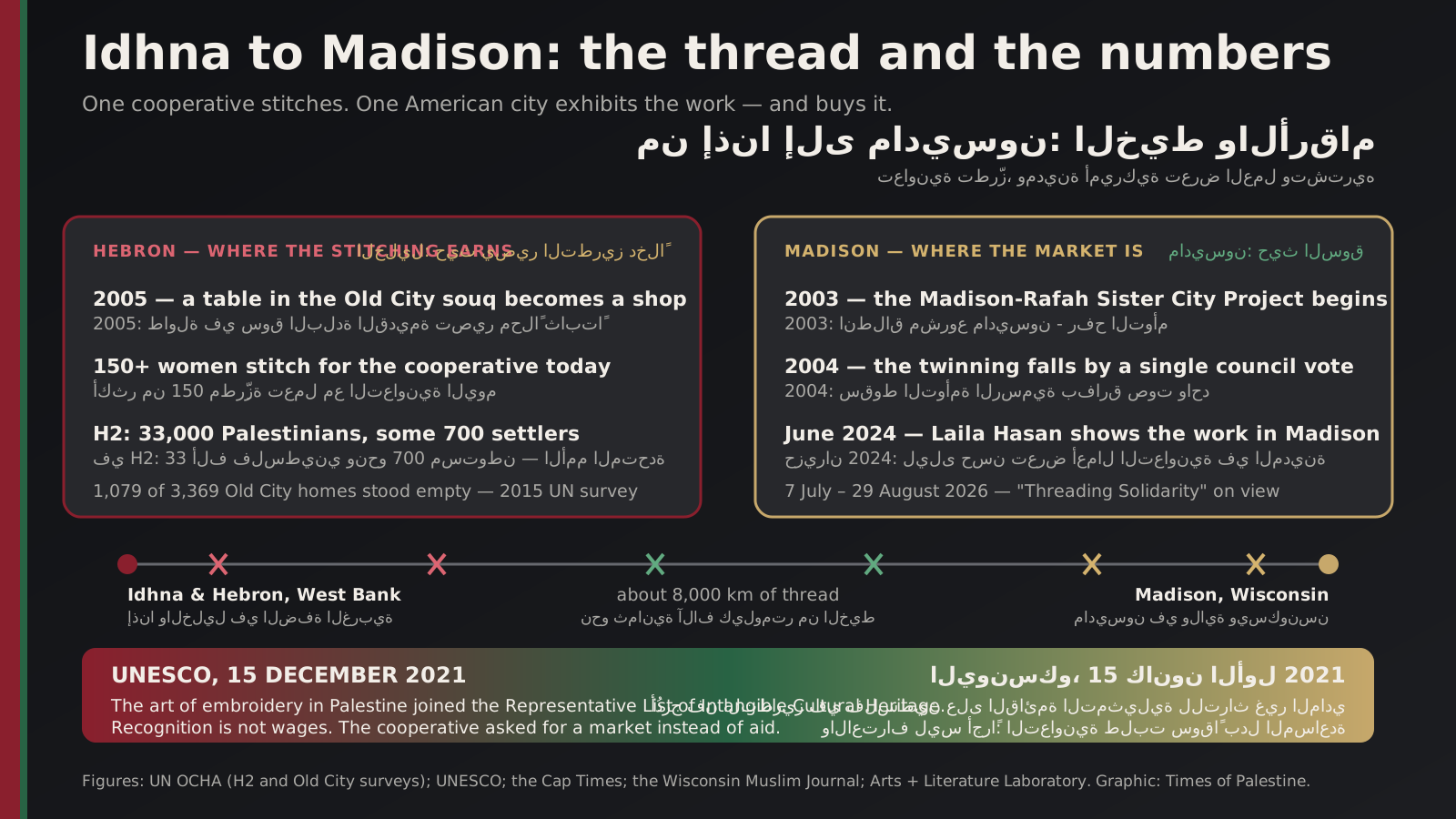
Women in Hebron began in 2005 as a table on the main thoroughfare of the Old City souq, and grew into a permanent shop there, a short walk from the Ibrahimi Mosque. It operates under the Idhna Cooperative Association for Embroidery and Handicrafts, named for the town of Idhna south-west of Hebron, and the Cap Times reported that it now works with more than 150 stitchers.
What the cooperative wants is unusually specific, and it is the reason a gallery wall in Wisconsin matters to a village in the Hebron hills. It wants to depend less on humanitarian aid. Aid can be switched off by a foreign parliament in an afternoon; a customer who buys a cushion cover cannot be lobbied into cancelling the women's wages.
The same Cap Times report set that ambition against Israel's suspension of more than 110,000 Palestinian work permits, which stripped families across the West Bank of their main earnings.
A sealed old city, and the arithmetic of a shop#
The shop's address explains the stakes. It stands in H2, the part of central Hebron kept under Israeli military control, where the United Nations humanitarian office recorded some 33,000 Palestinians living alongside roughly 700 Israeli settlers, and reported that more than 20 per cent of them, about 7,000 people, live in access-restricted areas.
The same UN office reported that a 2015 survey of what it defines as Hebron's Old City found 1,079 of 3,369 housing units empty — close to a third of the neighbourhood gone. Shuhada Street, once the commercial spine of the city, has been closed to Palestinian cars since 1994 and to most Palestinian pedestrians since 2001.
Trade in that quarter is therefore not an ordinary business proposition. A women's cooperative that keeps a shop open in the middle of it, and gets its work onto walls and into homes eight thousand kilometres away, is running an economy against a closure.
Twenty-three years of a sister city nobody would make official#
The Madison network behind the exhibition has a longer record than the show suggests. The Madison-Rafah Sister City Project was founded in 2003 by a small group of city residents who wanted person-to-person ties with Rafah. Its first project was to be recognised, and it lost.
The Wisconsin Muslim Journal reported that when the city council voted in 2004, a majority of the alders present backed the twinning, but the proposal fell by one vote under a council rule, with Mayor Dave Cieslewicz having said he would veto it. The group kept going as an unofficial sister city, took 501(c)(3) nonprofit status, and stayed.
What it built in those years is a list of small, finished things: reconstructed wells, water systems for schools, a playground in Tal al-Sultan, medical care for injured children in Gaza, the Samira Project for mental health support, back-to-school backpacks, and an annual commemoration for Rachel Corrie, the American volunteer an Israeli army bulldozer crushed in Rafah in 2003.
Alongside all of it runs the least glamorous activity of the lot — selling Palestinian crafts and olive oil at community festivals, which is how the Hebron cooperative's jewellery and embroidery reach Wisconsin buyers at all.
The same outlet reported that in February 2024 the group launched a year-long "Grassroots to Gaza" appeal with a $5,000 goal, more than half of it raised before the launch. Barb Olson, a co-founder of the project, said the terms were absolute: "One hundred percent of all proceeds will go immediately to MECA for urgently needed food, shelter, water and medical supplies," referring to the Middle East Children's Alliance.
Cassandra Dixon, the Madison carpenter who founded Palestine Partners and who runs the online store that carries the cooperative's goods, has been among the group's steadiest voices.
What the stitches record#
The exhibition's own text reads the craft as an archive. Earlier centuries of the tatreez library are full of motifs named for the cypress tree and the star; after 1948 and the Nakba, the gallery notes, the catalogue grew motifs called "The Bombing" and "Missile". Its summary of that shift is blunt: "Stitching became resistance in the face of an occupier who sought to erase Palestinian culture."
Institutions outside Palestine now agree in their own language. On 15 December 2021, at the 16th session of its intergovernmental committee, UNESCO inscribed the art of embroidery in Palestine — its practices, skills, knowledge and rituals — on the Representative List of the Intangible Cultural Heritage of Humanity, an application the Palestinian culture ministry, then led by Atef Abu Saif, worked on for more than two years.
None of that recognition pays a woman in Idhna for an evening's work. A market does. The modest achievement of the people who hung this show is that they built both halves at once: a wall where Palestinian craft is read as art and history, and a till through which somebody actually gets paid.
The exhibition is free, and open Tuesday to Friday and Saturday afternoons until 29 August.