Real Lives
Salim Abu-Rabia showed a second language can teach the first
Graphic: Times of Palestine
Original Reporting
The Newsdesk gathers reporting from wire services and primary sources and rewrites every story in-house before publication. How our journalism is made →
Salim Abu-Rabia has spent three decades on a question that sounds simple and is not. What happens in a child's head when the language they read is not quite the language they speak?
He is a professor of education at the University of Haifa, where he has taught since 1994, and his answers have travelled further than work on Arabic literacy usually does. His Google Scholar profile listed more than 6,300 citations at the time of writing.
The finding he is best known for reversed something school systems had treated as obvious.
The transfer that runs backwards#
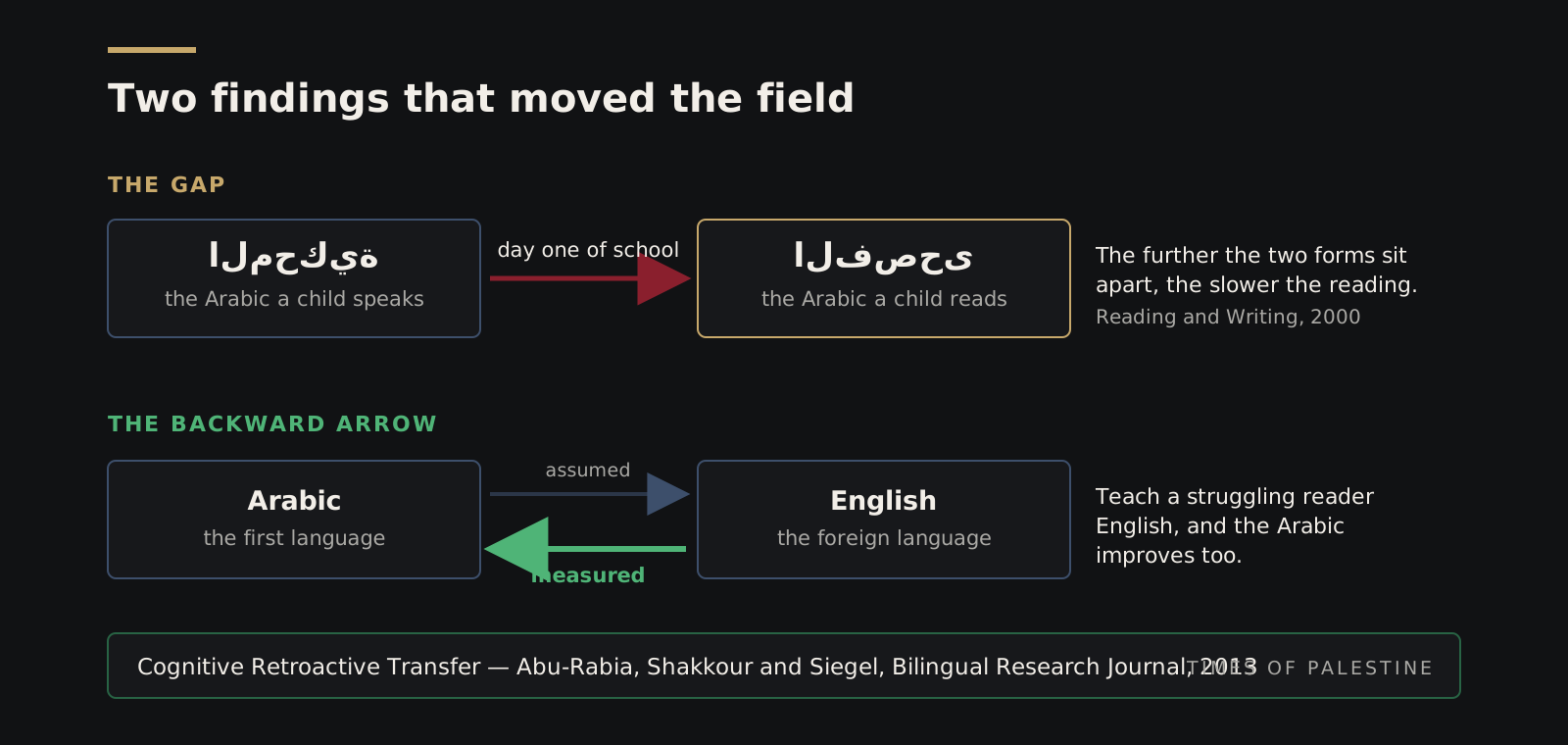
Language teaching has long assumed the mother tongue feeds the foreign one: a strong reader in Arabic will make a better reader in English. Abu-Rabia's work established that the traffic also runs the other way.
He named it Cognitive Retroactive Transfer. With Wael Shakkour and the Canadian reading researcher Linda Siegel, he set out the case in the Bilingual Research Journal in 2013, working with bilingual Arabic-English readers. Teach a struggling reader English, and the gains reappear in their Arabic.
He and Shakkour extended it the following year to trilingual Arabic-Hebrew-English learners in the Open Journal of Modern Linguistics, testing orthographic knowledge, phonological awareness, morphological and syntactic awareness, reading accuracy and comprehension in all three languages.
In 2022, with Liat Feder in the Journal of Learning Disabilities, he found the same effect running from English as a foreign language back into Hebrew as a first language. Researchers in Morocco have since put the hypothesis to university readers of their own.
Teach a struggling reader English, and the Arabic improves too.
The finding behind Cognitive Retroactive Transfer
For a child failing in Arabic, the practical consequence is unusual and hopeful. The help may arrive through a different lesson than the one where the trouble shows.
The second language a child meets in their own tongue#
Arabic asks something of its children that English does not ask of its own. The Arabic a child speaks at home and the Arabic waiting in a book on the first day of school are not the same language.
Abu-Rabia measured what that distance costs. In Reading and Writing in 2000 he reported that exposure to literary Arabic improves reading comprehension in a diglossic situation — an argument for putting the written form in front of children long before the alphabet does its work.
Later research followed the logic further. The effect tracks the lexical distance between the spoken and standard forms: words identical in both are read more accurately and faster than words that live only in the standard, and the gap holds across grade levels.
The reframing matters beyond the classroom. An Arabic-speaking child who reads slowly is not necessarily a poor reader, and the field has since moved toward treating diglossia as a condition to teach around rather than a deficit to diagnose.
What the vowels are doing there#
Arabic writes its short vowels as optional marks and expects readers to manage without them. Abu-Rabia asked what they are for.
His 2001 paper in Reading and Writing, drawing on both Arabic and Hebrew, set out the role of vowels in reading Semitic scripts. He followed it in the Journal of Research in Reading with work on reading in a root-based morphology language in 2002, and on morphological structures in visual word recognition in 2004.
The through-line is a refusal to treat Arabic as English with different letters. A script built on roots and patterns, whose vowels appear and vanish, needs a reading science of its own — and much of that science now cites him.
Motivation, measured where the politics are hard#
His second-language work runs straight into the social conditions around it, and he measured those rather than assuming them.
In the International Journal of Applied Linguistics in 1996 he compared eighth-graders in three settings: Arab students in Israel learning Hebrew, Jewish students in Israel learning English, and Arab students in Canada learning English. Motivation was instrumental rather than integrative in all three, and instrumental motivation was the strongest single predictor of reading comprehension.
Students also understood stories from their own culture better, whatever language the story was written in. His conclusion was a curricular one: Hebrew for Arab children should be taught through material drawn from Arab culture.
He then built the argument into a model. Writing in Race Ethnicity and Education in 1999, he proposed a second-language model of learning for what he called problematic social contexts — settings where contact between the groups is limited and the power between them unequal, and where the standard motivation models therefore do not describe what is happening in the classroom.
Reading difficulty, in the right language#
The applied end of the work is diagnosis. A child who struggles with Arabic has usually been assessed with instruments designed for English.
Abu-Rabia has published on word recognition among reading-disabled and typical readers in Arabic, and returned to the question in 2024 in the journal Dyslexia, evaluating the multiple-deficit hypothesis among dyslexic Arabic-speaking children.
He is still at it. In 2025, with Laila Haddad-Najjar in the International Journal of Bilingualism, he reported an intervention study tracing phonology, morphology, syntax and orthography from Arabic into English among ninth-graders — the transfer question again, this time in a form a teacher can be handed.
Three decades on, the work amounts to an argument made by measurement. The reading of Arabic-speaking children is worth explaining on its own terms, and a language a child is still learning can quietly teach them the one they already have.

.jpg?width=640)

