Economy & Aid
Israel's army uproots olive groves as Palestinian harvest nears
Graphic: Times of Palestine
Original Reporting
The Newsdesk gathers reporting from wire services and primary sources and rewrites every story in-house before publication. How our journalism is made →
Four weeks before the 2026 olive harvest opens in the occupied West Bank, the destruction of Palestinian olive trees is running through two separate channels: attacks by Israeli settlers, and uprooting carried out by the Israeli military and the Civil Administration under written orders.
The Times of Israel reported in May that the army appeared to have sharply accelerated the uprooting of olive trees, citing security grounds.
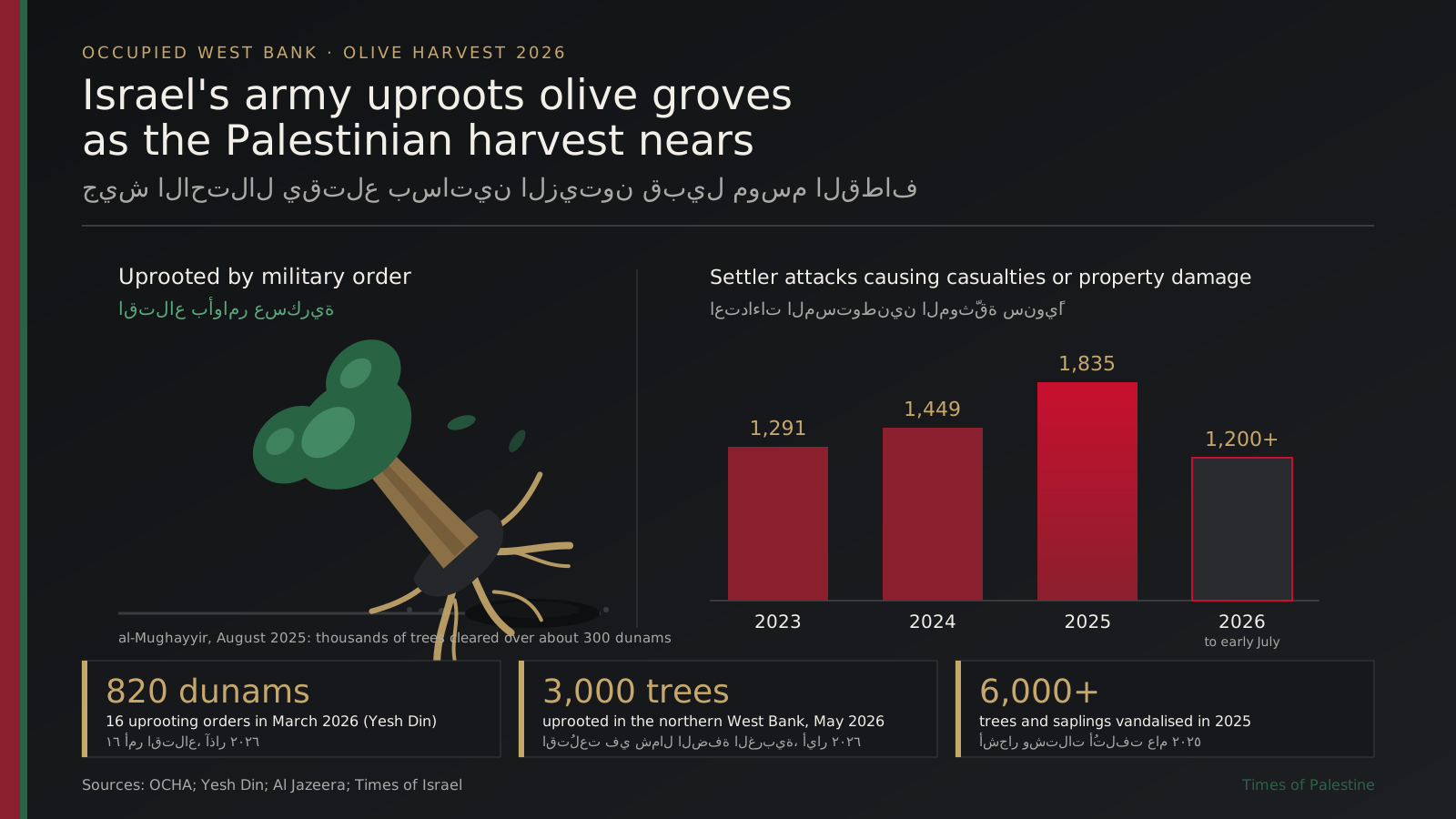
According to that report, the Israeli rights group Yesh Din collected at least 16 separate uprooting orders issued in different parts of the West Bank during March 2026 alone, covering roughly 820 dunams — about 200 acres — of various plots, at least some of them private Palestinian land.
The orders are classified as "security measures" and permit trees to be removed or relocated. In every case described in that report, the trees were uprooted and not replanted elsewhere. How many of the March orders have been executed is not publicly known.
“Yesh Din and the Association for Civil Rights in Israel asked the Military Advocate General to open a criminal investigation. Answering a Yesh Din petition, the army told the High Court the trees had constituted”
Separately, Finance Minister Bezalel Smotrich announced in May that Israel had uprooted some 3,000 trees planted by Palestinians in the northern West Bank, which he said stood on state land. Yesh Din, responding, said the state was cutting down thousands of olive trees "just because they belong to Palestinians," damaging the income of thousands of people.
The practice took shape in August 2025 at al-Mughayyir, east of Ramallah, where the army uprooted thousands of olive trees across about 300 dunams after a shooting attack by a village resident.
The military confirmed the operation and denied it was collective punishment, saying the Central Command chief acted "in accordance with the law." Yesh Din and the Association for Civil Rights in Israel asked the Military Advocate General to open a criminal investigation.
Answering a Yesh Din petition, the army told the High Court the trees had constituted "a security weak point" exploited to harm civilians and security forces.
Human Rights Watch reported in August that OCHA recorded at least 43 settler attacks causing casualties or property damage in al-Mughayyir during 2025 alone — as many as in the previous two years combined.
The volume of attacks entering this season is higher than any on record. OCHA reported that settler attacks causing casualties or property damage passed 1,000 by 11 June 2026, affecting more than 230 communities, and exceeded 1,200 across over 240 communities by early July, an average of about six a day. Al Jazeera, compiling OCHA figures, counted 1,291 such attacks in 2023, 1,449 in 2024 and 1,835 in 2025.
Last season set the benchmark. OCHA documented about 150 harvest-related attacks between 1 October and 3 November 2025, with more than 140 Palestinians injured and over 4,200 trees and saplings vandalised across 77 villages. October 2025 was the most violent month since OCHA began counting in 2006, with 264 settler attacks.
Yesh Din, reviewing the full season, counted 178 harvest-related attacks between 1 October and 30 November, spread across 88 towns and villages — the widest geographic spread since 2020 — and put the number of trees and saplings vandalised in 2025 at more than 6,000, against about 3,700 the previous year.
Access is governed by a permit system.
OCHA's April 2026 review of movement in the West Bank found that farmers reaching land trapped between the separation barrier and the Green Line must cross roughly 62 agricultural gates, most of which stay closed year-round; during the 2025 harvest, 74 per cent opened for a limited number of days.
A further 98 communities across nine governorates must apply for "prior coordination" from the military to reach farmland on the edges of settlements, granted twice a year.
Yesh Din's assessment is that coordination in 2025 was granted late in the season and for one or two days, too short to harvest and late enough that fruit rots or is stolen. The organisation described the mechanism, presented by the military as protection, as an effective tool for preventing the harvest.
In November, the army declared a closed military zone around Burin hours before Israeli volunteers were due to arrive, and police stopped seven buses of activists near Ariel, the Times of Israel reported.
Estimates of what the crop is worth diverge.
A 2024 study in Culture, Agriculture, Food and Environment put olives at 4.6 per cent of GDP, citing World Bank data, and the livelihood of 80,000 to 100,000 families; IFPRI wrote in November 2025 that olive products contributed around 5 per cent of GDP; a UN-sourced fact sheet circulated on ReliefWeb puts the contribution near 14 per cent.
Palestinian census figures from 2021 show olives account for 85 per cent of the area planted with horticultural trees.
The Palestinian Agriculture Ministry, quoted by Al Jazeera in October 2025, put West Bank agricultural losses at about $70 million from January to mid-October, with 5,353 farmers directly affected, a 17 per cent rise on the previous year.
The ministry's spokesman, Mahmoud Fatafta, told Al-Araby Al-Jadeed that no compensation is paid because liability rests with whoever caused the damage, and that about $11 million in aid reached some 390 affected farmers, with $6 million more planned.
Abbas Milhem, director of the Palestinian Farmers Union, told the same outlet that farmers who once worked close to 500 dunams now cultivate only 50.
Yesh Din's law-enforcement data, published in February 2026, found that 93.6 per cent of police investigations into ideologically motivated offences by Israelis against Palestinians since 2005 closed without an indictment, and 3 per cent ended in conviction. A donor statement issued in November said soldiers systematically fail to detain suspects and hand them to police.
Prime Minister Benjamin Netanyahu, in a Fox News interview cited by a Jerusalem Post column in January, attributed the violence to "around 70 kids from broken homes."
The Yesh Din petition over uprooting near Ya'bad remains before the High Court, and the land seized around al-Mughayyir under military order stays closed to its owners.