Politics & Diplomacy
Twenty-one lawmakers demand Rubio restore West Bank settler sanctions
Graphic: Times of Palestine
Original Reporting
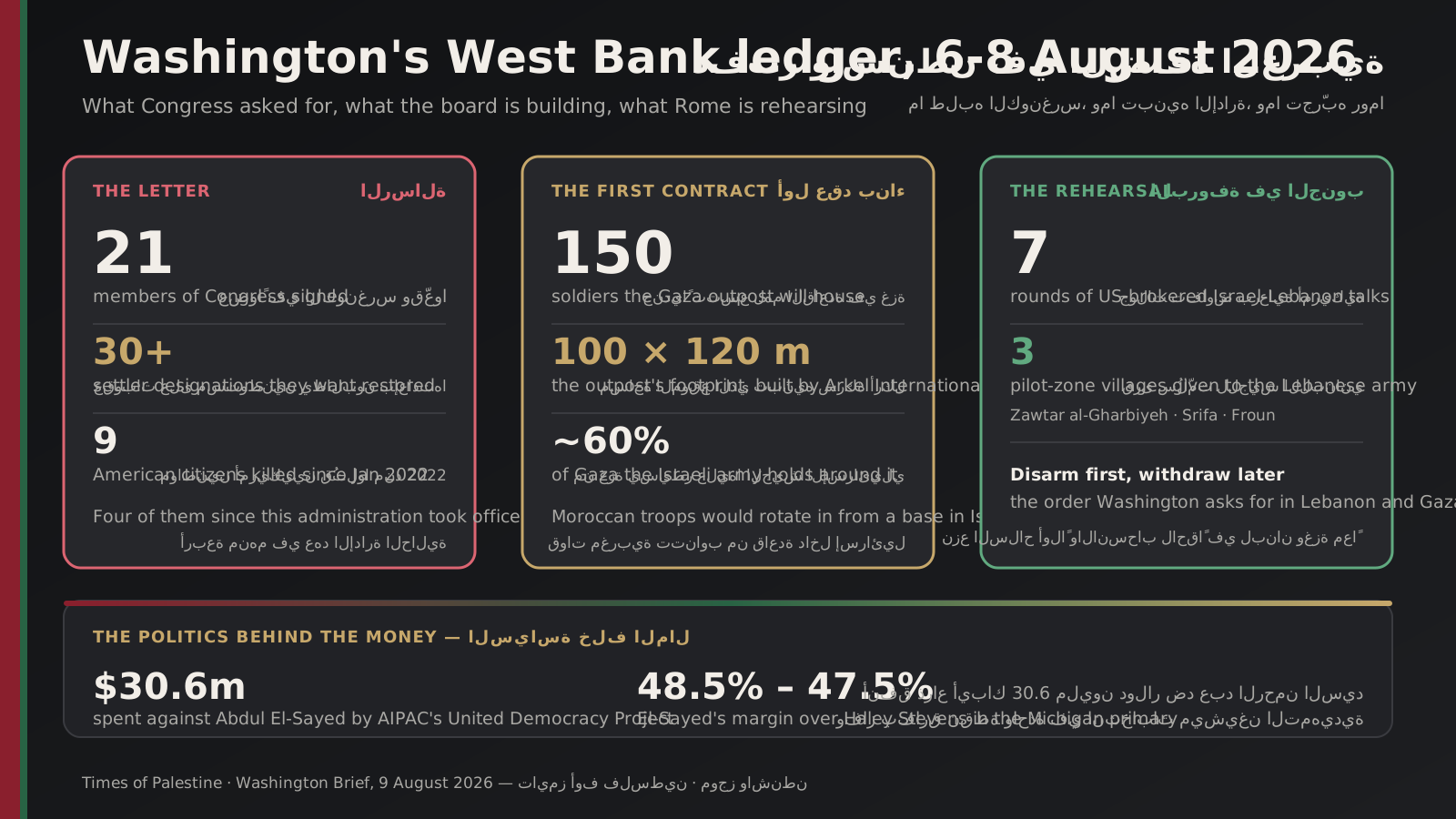
Twenty-one members of Congress wrote to Secretary of State Marco Rubio, Treasury Secretary Scott Bessent and Acting Attorney General Todd Blanche on Thursday, demanding that the administration put back the sanctions it removed from Israeli settlers accused of violence in the West Bank and open independent investigations into the deaths of nine American citizens killed there since January 2022.
The letter was led by Senators Elizabeth Warren and Chris Van Hollen, and the sentence at its centre argues that Washington's own decision changed the weather in the hills around Hebron and Nablus. Ending sanctions on those tied to West Bank extremism, the lawmakers wrote, "sent a clear message: settlers can use violent and deadly force with impunity."
They went further and named the cause. "We have concerns that the administration's deference to the Netanyahu government has contributed to a climate of impunity and unbridled violence," the letter says — a rare instance of sitting American legislators locating the source of settler violence inside their own government's posture rather than in the West Bank alone.
The names that came off the list#
The programme the letter wants revived was assembled in 2024, when the Treasury designated more than thirty settlers, outposts and organisations accused of attacking Palestinians — freezing their access to American banking and, more consequentially, to the European and Israeli institutions that follow Washington's designations. The executive order underpinning it was revoked in the president's first days back in office, and the designations lapsed with it.
One name from that list surfaced in an Israeli courtroom the same day the letter went out.
Prosecutors indicted the settler activist Yinon Levy on a charge of reckless homicide over the killing of Awdah Hathaleen, a 31-year-old teacher and father of three, in the southern West Bank village of Umm al-Khair in July 2025. Al Jazeera reported the indictment, which also carries counts of armed trespassing and malicious property damage, as the first of its kind against an Israeli in more than seven years.
Levy had been sanctioned by both Washington and the European Union in 2024 over earlier attacks on Palestinians. The American designation was gone before the killing was charged. That sequence — designated, un-designated, then indicted at home — is the whole argument of Thursday's letter compressed into one file.
The Americans in the ledger#
The nine deaths the lawmakers want investigated are the count since January 2022; four of them, the letter says, have come since the current administration took office. No independent American investigation has produced a public finding in any of them, which is why the demand is for investigations rather than for their conclusions.
The letter also asks for the release of Sama Safi, a Palestinian-American psychology student at Birzeit University, detained by the Israeli army during a raid on her family's Ramallah home on 2 June and held since without charge.
Her lawyer, the Israeli attorney Lea Tsemel, has said she denies the accusation of association that the military has offered. Safi has familial Mediterranean fever, a chronic inflammatory illness requiring daily medication and a quarterly injection she can only receive outside the country.
Against that, the administration's most visible West Bank presence is its ambassador. The Guardian reported this week that Mike Huckabee has visited the settlement of Shilo twice in two years, and that Palestinian-Americans in nearby Turmus Ayya describe settler attacks rising after such visits.
Washington's first building in Gaza is a barracks#
While Congress argued about the West Bank, the Board of Peace signed its first construction contract in Gaza — and it is not for a house, a clinic or a school.
The Guardian reported that the American-chaired board awarded the job to Arkel International, a Baton Rouge firm with a record of United States government work in Iraq, to build a 150-person military outpost measuring 100 metres by 120 metres for Moroccan troops who would rotate in from a base in Israel.
The site sits inside the roughly 60 per cent of Gaza the Israeli army controls, about an hour from the Israeli border, and was designed with what the paper described as a quick extraction route in case the soldiers inside came under attack. The contract has not been finalised.
For a Palestinian reader the detail that matters is the order of construction. The reconstruction architecture Washington announced in July is producing a barracks first, in territory the occupying army still holds, for a foreign force whose job under the roadmap is explicitly not to police Gaza.
The rehearsal running in south Lebanon#
Washington is testing the same sequence one border north, and it is three weeks ahead there. American mediators convened the seventh round of Israeli-Lebanese talks at the United States embassy in Rome from 4 to 6 August, with military officers, diplomats and legal advisers on both sides. State Department spokesman Tommy Pigott confirmed the talks were under way.
The two sides asked for opposite orders of business, which is the same argument Gaza is having. Israel wanted Hezbollah's disarmament settled before border questions, with the Lebanese army clearing Ali Taher Hill and verification of the weapons removed. Lebanon wanted an Israeli withdrawal, an end to demolitions and bombing, pilot zones at Khiam or Bint Jbeil instead, and third-party verification of any pullback.
| The sequencing argument | What Israel asks | What the other side asks |
|---|---|---|
| South Lebanon, Rome round seven | Hezbollah disarms and the Lebanese army verifies first | Withdrawal and demolitions halt first, verified by a third party |
| Gaza roadmap | Full decommissioning before withdrawal past the Yellow Line | Withdrawal moving in step with decommissioning |
| Who holds the ground meanwhile | About 60 per cent of Gaza; seven-plus positions in Lebanon | Neither transitional authority has been let in to govern |
Three villages have been handed to the Lebanese army under the pilot-zone scheme so far — Zawtar al-Gharbiyeh, Srifa and Froun. On Saturday, Lebanese state media and a southern mayor said Israeli troops had entered one of them, thrown up an earthen barrier and blocked a road; the Israeli military said it was unaware of the incident.
Palestinians have a direct stake in how that experiment ends, and not only as a preview of Gaza's. Since August 2025 the same disarmament logic has run through Lebanon's Palestinian refugee camps, where factions have handed weapons to the Lebanese army at Ain al-Hilweh, Beddawi, Burj al-Barajneh and Shatila. What the camps received in return — on residency, work and rights — remains the unanswered part of that bargain.
The strait that pays the reconstruction bill#
Vice President JD Vance told Fox News on Saturday that Tehran had given Washington an assurance about the waterway that carries a fifth of the world's oil. "The Iranians have told us they have no plans to toll the Strait of Hormuz," he said, adding that the administration would judge Tehran by its conduct: "We don't trust. We verify."
The expectation, he said, is that "we see the same amount of oil and gas come out of the Gulf that you saw before the conflict."
Tehran raised its price the same weekend. Mohammad Bagher Zolghadr, secretary of Iran's Supreme National Security Council, set out demands that go far past shipping: that the United States never threaten Iran again, permanently end its war with Iran and its regional allies, lift the naval blockade of Iranian ports, compensate the damage of the 2025-26 wars and release frozen Iranian assets.
That argument is a Gaza budget line. The Gulf treasuries that pledged reconstruction money earn it from oil priced by a closed strait, and pledges become transfers only when the waterway and the price both settle.
The politics behind the money#
The clearest signal about American politics came from Michigan.
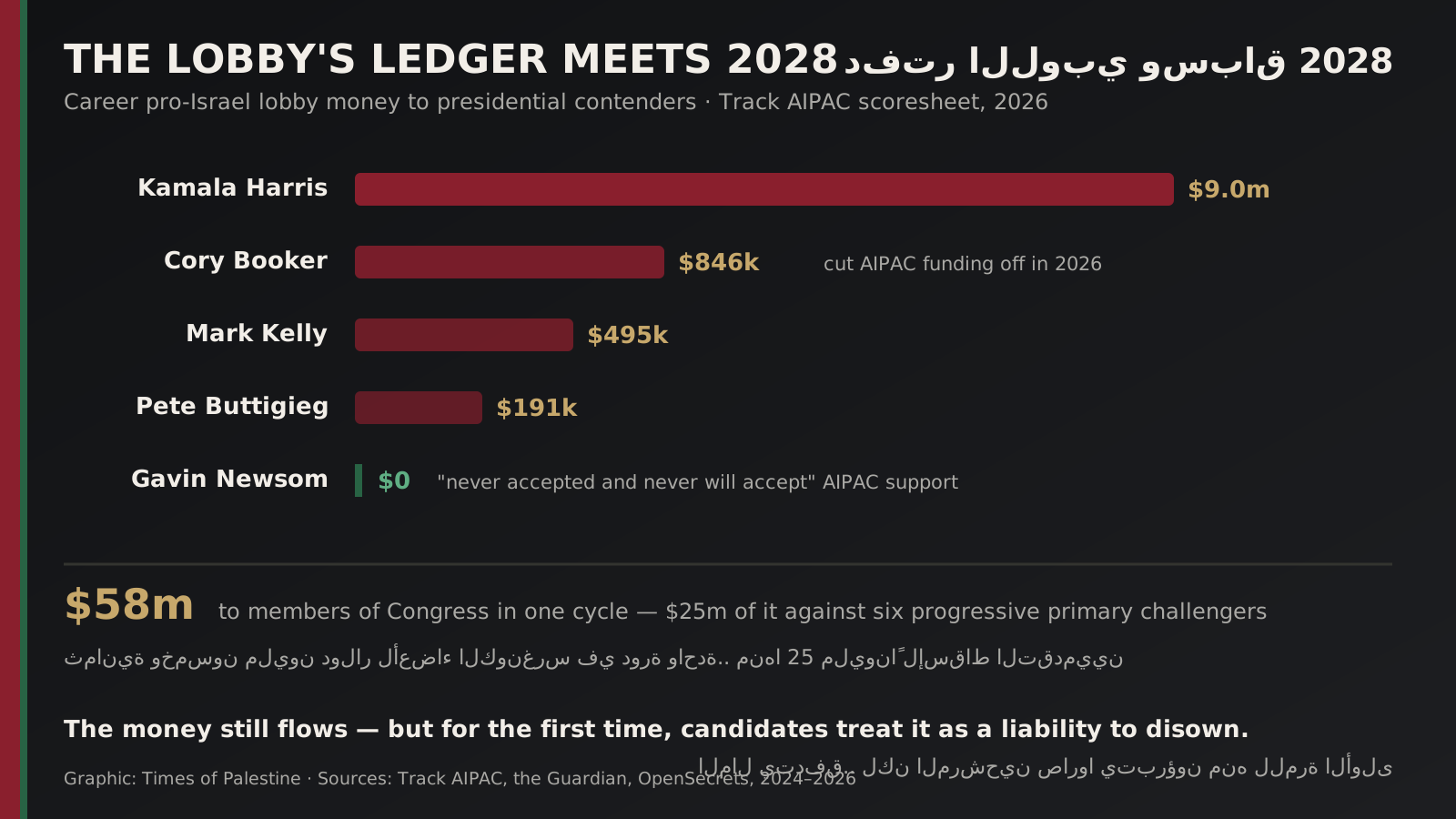
Abdul El-Sayed won the Democratic Senate primary on 48.5 per cent to Haley Stevens's 47.5, after the American Israel Public Affairs Committee's super PAC, the United Democracy Project, spent a record $30.6 million against him, AIPAC-aligned spending reached as much as $46 million in what became the most expensive Democratic Senate primary in American history, and El-Sayed ran on ending unconditional military aid to Israel.
The result does not change a single line of American policy this month, and the same money defeated other candidates the same week.
But the letter, the indictment and the primary all point at one mechanism: sanctions, investigations and arms conditions are decided in Washington, and for the West Bank they were switched off by choice. What Thursday's letter asks for is not a new instrument, only the one that already existed.
%20(cropped).jpg?width=640)