Gaza
Gaza universities restart degrees online as Israel blocks student travel
Graphic: Times of Palestine
Original Reporting
The Newsdesk gathers reporting from wire services and primary sources and rewrites every story in-house before publication. How our journalism is made →
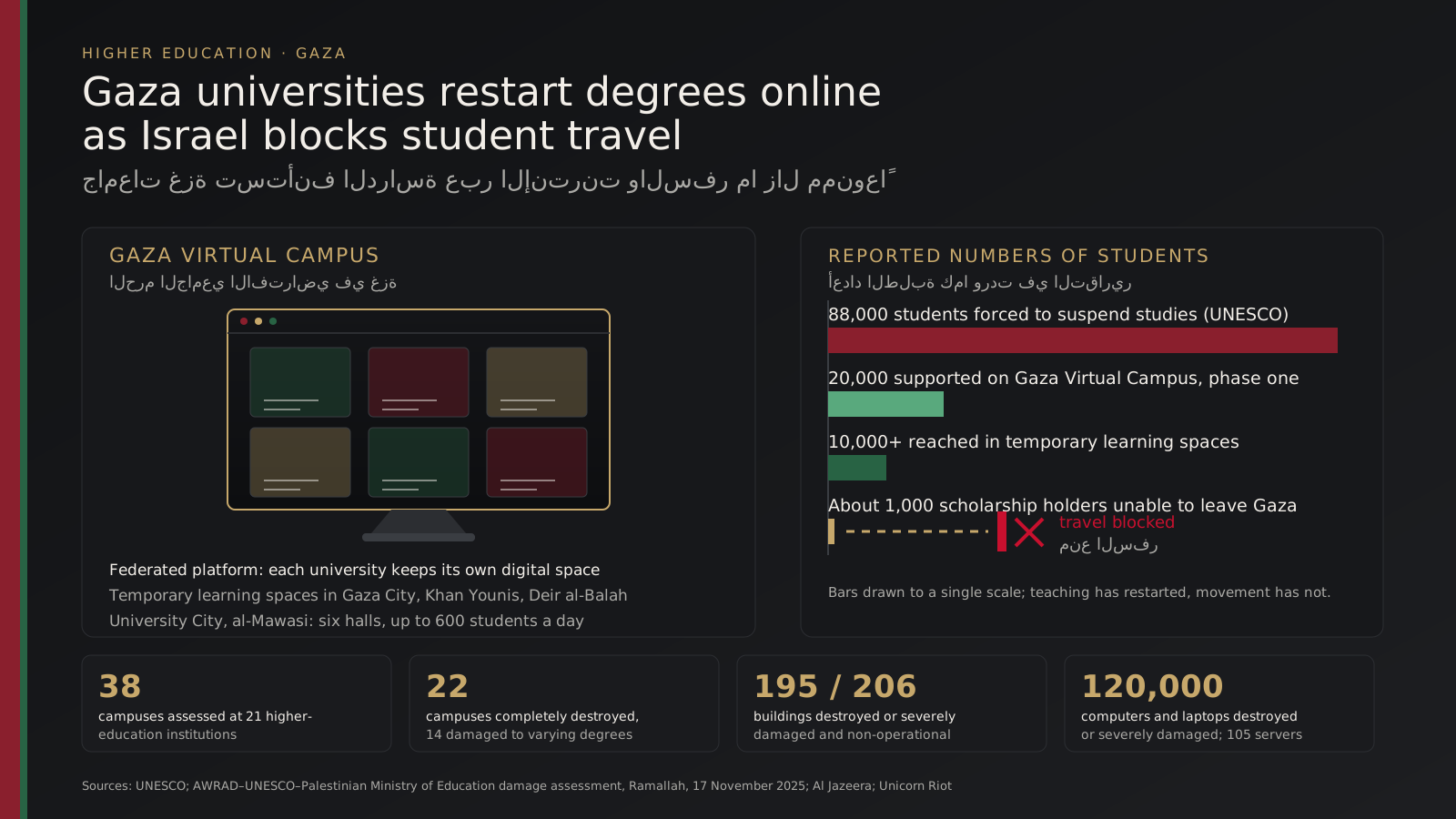
Gaza's universities have resumed teaching for tens of thousands of students through a shared online platform, borrowed classrooms and a makeshift campus built from scrap wood and sheet metal — while roughly 1,000 students holding scholarships to universities abroad remain unable to leave the territory, Unicorn Riot reported in May, citing student organisers.
The gap between those two facts defines the higher-education recovery. Teaching has restarted. Movement has not.
The physical loss is documented. A damage assessment carried out by Arab World for Research and Development with UNESCO and the Palestinian Ministry of Education and Higher Education, presented in Ramallah on 17 November 2025, covered 21 higher-education institutions across 38 campuses.
It found 95 percent of campuses affected, 22 campuses completely destroyed and 14 damaged to varying degrees. Of 206 buildings assessed, 195 were destroyed or severely damaged and non-operational. The assessment also counted about 120,000 computers and laptops and 105 servers destroyed or severely damaged, and 620 specialised labs and facilities knocked out.
UNESCO says 88,000 higher-education students in Gaza were forced to suspend their studies after October 2023, part of 745,000 students out of school for more than two academic years.
The main instrument for restarting those degrees is the Gaza Virtual Campus, which UNESCO launched late in 2025.
According to UNESCO, the platform supports 20,000 students in its first phase, with plans to extend to all 88,000, and operates as a federated system giving each university its own digital space rather than merging them into one institution.
UNESCO says it has also set up temporary learning spaces in Gaza City, Khan Younis and Deir al-Balah, supplying laptops, connectivity and psychosocial support to more than 10,000 students. The Globe and Mail reported in April that as many as 180 students a day use a single UNESCO-equipped learning space.
In-person teaching has come back in fragments.
Borgen Magazine reported this month that classes resumed on site at the Islamic University of Gaza in December 2025 for the first time in two years, held among tents pitched where lecture halls stood, and quoted Youmna Albaba, a first-year medical student, saying she had found hope in "building everything from scratch".
Türkiye Today reported in January that dentistry students had returned to Al-Azhar University in Gaza to rooms with broken windows and plastic-sheet walls, and that for thousands of others remote learning remains the only option because campuses are unusable or serving as shelters for displaced families.
The most substantial attempt to rebuild a physical classroom is in al-Mawasi, Khan Younis. Al Jazeera reported in April that Scholars Without Borders, a US non-governmental organisation, has built a site it calls University City from wood, metal sheets and locally salvaged material, powered by solar panels.
Hamza Abu Daqqa, the organisation's representative in Gaza, told Al Jazeera the site has six halls accommodating up to 600 students a day and was designed to serve several institutions at once.
Under the arrangement described by The Globe and Mail, each participating university gets the whole site for one full day on a weekly rotation, with courses that cannot be taught remotely — medical training among them — given priority.
Students describe compressed calendars. A student at the Islamic University of Gaza wrote in The Electronic Intifada in January that she completed four semesters in a single year, between August 2024 and December 2025, because the university wanted graduates to finish on their original timetable.
She described studying through repeated displacement, scarce electricity and weak or absent internet after Israeli forces destroyed the headquarters of internet providers. Türkiye Today reported that Israeli restrictions on what may enter Gaza continue to keep out the equipment and materials universities need to repair buildings.
Transfers abroad have moved fastest through Italy.
The Italian foreign ministry said in October 2025 that 49 Palestinian students had arrived on two flights from Amman, organised with the Civil Protection Department, the EU Civil Protection Mechanism and the Conference of Italian University Rectors, and that the Italian system had by then awarded more than 150 scholarships to students and researchers from Gaza, most under the IUPALS scheme, involving 41 universities.
Al Jazeera reported in August that about 229 students had been evacuated from Gaza to Italy before May 2026, with roughly 40 more in June, and put annual costs in Italy near €10,200 against £30,000 to £60,000 in the United Kingdom.
The individual allocations are small and university-funded.
The University of Milan lists 21 IUPALS places plus 10 more for 2025/2026; Padova lists up to four at €12,000 a year with fees waived; Sapienza lists two covering fees, accommodation, meals and insurance; Brescia says it funded three from its own resources at about €11,000 a year for four years and is appealing for donations to reach candidates still on its waiting list.
Padova's page states that IUPALS 2025 has closed and that no new edition is expected for 2026-27 — leaving the scheme's continuation unclear.
Elsewhere the obstacle is paperwork.
Palestinian Students and Scholars at Risk told University Affairs in December that about 70 graduate students admitted to 20 Canadian universities with full funding, in fields including cancer research and artificial intelligence, could not take up their places because of visa delays, with security screening handled by private contractors in Egypt.
The BBC reported that four students awarded Goldsmiths scholarships, among more than 80 in Gaza, cannot submit the biometric data the Home Office requires because there is no visa application centre in Gaza; 113 MPs, led by Barry Gardiner, signed a letter asking that biometrics be taken in Egypt or Jordan, and the Home Office said it was considering how best to support them.
The Electronic Intifada reported in June that Bilal Salama, 23, holding a Goldsmiths master's place, still could not exit.
Israel's coordination body COGAT, in a statement carried by DW in July, said the vast majority of exit requests submitted are approved and that nearly 50,000 Gaza residents have left for third countries since the war began, for reasons including medical treatment, residency and study; COGAT gave no details on students holding Malaysian scholarships.
Rafah has been mostly shut since Israeli forces took it in May 2024, opened partially in February 2026, then closed again on 1 March, when COGAT announced all crossings were closing after joint Israeli-American strikes on Iran, according to Truthout. Students carrying their passports protested in Gaza City on 20 April under the banner "Between the Dream and the Crossing", palinfo reported.
Whether IUPALS runs again, whether Britain will take biometrics outside Gaza, and when the virtual campus reaches the remaining 68,000 students are all still open. The final Rapid Damage and Needs Assessment released by the EU, the UN and the World Bank in April put Gaza's ten-year recovery bill at $71.4 billion, with education among the hardest-hit sectors.