Gaza
Palestinian ministry opens Gaza's fourth school year mostly in tents
Graphic: Times of Palestine
Original Reporting
The Newsdesk gathers reporting from wire services and primary sources and rewrites every story in-house before publication. How our journalism is made →
The Palestinian Ministry of Education and Higher Education has fixed Sunday 6 September as the start of the 2026/2027 school year in the West Bank, Gaza and occupied Jerusalem, according to an announcement reported this month by the Palestinian outlet Palestine Post. In Gaza it will be the fourth school year to open since October 2023, and most of the strip's children will not walk into a school building.
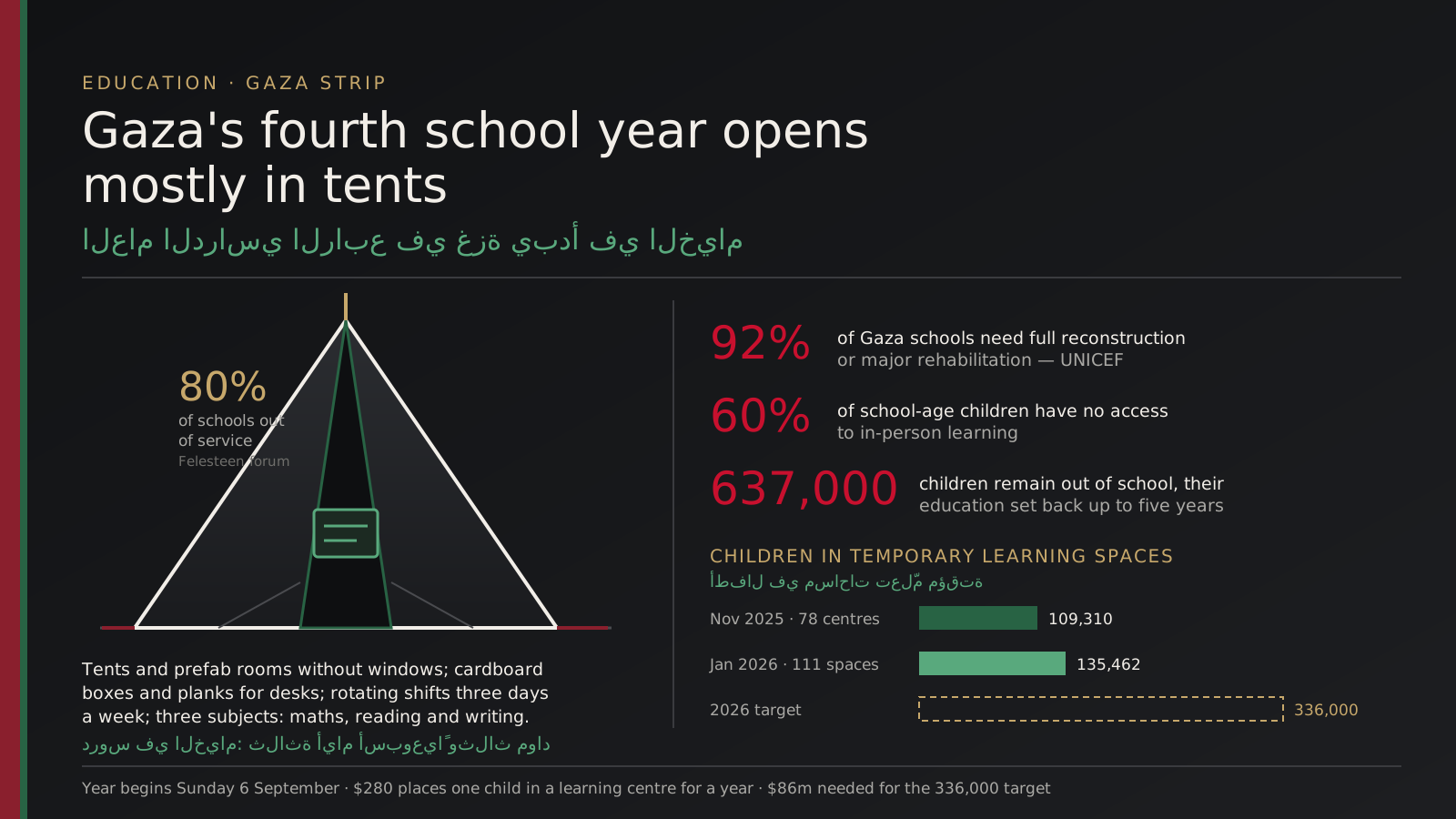
UNICEF said in a statement issued from Geneva on 27 January that 60 percent of school-age children in Gaza had no access to in-person learning, that more than 90 percent of schools had been damaged or destroyed, and that more than 335,000 children under five were at risk of severe developmental delays because early childhood services had collapsed.
The agency's State of Palestine office put the repair bill in structural terms: at least 92 percent of schools in Gaza require either full reconstruction or major rehabilitation before they can function, a figure it gives elsewhere as 91.8 percent of all education facilities.
Enrolment in emergency learning is climbing slowly. UNICEF reported 78 learning centres holding 109,310 children in early November 2025, and 111 temporary learning spaces holding 135,462 children at the end of January 2026. Its Back to Learning programme aims to reach 336,000 school-age children during 2026 and, UNICEF says, to return every school-age child in Gaza to in-person learning in 2027.
UNICEF USA reported in February that the agency needed $86 million to reach the 336,000 target for the remainder of the year. UNICEF puts the cost of placing one child in a learning centre for a year at about $280.
Local education figures are bleaker than the aggregate. An education official identified by the Gaza newspaper Felesteen as Abu Zaiter told the paper's Nabd Ghazza forum, in a report published Saturday, that about 80 percent of Gaza's schools are out of service and that 127,000 students remain without any schooling.
He said the strip had roughly 584 school buildings — government, UNRWA and private — of which about 307 were destroyed or their condition unknown and about 161 sustained total or partial destruction, leaving some 21 percent of classrooms fit for teaching.
He added that Gaza City has gained almost no usable classrooms because standing schools are still serving as shelters for displaced families, and that the new year is expected to begin there on 6 September in coordination with the ministry in Ramallah. His figure of 127,000 children without schooling is far below the share implied by UNICEF's 60 percent; neither body has published a reconciliation of the two counts.
What a lesson looks like was described by a UNICEF official quoted by Sky News Arabia in October 2025: classes held in tents or prefabricated rooms without windows, with cardboard boxes and wooden planks used as desks, children writing on slates or on pieces of stone and plastic, teaching on rotating shifts three days a week for a few hours, and three subjects only — mathematics, reading and writing.
Mohammed Hamdan, director of education for the central governorate, told Euronews Arabic in May that exam preparations were proceeding amid an acute shortage of school furniture, stationery and examination materials.
UNICEF says educational supplies were allowed into Gaza at the end of January 2026 for the first time in more than two years, when School-in-a-Box kits were distributed. Its February revision of the 2026 humanitarian appeal states that more than 637,000 children remain out of school, that their education may be set back five years, and that attacks on education and teacher salary cuts have deepened the crisis.
Teachers are working largely unpaid. Al Jazeera reported on 14 August that Gaza's public employees receive only partial payments months apart; an Arabic-language teacher, Yasser Dakka, said his entitlements had been delayed more than 90 days and described teaching in worn-out tents, adding that pupils are "our children regardless of who governs Gaza."
Counts of teachers killed differ. The official quoted by Felesteen gave about 535 of roughly 22,000 education staff; Al-Quds reported in May that the education system had lost 801 teaching cadres. No published audit reconciles the two.
The workaround has been remote. The ministry opened the 2025/2026 year on 8 September 2025 entirely online through virtual schools, teaching pupils inside Gaza from condensed learning packages and pupils outside the strip from the full curriculum, Felesteen reported at the time.
Examinations returned to classrooms this summer.
Minister of Education Amjad Barham said on 24 July, in remarks carried by the official agency WAFA, that Tawjihi exams were held simultaneously in the West Bank and Gaza for the first time in three years, that 36,900 Gaza students sat them this year out of more than 106,000 over three years, that the pass rate reached 74 percent, and that more than 1,100 students expected to sit this year's exams had been killed.
He said 67 students could not sit because they are held in Israeli prisons.
Higher education remains largely shut. The Global Coalition to Protect Education from Attack, in its Education Under Attack 2026 report, found that 87,000 higher-education students in Gaza could not access formal learning spaces as of November 2025, and that 97.5 percent of Gaza's schools had sustained damage.
The Palestinian Centre for Human Rights concluded in September 2025 that the sustained deprivation of Gaza's children of education constitutes a systematic crime amounting to an act of genocide. No Israeli government response to that finding is on record.
Whether 6 September delivers classrooms rather than calendars is unsettled. CNN reported in July that the Israeli military's expansion of the "yellow line" was driving fresh waves of displacement, and schools serving as shelters cannot be emptied while families have nowhere to go.