Politics & Diplomacy
Trump's peace board dropped the withdrawal clause Hamas accepted
 Politics & Diplomacy
Graphic: Times of Palestine
Original Reporting
The Newsdesk gathers reporting from wire services and primary sources and rewrites every story in-house before publication. How our journalism is made →
Three men flew into Israel this weekend carrying an American plan to end the war in Gaza. It is no longer the plan Palestinians were asked to accept.
Jared Kushner, the former British prime minister Tony Blair and Nickolay Mladenov — the Gaza high representative of the Board of Peace that President Trump chairs — were due in Israel on Sunday, Reuters reported, to salvage the roadmap after Prime Minister Benjamin Netanyahu rejected it last week.
From there the delegation travels to Cairo, to meet the Egyptian, Qatari and Turkish mediators and the Palestinian technocrats who are supposed to take delivery of Gaza.
The Times of Israel reported on Sunday that Hamas is seeking a meeting with Mladenov and American officials during the Egyptian leg. What none of the parties has yet said in public is which version of the plan is on the table.
“will take place only once decommissioning is complete, as Hamas committed to the mediators”
The clause that went missing#
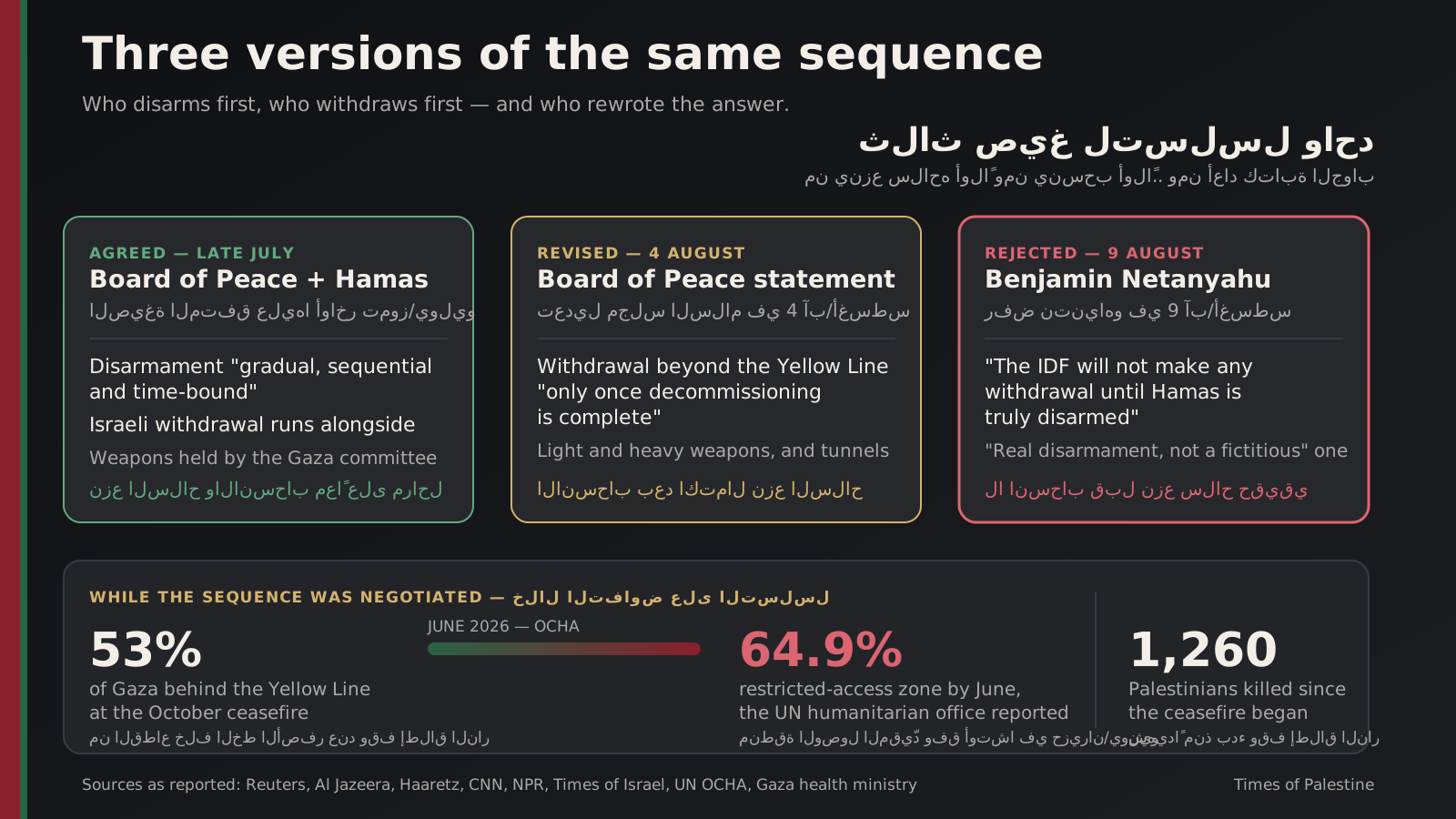
The 15-point plan was settled late last month between the board and Hamas. Reuters set out its terms: the disarmament of Palestinian factions in Gaza in a "gradual, sequential, and time-bound manner", Israeli forces withdrawing as that proceeded, and the surrendered weapons held by the National Committee for the Administration of Gaza.
For the Palestinian side, the pairing was the plan. Disarmament was tied to withdrawal, in phases, each step buying the next — which is why factions that had refused for months signed on.
On 4 August, Mladenov met Netanyahu in West Jerusalem. The statement the board issued afterwards, reported by Al Jazeera, unpicked that knot.
Withdrawal beyond the Yellow Line, the board said, "will take place only once decommissioning is complete, as Hamas committed to the mediators" — light weapons, heavy weapons and the tunnels alike. Simultaneity had become sequence, and the sequence now ran one way.
The concession bought nothing. The following day Netanyahu told Israelis he had agreed to none of it. "They sent us a draft. We did not agree to it. It was not our draft. We sent back our comments," he said in a video carried by the Times of Israel.
On Sunday 9 August he rejected the plan outright, in remarks reported by Haaretz, CNN and NPR alike. "The IDF will not make any withdrawal until Hamas is truly disarmed," he said, defining that as "the heavy weapons, the less heavy weapons, and the light weapons, all the weapons, and we are talking about real disarmament, not a fictitious disarmament."
Washington moved first, and moved alone.
The argument is about a map#
The Yellow Line is the ceasefire's demarcation, the boundary Israeli forces pulled back to under the October agreement and have held since. Everything east of it is under Israeli control, and the disarmament argument is, in practice, an argument about when that line moves.
At the ceasefire it left Israel holding roughly 53 per cent of the Gaza Strip. By June, the UN Office for the Coordination of Humanitarian Affairs put the restricted-access zone at 64.9 per cent — the line has moved, in the wrong direction, while the sequencing was being negotiated.
The cost of the interval is counted in people. Al Jazeera's running tally, drawn from Gaza's health ministry, put the toll at 73,389 killed since October 2023, more than 1,260 of them since the ceasefire began. Two more Palestinians were killed and 14 wounded in strikes on Saturday.
The Palestinians waiting in Cairo#
The body that would take custody of the weapons is barely a year old and has never governed anything.
The National Committee for the Administration of Gaza was formed in January under UN Security Council Resolution 2803, which endorsed Trump's Board of Peace as the overseer of Gaza's reconstruction. The European Council on Foreign Relations describes a committee of 16 to 17 Palestinian technocrats from Gaza, led by Ali Shaath, holding portfolios from energy to waste management.
Its reporting line runs upward and outward. The committee answers to Mladenov, who answers to a board chaired by the president of the United States.
Yara Hawari, writing for the Palestinian policy network Al-Shabaka in January, argued that the arrangement converts a political question into an administrative one. "Most glaring in Trump's plan for Gaza is the absence of any discussion of Palestinian sovereignty," she wrote.
Hamas is manoeuvring around the same problem from the other side. Its political leader Khalil al-Hayya travelled to Cairo on Sunday morning to see the Egyptian intelligence chief Hassan Rashad, briefing him, a Hamas official told Al Jazeera, on Israeli violations of the ceasefire.
Basem Naim, of the movement's political bureau, said Hamas is waiting for "pressure from mediators and the US side on Netanyahu" to enforce the roadmap. That is the whole Palestinian position in a sentence: the plan is acceptable, and only Washington can make Israel keep it.
The channel Washington did open#
There is a file on which this administration has proved willing to improvise a route around a stuck negotiation, and it is not Gaza.
Axios reported on Sunday that the White House, concluding that Iran's official negotiators were being overruled at home, built a private channel to the Islamic Revolutionary Guard Corps. Around 10 May, the then director of national intelligence Tulsi Gabbard telephoned the Kurdish leader Nechirvan Barzani, who lived in Iran during the Iran-Iraq war and speaks Persian, and asked him to reach the Guard's commander.
On 14 May, according to the account, an IRGC official walked into Barzani's office in Erbil carrying an encrypted phone. General Ahmad Vahidi came on the line and told Barzani: "I fully support them and this is also the position of the IRGC. We prefer to solve this crisis through negotiations." Plans for secret talks in Erbil were explored and dropped over Iranian security concerns.
That effort produced the 14-point memorandum of understanding signed in mid-June, which the House of Commons Library, in a research briefing on the war, describes as opening a 60-day window covering navigation through the Strait of Hormuz, Iran's nuclear and missile programmes, and sanctions. It broke down in July and the naval blockade returned.
The economic track never paused. The Treasury sanctioned two digital-asset exchanges and a front-company network this month, with Secretary Scott Bessent saying in the department's announcement that Iran's reliance on such channels "is further evidence that Economic Fury is working."
No comparable ingenuity has attached itself to the Gaza timetable. The board has amended its own text once already, and has named no date by which Israeli forces must be behind any particular line.
An ambassador's words, and what came after#
Washington's sharpest language last week was aimed not at the Gaza deadlock but at a hillside south of Nablus.
Settlers surrounded three houses in the village of Qusra, among them the home of Loui Ridi, a Palestinian American, throwing stones and keeping the families inside as food and water ran down. The American ambassador Mike Huckabee, a long-standing ally of the settlement movement, called it "a horrific act of terror meant to intimidate and harass this family" and said the embassy was coordinating with the Israeli military and police.
The words were unusual. The policy behind them has not changed: the settler sanctions the previous administration imposed remain revoked, and the bicameral letter from Senators Elizabeth Warren and Chris Van Hollen and eighteen colleagues asking Secretary of State Marco Rubio to restore them is still unanswered.
The UN's envoy told the Security Council on 11 August that 76 Palestinians had been killed in the West Bank this year to 10 August, 18 of them children.
For a reader in Gaza City or Ramallah, the week reduces to one fact about how this ends. The only text Palestinians agreed to has been edited in Israel's favour by the body that wrote it, before the delegation carrying it ever landed — and the mediators in Cairo will be asked to sell the amended version to the people it binds.