Arab Support
Arab states pledged $4.2 billion; the Gaza fund holds nothing
Graphic: Times of Palestine
Original Reporting
The Newsdesk gathers reporting from wire services and primary sources and rewrites every story in-house before publication. How our journalism is made →
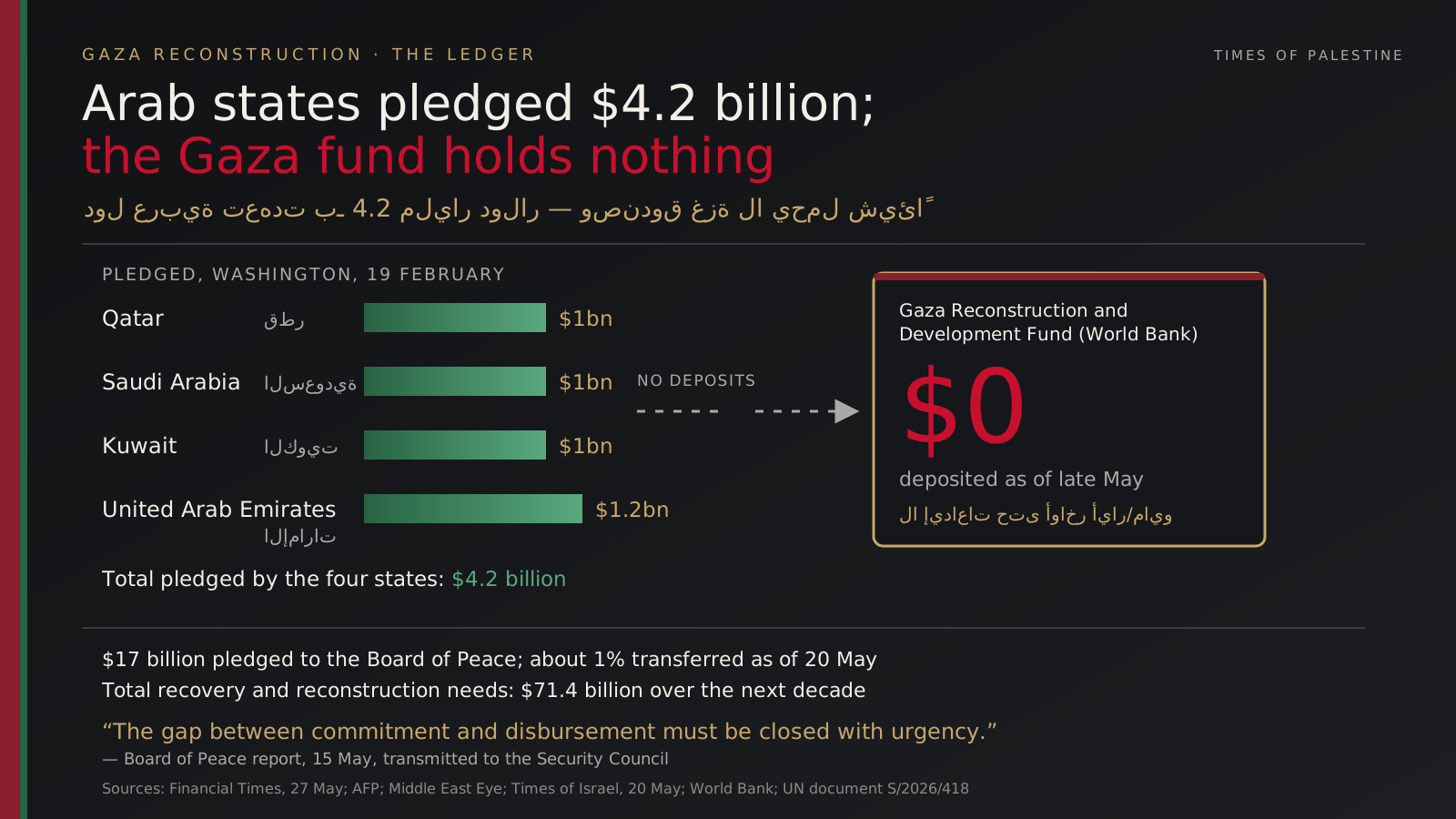
The World Bank-administered fund built to receive pledges for Gaza's reconstruction had taken in no deposits as of late May, four months after four Arab governments committed at least $4.2 billion at its launch.
The Financial Times reported on 27 May that zero dollars had been deposited into the fund, and a source described by AFP as familiar with the Board of Peace told the agency the same day that its official reconstruction fund held no cash.
The pledges themselves are on the public record and precisely stated. Middle East Eye reported that Qatar, Saudi Arabia and Kuwait each committed $1 billion, citing statements by their representatives at the Board of Peace's inaugural meeting in Washington on 19 February, and that the United Arab Emirates committed $1.2 billion.
The Arab Weekly and the Gulf business outlet AGBI carried the same four figures. The Foundation for Defense of Democracies, in a 20 February analysis, listed the same UAE and Saudi amounts.
Trump, who chairs the board, said nine member states had pledged roughly $7 billion in total and named them as Kazakhstan, Azerbaijan, the UAE, Morocco, Bahrain, Qatar, Saudi Arabia, Uzbekistan and Kuwait, according to the TNND report of the meeting and to Middle East Online. He said the United States would add $10 billion.
AGBI's account differs: it reported that around a dozen countries had committed, also including Jordan and Egypt. No per-country ledger of amounts pledged has been published by the board.
The formal instrument is the Declaration of Founding Donors, signed at the Washington meeting on 19 February by eight states — Bahrain, Kazakhstan, Kuwait, Morocco, Qatar, Saudi Arabia, the UAE and Uzbekistan.
Its text, as reproduced in the board's report to the Security Council published by the UN as document S/2026/418, commits the signatories to provide financial support "consistent with the decisions of the Board and their respective national processes" and to ensure the board is adequately resourced.
Azerbaijan, named by Trump among the nine, is not among the eight signatories in that document.
That national-processes clause is where the timing sits.
The Carnegie Endowment for International Peace, in a study published on 16 March, reported that Saudi Arabia and Kuwait have indicated their pledges would be disbursed over a period of years rather than in a single transfer, and that donor unease has centred on the lack of clarity over who can access the money and how it will be spent.
Carnegie also reported that negotiations were under way between the Trump administration and JPMorgan Chase to establish a private account for the board.
The board has said the delay is a problem.
In its report dated 15 May, transmitted to the Council by the US permanent representative, it recorded $17 billion in pledges during the reporting period and stated that "the gap between commitment and disbursement must be closed with urgency," adding that funds committed but not disbursed are the difference between a framework on paper and one that delivers on the ground.
Reuters, which first published parts of the letter, had reported in April that only a small fraction of the $17 billion had reached the board.
How small is not officially published. The Times of Israel reported on 20 May that around one percent of the $17 billion had actually been transferred as of that week, attributing the figure to two officials familiar with the matter rather than to any account statement.
In a statement to Reuters, a board official said the board had been consistent in urging member states and international organisations to fulfil their pledges.
The receiving mechanism was declared ready on the day the pledges were made.
World Bank Group president Ajay Banga told the February meeting that the Gaza Reconstruction and Development Fund was ready for donations, that the World Bank acts as a limited trustee holding donor money while the board directs disbursements, and that a World Bank financial controller had been seconded to the board.
Tech Times reported on 11 July, citing the board's own May report, that the fund still stood at zero.
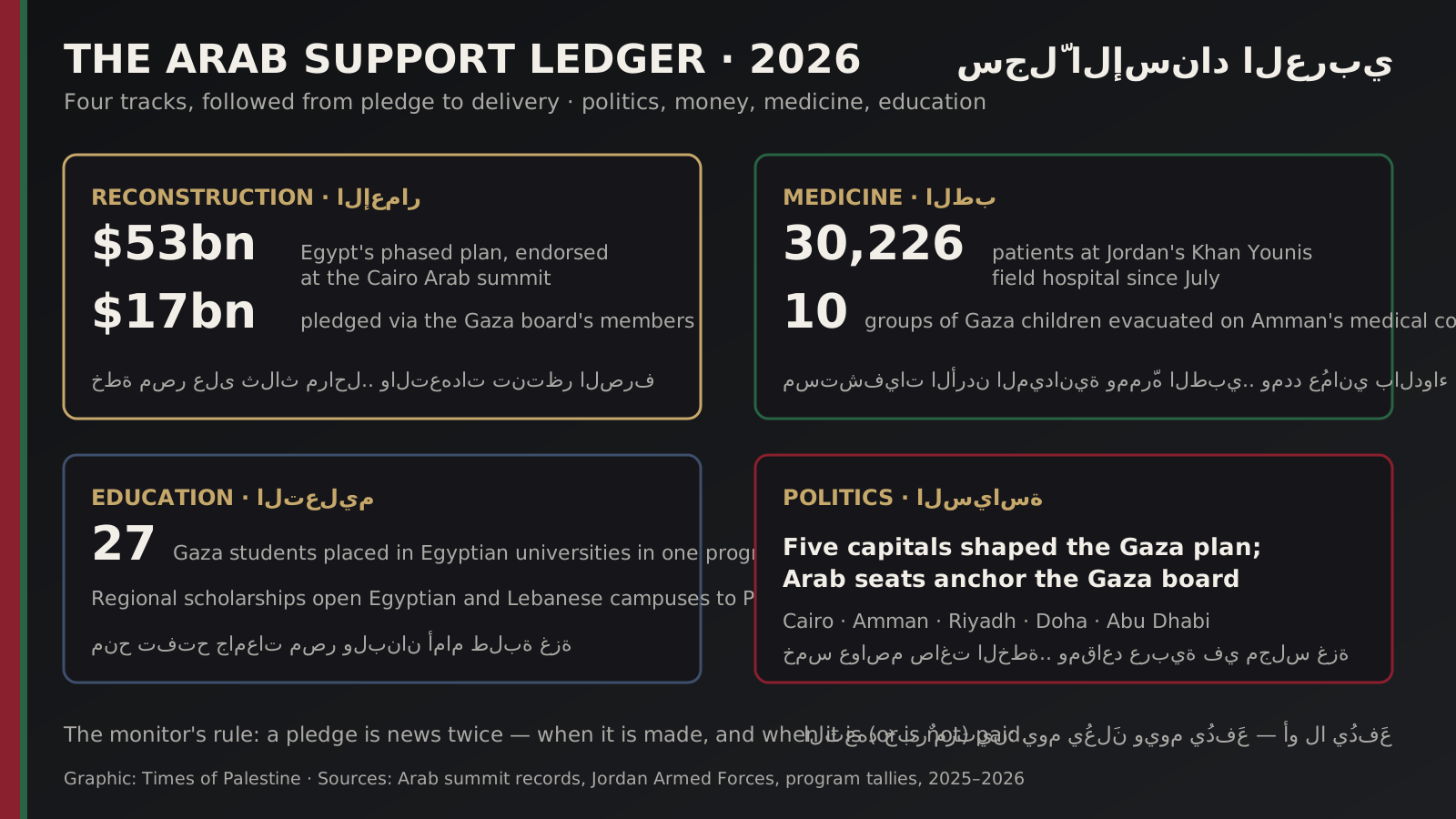
Scale sets the context. The letter to the Council put total recovery and reconstruction needs at $71.4 billion over the next decade, drawing on the UN estimate; the World Bank's earlier joint assessment with the UN and EU put Gaza's needs at $53 billion. The four Arab pledges together would cover about six percent of the higher figure.
Two structural questions remain unresolved on the record. Reuters reported that under the board's charter member states hold three-year terms unless they pay $1 billion each for permanent membership, and that it is unclear whether any state has paid that fee. The Council on Foreign Relations reported that NATO allies of the United States have broadly declined to join the board, citing the scope of its charter.
The Arab track that would have run in parallel has no date.
Egypt announced in October 2025 that it would host an early recovery and reconstruction conference in November; an Egyptian source told Asharq Al-Awsat on 25 November that it would be postponed because of the escalation in Gaza, and the foreign ministry spokesman told the paper days later that Cairo was working to hold it effectively without naming a new date.
Asharq Al-Awsat reported in December that Qatar's prime minister and foreign minister, Sheikh Mohammed bin Abdulrahman Al Thani, told a Doha Forum session that Qatar would not fund what others had destroyed.
What Arab states have spent bilaterally on Gaza outside the board is not counted in the May report, which tallies pledges made to the board. The board's next report to the Security Council under Resolution 2803 is the next point at which a figure is due.