Her Story
Gaza's widowed women now head 58,600 households and rebuild them
Graphic: Times of Palestine
Original Reporting
The Newsdesk gathers reporting from wire services and primary sources and rewrites every story in-house before publication. How our journalism is made →
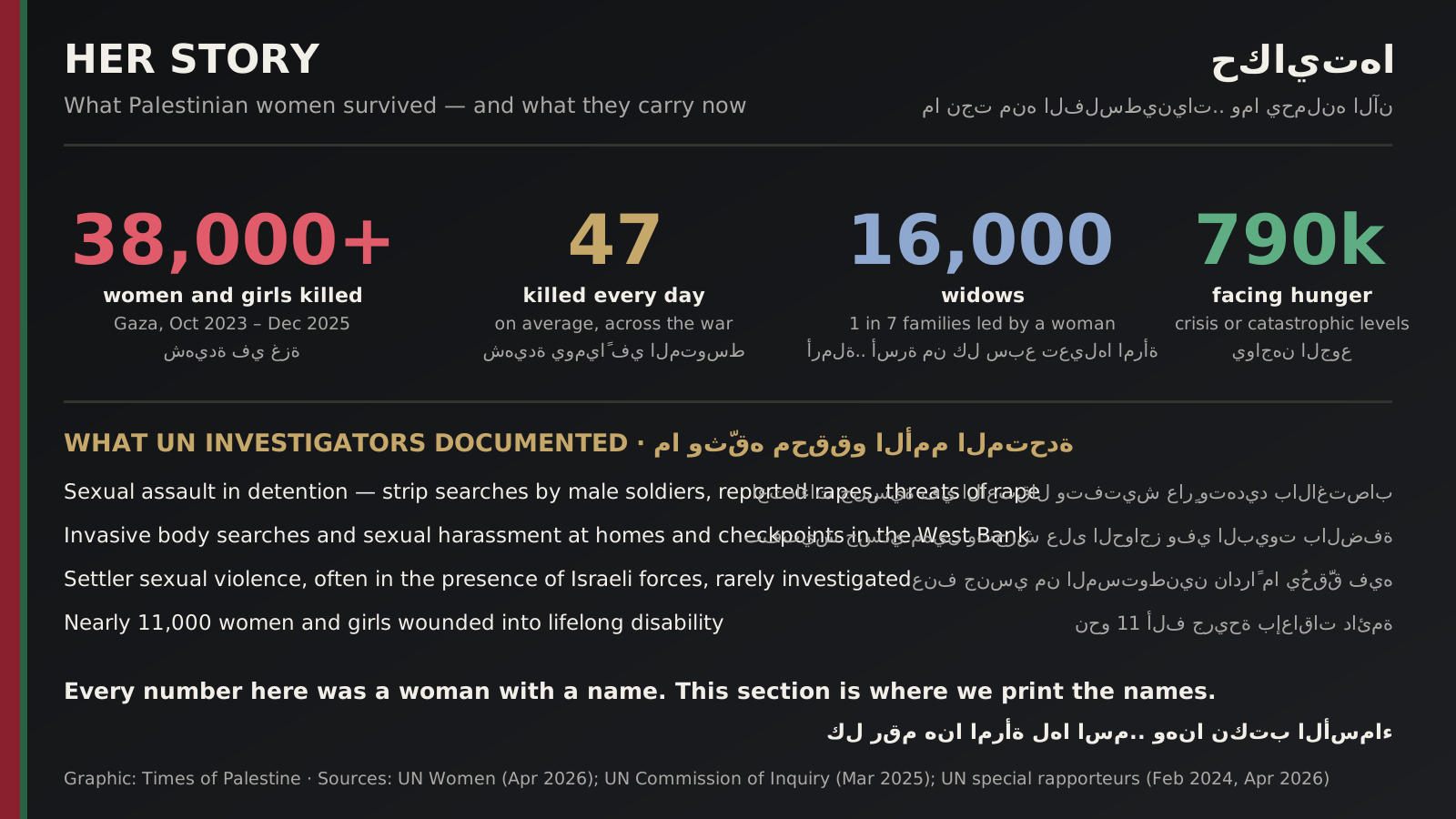
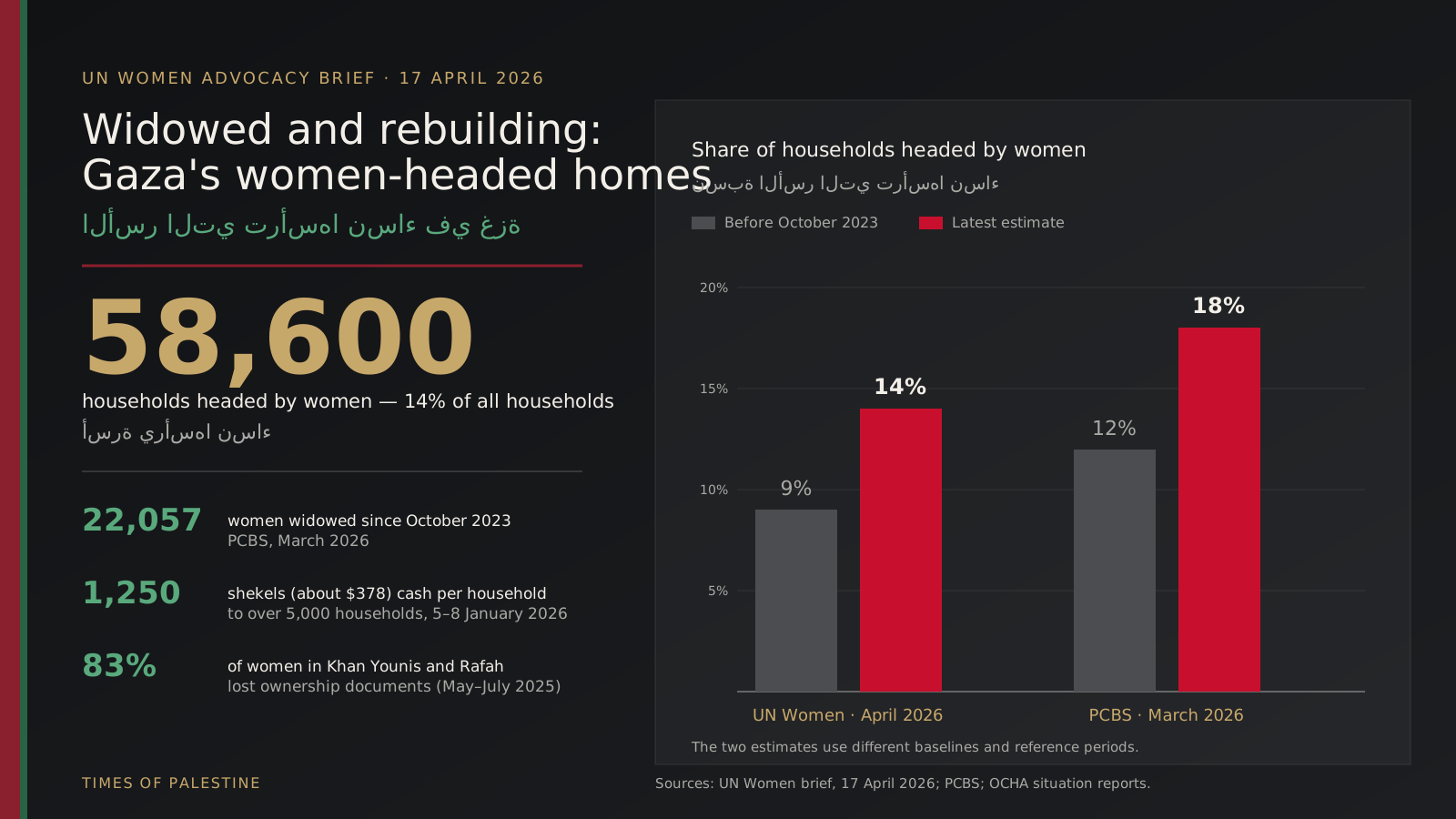
More than 58,600 households in the Gaza Strip are now headed by women, roughly 14 per cent of all households, compared with 9 per cent before October 2023, according to the UN Women advocacy brief "The cost of war in Gaza on women and girls", published on 17 April 2026.
In a street west of Khan Younis, UN News reported on 17 April 2026, an elderly woman works a worn sewing machine, mending clothes for customers — work she took up not by choice but after the social assistance her family had depended on was cut off.
The Palestinian Central Bureau of Statistics puts the shift higher. In figures released ahead of International Women's Day in March 2026, PCBS reported that 22,057 women in Gaza lost their husbands since October 2023 and that the proportion of female-headed households rose from 12 per cent in the first nine months of 2023 to about 18 per cent during the period of the assault, an increase of 50 per cent.
The two estimates rest on different baselines and reference periods, and neither body has published a reconciliation of the gap. UN Women's own count has moved: in a joint statement issued in September 2025, the Gender in Humanitarian Action Working Group cited a UN Women estimate of more than 50,000 women-headed households.
What these households live on is thin. PCBS reported that women's labour force participation in Gaza held at 17 per cent through 2025 while men's fell from 63 to 31 per cent, and that unemployment reached 92 per cent among women against 81 per cent among men.
The Ministry of Women's Affairs, quoted in Palestinian press reports in May 2026, attributed the shift to the killing of husbands and the detention of thousands of men, which turned tens of thousands of women into sole providers.
Aid reaches them through targeting systems that had to be built during the war. UN Women's data hub reported in January 2025 that 14,716 women-headed households were given priority food aid, in part because of data produced by its Women Count programme and a distribution partnership with the World Food Programme begun in November 2023.
Susanne Mikhail Eldhagen, then UN Women's regional director for Arab States, said reaching women-headed households was among the hardest tasks of that period.
Cash assistance remains small against the caseload. OCHA reported that between 5 and 8 January 2026, Cash Working Group partners distributed multi-purpose cash to more than 5,000 households, each receiving 1,250 shekels, about 378 US dollars, through digital payments.
UNICEF has described a parallel programme paying families about 200 dollars a month, with 100 dollars extra where a household includes a pregnant or breastfeeding woman, and has listed female-headed households among its priority categories.
No UN agency has published a figure for how many of the 58,600 women-headed households receive regular cash, and OCHA's situation reports do not disaggregate cash recipients by the sex of the household head.
Shelter is where the arithmetic bites hardest. OCHA reported that since the beginning of 2026, limited stocks of tents and tarpaulins meant shelter partners were reaching about 20,000 households a week, while winter conditions accelerated the deterioration of tents and drove repeat distributions.
After the December storms, OCHA reported that more than 42,000 tents or makeshift shelters sustained full or partial damage across 320 displacement sites, affecting at least 235,000 people, and that heavy rain from 11 December affected over 56,000 families.
In its response to that flooding, OCHA said 3,500 dignity kits were committed over 27 and 28 December and that coordination with the Gender-Based Violence Taskforce continued to reach survivors and female-headed households affected by the storm.
Property is the slower crisis. Citing an assessment by the Palestinian Housing Council conducted between May and July 2025, OCHA reported that up to 83 per cent of women and 72 per cent of men in Khan Younis and Rafah had lost ownership documents, with around 70 per cent affected in Gaza city.
Between 48 and 80 per cent of women across governorates face discrimination in claiming or retaining property because of inheritance laws and social norms, OCHA reported, and between 57 and 87 per cent reported unresolved inheritance disputes.
Personal status matters in Gaza are governed by sharia-based law. The UNFPA and ESCWA assessment "Gender Justice and the Law" records that inheritance rules generally give a woman half the share of a comparable male relative, and that fathers are the sole legal guardians of their children.
A Norwegian Refugee Council study of Gaza's sharia courts, published in 2011, found that in practice women often did not receive even that share and could be pressured or threatened by male relatives against filing a claim.
Legal and land specialists in Gaza told Al Majalla in 2026 that losing a deed does not extinguish ownership, but no authority has published how many succession files widows have opened since the ceasefire, or how many courts are functioning to hear them.
The killing has not stopped. OCHA, citing the UN human rights office on 23 January 2026, reported that between 11 October 2025 and 21 January 2026 at least 216 Palestinians were killed in areas far from the "Yellow Line", including 28 women, and at least 167 near it, including 17 women.
UN Women said in April 2026 that women's organisations must be funded and represented in decision-making and reconstruction. At the International Women's Day event convened in Ramallah on 30 March 2026 with UNFPA and OHCHR, the Minister of Women's Affairs pressed for women's participation in recovery and for support to small enterprises.
Whether that participation is written into the reconstruction financing, and at what share, has not been published.