Money & Access
Israeli banks cut Palestinian lenders off from the shekel system
Graphic: Times of Palestine
Original Reporting
The Newsdesk gathers reporting from wire services and primary sources and rewrites every story in-house before publication. How our journalism is made →
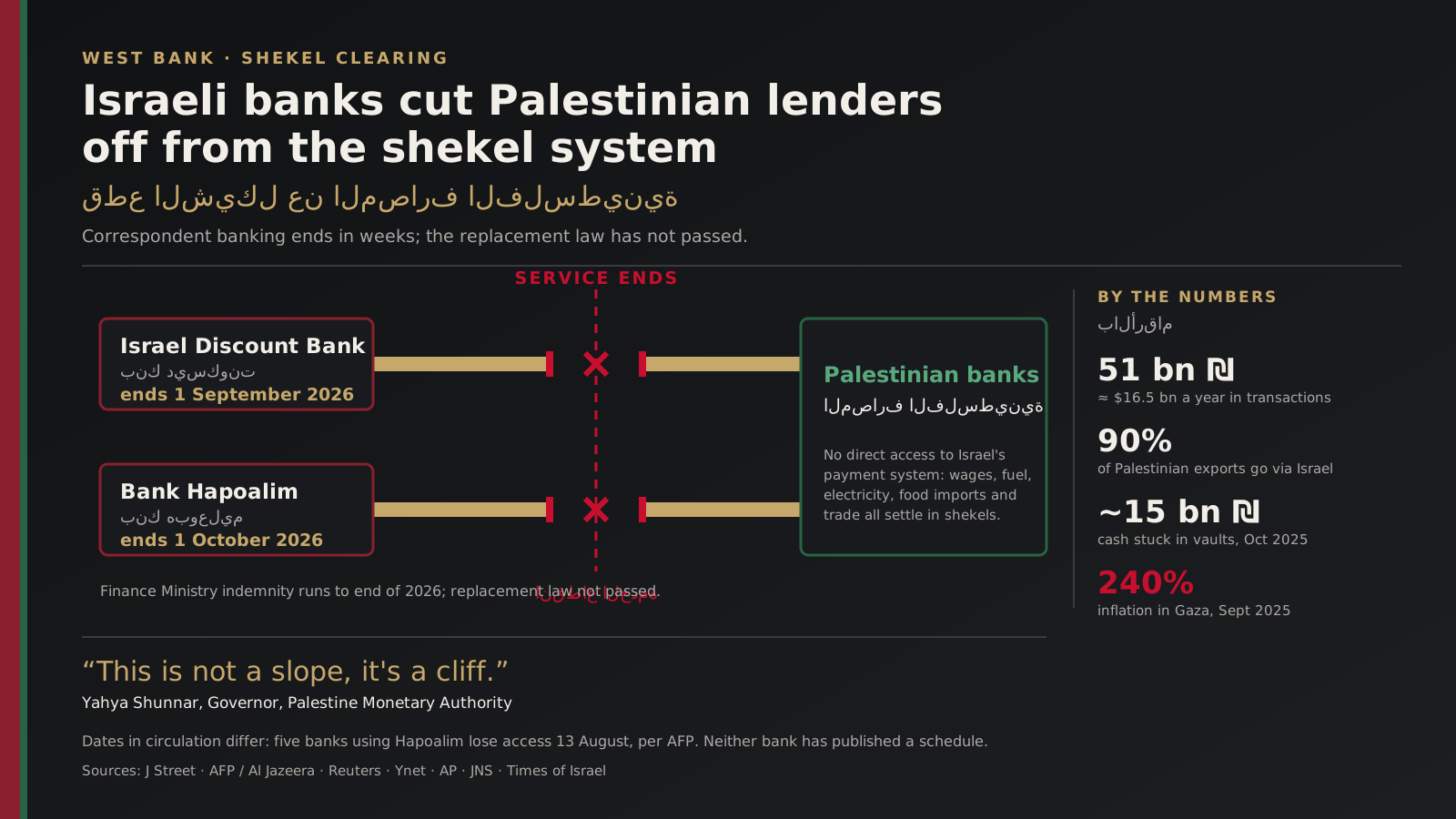
The two Israeli banks that connect the Palestinian banking system to the shekel have set dates, weeks away, to end that connection, and the Israeli legislation meant to replace them has not passed.
Israel Discount Bank informed its Palestinian counterparts in July 2026 that it intends to terminate correspondent banking services on 1 September, with Bank Hapoalim planning the same on 1 October, according to a review of the West Bank economy published by J Street.
Palestinian banking officials told Agence France-Presse, in an account carried by Al Jazeera's Arabic service, that five Palestinian banks working through Hapoalim would lose access on 13 August and those using Discount on 1 September. The dates in circulation do not match, and neither bank has published a schedule.
The two Israeli banks process around 51 billion shekels, about 16.5 billion dollars, in Palestinian transactions each year, including payments tied to the 90 percent of Palestinian exports routed through Israel, Palestine Monetary Authority Governor Yahya Shunnar told journalists in remarks reported by Reuters. "This is not a slope, it's a cliff," Shunnar said.
“PMA deputy governor Mohammad Manasra told AP, adding”
Palestinian banks cannot enter Israel's payment system directly. They rely on the two Israeli banks to settle shekel-denominated transactions, including payments for electricity, water, fuel and food imported from Israel, the transfer of wages earned by Palestinians working inside Israel, and foreign trade settlement, Al Jazeera reported, citing AFP.
The arrangement rests on an indemnity issued by Israel's Finance Ministry that shields the two banks from liability under Israeli terror-financing law, JNS reported.
Finance Minister Bezalel Smotrich ordered the accountant general to cancel that indemnity in June 2025, citing what he called the Palestinian Authority's delegitimisation campaign against Israel, according to a statement reported by The New Arab at the time.
Amid reported pressure from the Trump administration, the indemnity was later extended to the end of 2026, JNS reported.
The Times of Israel reported that since taking office at the end of 2022, Smotrich has shortened each waiver from one-year to two-week increments, and that the two banks moved to terminate after his refusal to sign the latest extension.
Discount told AFP it had conveyed its concerns to the relevant authorities given rising risks and its responsibility to depositors and shareholders; Hapoalim said the matter was still under review. Israel's Finance Ministry confirmed both banks had proposed ending the relationships, citing the overall risk environment and growing concern over private lawsuits, Reuters reported.
Ynet reported two weeks ago that the Israeli government has not completed the legislation that would replace the waiver mechanism, and is instead asking the banks to continue for roughly three more months, until after the elections. The Knesset dissolved on 17 July, elections are set for 27 October, and a new government would be sworn in at best in the first quarter of 2027, Ynet noted.
Behind that is a second blockage. Israel limits how much physical currency it takes back from the West Bank, and with the Bank of Israel refusing further notes and coins, Palestinian commercial banks cannot convert cash into electronic balances to pay suppliers or process transfers, the Associated Press reported.
"The banks have been shackled," PMA deputy governor Mohammad Manasra told AP, adding: "What is being practiced in the West Bank is economic warfare."
Estimates of the pile-up differ. Shunnar put the surplus at about 15 billion shekels in October 2025, the Palestinian outlet Al-Iqtisadi reported; Al-Araby Al-Jadeed reported roughly 18 billion, near six billion dollars, three weeks ago; Ynet described about 15 billion shekels in banknotes sitting in plastic bags in bank vaults in Ramallah, Nablus and Hebron.
Anadolu reported in August 2024 that the PMA put annual shekel accumulation at more than 22 billion, and Al Jazeera reported in June 2025 that Israel had taken back nothing for six months against arrangements providing for about 4.5 billion shekels quarterly.
JNS reported last week that Palestinian banks are moving to expedite a 4.5-billion-shekel transfer to the Bank of Israel.
Cash enters and cannot leave because employers in Israel and settlements pay Palestinian labourers in cash, AP reported. Under the 1990s Paris Protocol the PMA holds central-bank-like powers but cannot issue currency, as Al Jazeera reported when the authority studied a digital currency in 2021.
The PMA said in mid-2025 it was examining a currency other than the shekel, without naming one or setting a timeline, the Palestine News Network reported.
In Gaza the system has already failed. The Human Rights Foundation reported in September 2025 that banks had collapsed, ATMs were not working and inflation had reached 240 percent.
Residents pay brokers to convert bank balances into cash: the Institute for Palestine Studies documented commissions of 15 to 50 percent, and Prism Reports, interviewing more than a dozen people in March 2026, found rates from about 8 percent to 50.
Truthout reported that Bank of Palestine partially reopened on 19 October 2025 for administrative transactions only, with no cash entering, and that commissions on transfers routed through PayPal brokers do not fall below 15 percent. Jewish Currents reported the dollar trading inside Gaza at about 2.28 shekels against an official rate near 3.31.
PayPal itself does not serve Palestinians in the West Bank and Gaza while serving all Israelis, including settlers, as Al Jazeera reported when rights groups renewed their campaign in 2021; the Business and Human Rights Resource Centre records that the company did not respond.
A 2026 stockholder proposal asks PayPal's board to bar discriminatory exclusion in conflict zones or assess its cost, ImpactAlpha reported. The vote's outcome is not on the public record found here.
What Palestinians use instead is documented only in fragments. CoinDesk reported in 2019 that the PMA forbids institutional bitcoin transactions and that freelance payments and remittances were the main uses; +972 Magazine and Jewish Currents have since described Gazans turning to crypto alongside brokers. No published survey measures how many people actually transact that way.
Writing in MERIP, Hadas Thier argued most Palestinians lack the resources to use cryptocurrencies at all; Bitcoin Magazine disputed that reading.
Israel's counter-terror financing bureau has seized wallets it links to armed groups, though Elliptic noted of one 2023 order covering 93.7 million dollars that exchange accounts were included and the share belonging to the named group was unclear.
Whether the 4.5-billion-shekel transfer clears, whether Discount and Hapoalim hold to their notices, and whether any Israeli government legislates a replacement before a new one is sworn in remain open.