Politics & Diplomacy
Trump tells Iran to pay for Gaza's destruction

Image credit: United States Institute of Peace, Washington — G. Edward Johnson / Wikimedia Commons, CC BY 4.0 · License
Original Reporting
The Newsdesk gathers reporting from wire services and primary sources and rewrites every story in-house before publication. How our journalism is made →
Washington spent this week answering the question Palestinians have asked since the bombing of Gaza slowed: who pays to rebuild it. The answer the president gave was Tehran.
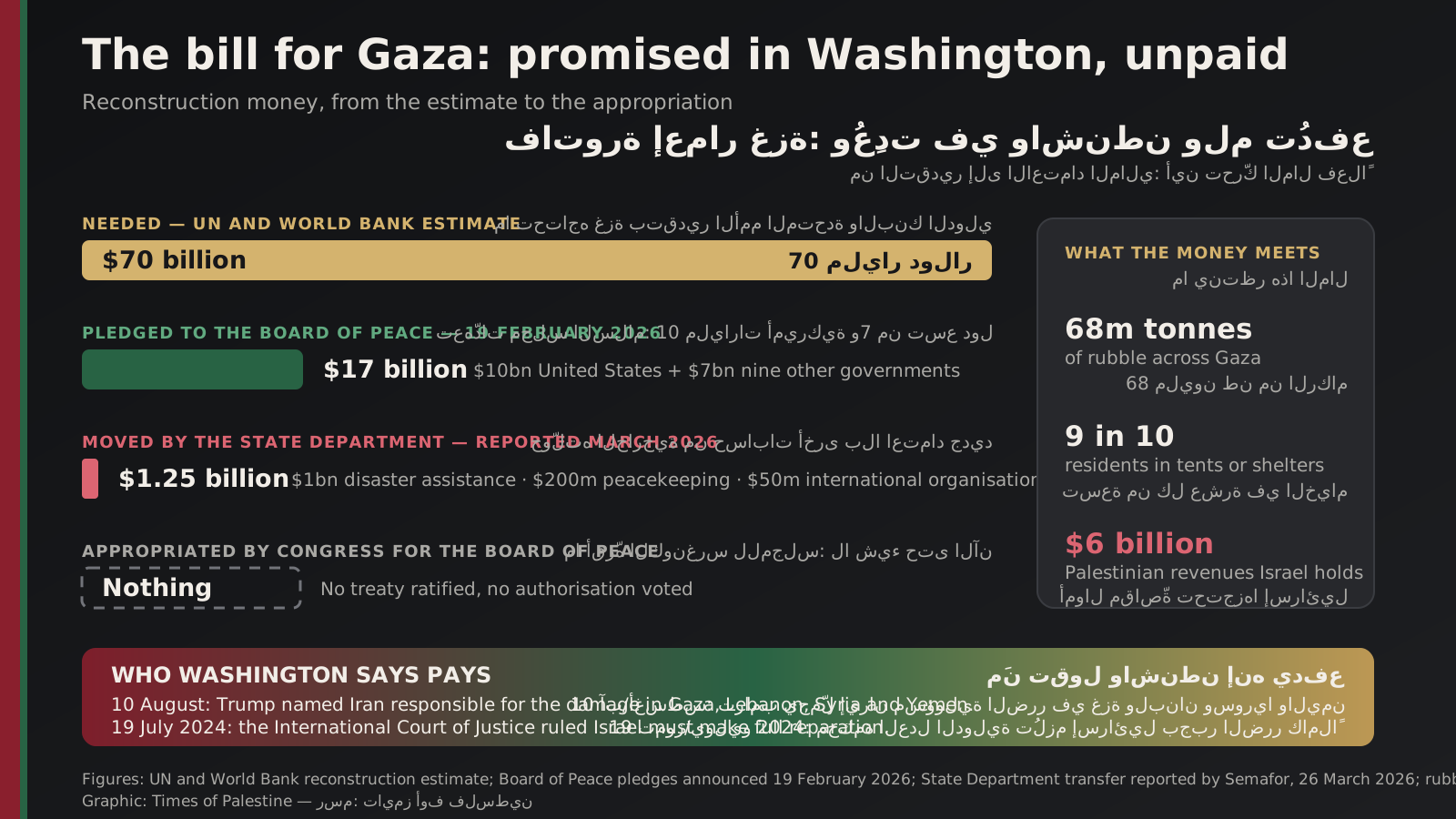
"Iran should also be responsible for the damages and death caused to the people of Lebanon, Syria, Yemen, and Gaza," Donald Trump wrote on his Truth Social account on Monday. He said he had instructed his representatives "to put this firmly into any, and all, future negotiations." The post was reported by the Times of Israel and, the following day, by Agence France-Presse.
The demand answered one Iran made first. Tehran has said American payment of war reparations is a condition of any settlement of the war that began at the end of February, along with an end to the naval blockade of its ports and the lifting of sanctions on its oil industry.
Speaking to reporters a day later, Trump described the exchange almost as a bargaining move. "They asked for reparations, you might say. Or they asked for money for the damage that we've done," he said, in remarks reported by Al Jazeera. "I said that's a good idea. Well, we're going to ask for money for the damage they've done over a 50-year period."
He said Iran should compensate the families of the 17 American sailors killed in the attack on the USS Cole off Yemen in October 2000, and raised payments to the families of Iranian protesters killed by their own authorities. Charles Kupchan, a former special assistant to President Barack Obama, told Al Jazeera the remarks amounted to "banter."
For a reader in Gaza the sentence that matters is the one naming Gaza. The destruction there was done by Israeli bombardment, and the question of who owes reparation already has a legal answer that Washington's diplomacy does not use.
The International Court of Justice held in its advisory opinion of 19 July 2024 that Israel is obliged to make full reparation for the damage caused by its internationally wrongful acts to all persons concerned in the occupied Palestinian territory. That finding sits outside the negotiating file entirely.
The ten billion Congress never voted#
The rebuilding of Gaza has an American price tag, announced with fanfare and never funded by the branch of government that holds the money.
Trump pledged $10 billion at the inaugural meeting of his Gaza Board of Peace on 19 February, held at the headquarters of the United States Institute of Peace in Washington. Nine other governments — among them Saudi Arabia, the United Arab Emirates, Qatar, Kuwait, Bahrain, Morocco, Azerbaijan and Kazakhstan — pledged $7 billion between them, and FIFA added $75 million for sports facilities.
Against that, the United Nations and the World Bank estimate Gaza needs about $70 billion for relief, recovery and reconstruction.
The pledges have not become money in the ordinary way. In a study published in March, Zaha Hassan, a senior fellow in Carnegie's Middle East programme, and the research assistant Charles H. Johnson wrote that the Senate has not ratified the Board of Peace charter as a treaty and Congress has never authorised American participation in the body.
The World Bank set up a financial intermediary fund for the effort, the Gaza Reconstruction and Development fund, but as the Carnegie authors noted the bank acts as a limited trustee with "no responsibility or accountability, fiduciary or otherwise, for the use of the funds after they have been transferred." Saudi Arabia and Kuwait have said their pledges will be paid over a period of years rather than at once.
American money has moved, but not through appropriations. Semafor reported in March that the State Department had sent $1.25 billion to the Board of Peace out of accounts written for other purposes: $1 billion from international disaster assistance, $200 million from peacekeeping operations and $50 million from international organisations and programmes. The administration had designated the board a public international organisation in January, a status that carries legal privileges.
Senator Mark Kelly of Arizona introduced a bill in April to stop it. "Trump is taking over a billion taxpayer dollars meant for disaster relief and peacekeeping — things that actually make Americans safer — and using it for his vanity project with no accountability," Kelly said.
His measure would bar federal funding for the board without separate congressional authorisation, strip the body of its privileges and immunities, and require the State Department to report on what the money has achieved in Gaza.
Senator Jeanne Shaheen, the ranking Democrat on the Senate Foreign Relations Committee, wrote to Secretary of State Marco Rubio in June with a narrower complaint. "Congress has remained largely in the dark about the Board's work, even as the Administration has sought to transfer tens of millions in U.S. funds," she wrote.
The department could not answer basic questions, Shaheen said — including whether American funds could be used to compensate Trump, who chairs the board — and the board had not established rules governing oversight and monitoring of the money.
Where the rebuilding actually began#
While the appropriation waits, one reconstruction project has started, and its location tells Palestinians more than the pledges do.
Israeli army radio reported on Sunday that Benjamin Netanyahu and his defence minister, Israel Katz, had quietly approved infrastructure works in "Green Rafah," in eastern Rafah, to build housing for Palestinians outside Hamas control. The area lies inside the Yellow Line, the boundary separating the zone the Israeli army holds from the areas where Palestinians are permitted to move.
Netanyahu's office told the station the report "distorts the facts and republishes outdated information," describing the project as an Emirati pilot scheme running for several months. The office added that the electricity, sewage and water works "will not be carried out by contractors from Gaza but will be supervised by the Israeli army."
That sequence — housing built under military supervision inside the army's line, ahead of any funded plan for the rest of the territory — is what Hassan warned about in a second Carnegie study published on 30 July.
She examined three development schemes circulating around the board, and wrote that Palestinian families would be left with "an impossible choice: Wait for what might be many years in the temporary compound, or accept resettlement abroad."
The physical facts behind that warning are not in dispute. About 68 million metric tonnes of rubble lie across Gaza, roughly nine in ten residents are living in tents or temporary shelter, two-thirds of the territory is privately owned, and the offices that held the land records were destroyed. The board's own mandate from the Security Council runs only to 31 December 2027.
The West Bank keeps its own ledger#
Palestinian money that already exists gets less attention in Washington than the billions being promised.
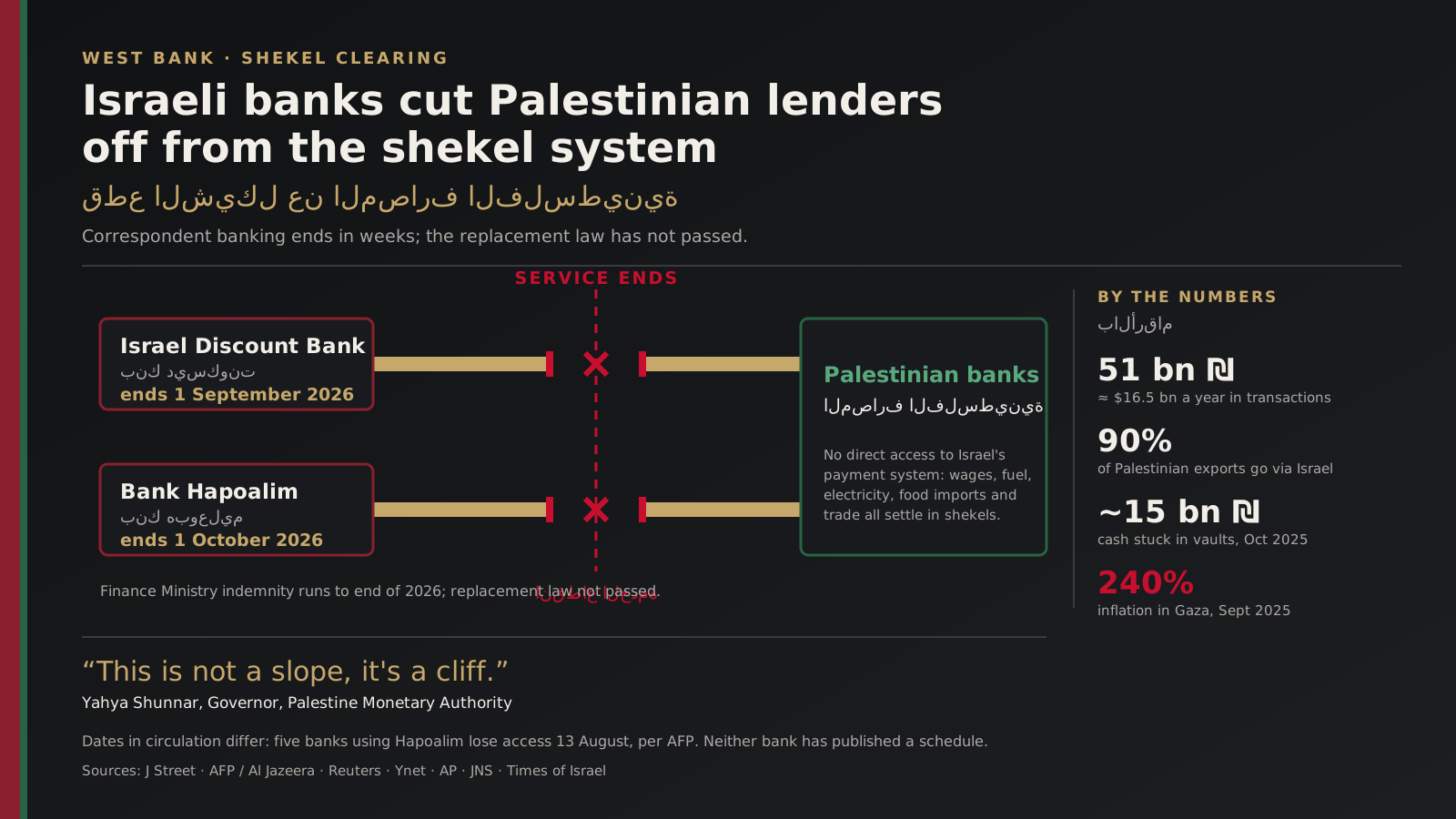
Ramiz Alakbarov, the deputy special coordinator for the Middle East peace process, told the Security Council on Tuesday that Israel is withholding around $6 billion in clearance revenues it collects on the Palestinian Authority's behalf, leaving the authority unable to pay full salaries, with a crisis over shekel transactions looming from 1 September.
He reported 76 Palestinians killed in the occupied West Bank so far this year, 18 of them children, and three Israelis killed. Some 3,800 Palestinians have been displaced this year by settler violence, demolitions and evictions, nearly half of them children.
Settlement approvals have accelerated in parallel: about 12,360 housing units advanced since January, 7,200 in Area C and 5,160 in East Jerusalem, alongside the 431 million dollars Israel allocated on 14 July for 34 new settlements. Alakbarov also recorded the first seizure of privately owned Area A land for settlement road works, near Qabatiya.
The war Washington wants closed#
The reason the president is discussing bills rather than battles is that he is trying to end the Iran war before American voters go to the polls in November.
United States Central Command said on Tuesday that a navy helicopter had fired two Hellfire missiles into the engine room of the Panamanian-flagged cargo ship Vela Nova in the Gulf of Oman after its crew ignored warnings to turn back, disabling the vessel.
It was the third ship disabled since the blockade of Iranian ports was reimposed on 14 July. The command said it has redirected 55 commercial vessels and boarded two, and that the blockade remains fully enforced.
Diplomacy is moving more slowly than the navy. A senior Iranian official told Reuters, in remarks published by Al-Monitor on Wednesday, that there is nothing to extend because "from Iran's perspective, there is no period that began" — the interim 14-point memorandum signed in June collapsed when Trump declared it over on 7 July — and that there has been "absolutely no progress" on the American return to it.
Pakistan is the channel. Its interior minister, Mohsin Raza Naqvi, met President Masoud Pezeshkian and Foreign Minister Abbas Araghchi in Tehran this week, and The National reported that Islamabad has until 16 August to turn its contacts with Washington, Tehran, Muscat and Doha into an agreement on the Strait of Hormuz that could revive the June terms.
On the other regional file, a State Department spokesperson called the Israel–Lebanon talks in Rome constructive, said the next technical round is set for early September and that "the direction of travel remains positive, and nobody is dragging their feet on implementation."
No comparable American statement has followed the settlement approvals or the withheld revenues. The administration has published no accounting of what the Board of Peace has spent or where, Shaheen's questions have drawn no public answer from the State Department, and neither the president's demand of Tehran nor his pledge of $10 billion has yet put a single dollar into the hands of a family clearing rubble in Gaza.

%20(cropped).jpg?width=640)