Politics & Diplomacy
Pentagon demands a weapons surge Congress has not funded

Image credit: US Capitol — Martin Falbisoner / Wikimedia Commons, CC BY-SA 3.0 · License
Original Reporting
The Newsdesk gathers reporting from wire services and primary sources and rewrites every story in-house before publication. How our journalism is made →
Washington spent the first week of August counting what the Iran war took out of its arsenal. It ended the week discovering that the money to put it back is stuck on Capitol Hill.
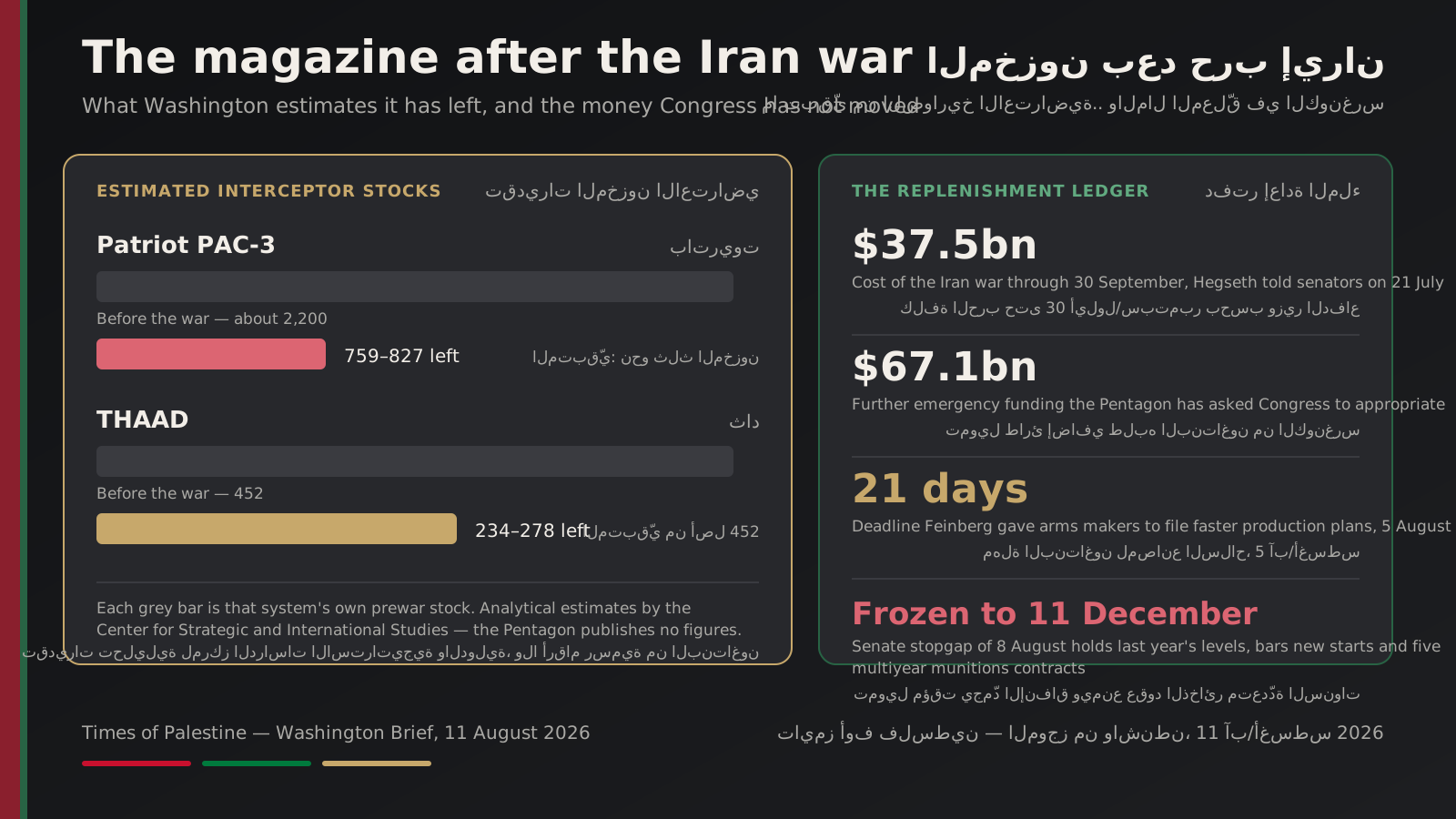
The deputy defense secretary, Steve Feinberg, wrote to the heads of the American arms industry last Wednesday with a deadline. They had 21 days, he told them, to come back with plans for "significantly faster, more aggressive delivery schedules and/or increased production for critical capabilities" — the weapons the United States has been firing faster than it can build them.
"Years-long development cycles are not acceptable," Feinberg wrote. "We must dramatically accelerate our program schedules and expand our production capacity now."
The memo was obtained by the Washington Post. The Pentagon spokesman, Sean Parnell, confirmed it was genuine and said it would inform the budget request the department sends Congress for the 2028 financial year — which is to say, money that would arrive years from now.
For a reader in Gaza or Ramallah this is not a distant American housekeeping matter. The same production lines, the same appropriations bills and the same senators decide what is delivered to Israel, and the arithmetic of scarcity is beginning to shape a debate that political argument alone had not moved.
What the war consumed#
The clearest public accounting of the damage comes not from the Pentagon but from a Washington research institute.
Analysts at the Center for Strategic and International Studies, whose missile-defence work is read across the American defence establishment, estimate that the United States held roughly 2,200 of its two most modern Patriot interceptor variants and 452 THAAD interceptors before the war with Iran began.
Their current estimate is between 759 and 827 Patriots — about a third of the prewar stock — and between 234 and 278 THAAD rounds. The figures are analytical estimates built from procurement records, not official disclosures, and the Pentagon has not published its own numbers.
"Diminished stockpiles may force the United States and its coalition partners to take more risks with interceptions," the CSIS analysts Mark Cancian and Chris Park wrote in the assessment, reported in late July by Stars and Stripes and Military Times.
CNN reported on 4 August, citing people familiar with the inventories, that close to 80 per cent of the interceptors for one key missile-defence system have been used since the fighting began.
The money that has not moved#
The Pentagon has been buying what it can without new legislation. On 3 August it signed framework agreements worth about $3 billion — some $2 billion with Northrop Grumman for Patriot rocket motors and about $1 billion for THAAD structural components, on seven-year terms — alongside a separate deal with L3Harris to triple output of Patriot propulsion parts, the trade publication DefenseScoop reported.
Michael Duffey, the under-secretary of defense for acquisition and sustainment, said such agreements are "vital to accelerating the tripling of PAC-3 and quadrupling of THAAD interceptor production." Earlier in the year the department announced similar arrangements with BAE Systems, Lockheed Martin and Honeywell.
None of that closes the gap, because the larger sums have not passed. Defense Secretary Pete Hegseth told the Senate Appropriations Committee on 21 July that the war with Iran had cost $37.5 billion through the end of September, about $8.5 billion more than the administration estimated in May.
He asked Congress for $67.1 billion in further emergency funding. NBC News reported that the department's internal figure for the war, including base repairs, destroyed aircraft and full replenishment, runs between $80 billion and $100 billion.
Then Congress did the opposite of surging. The Senate passed a stopgap funding measure on 8 August by 90 votes to 6, keeping the Pentagon at last year's spending levels through 11 December and barring new programme starts, Breaking Defense reported.
The bill left out the two things the White House had asked for by name: $1 billion for a new battleship, and permission to obligate money on five multiyear munitions contracts.
The House has passed its own version running only to 4 December. The two chambers reconcile in September, with a government shutdown waiting on 30 September if they fail. In practical terms, the department that just gave industry three weeks to move faster is itself forbidden to start anything new.
Why an empty magazine matters in Gaza and the West Bank#
Israel does not draw on American interceptor stocks alone, but it sits in the same queue, and that queue is now a subject of open argument in the Senate.
The State Department cleared $6.67 billion in new sales to Israel on 31 January, including 30 Apache attack helicopters worth about $3.8 billion and thousands of light tactical vehicles. In April the Senate voted down two resolutions by Senator Bernie Sanders to block sales of 1,000-pound bombs and armoured bulldozers; the bulldozer measure drew 40 votes against 59, the highest count yet recorded on an Israel arms sale.
On Sunday the argument moved from procedure to policy. Senator Chris Murphy, a Connecticut Democrat on the foreign relations committee, told NBC's Meet the Press that he wants "a strong U.S.-Israel relationship" and supports Israel, but is unable to support this government's actions. "They are not aligned with U.S. national security objectives," he said.
Until there is a different Israeli government and a different policy, Murphy said, "it's going to be hard for people like me that want a Palestinian state, side by side with a Jewish state in the region, to support continuing to send arms to Israel."
He was answering Benjamin Netanyahu, who had told his cabinet the same day that as long as he holds elected office "a Palestinian state will not be established, neither in Gaza nor in Judea and Samaria" — the Israeli official name for the occupied West Bank.
Israel builds its own line#
Israel read the scarcity earlier than Washington did. The Wall Street Journal reported on 27 March that the army had begun rationing interceptors; Semafor reported that Israeli officials had told the Americans their ballistic-missile interceptor stock was critically low, a characterisation the Israeli army publicly disputed.
In April the defence ministry announced a partnership with an American manufacturer to accelerate Arrow production, building on a multibillion-shekel contract signed with Israel Aerospace Industries in December to expand Arrow 3 output. The defence minister, Israel Katz, said the acceleration was "already driving a significant increase in monthly output."
For Palestinians the significance is not the interceptors, which are pointed at Iranian missiles. It is that Israel's war economy has moved to a footing where American supply is a bottleneck to be engineered around rather than a certainty — and where American leverage, if any is ever used, has a shorter reach than the arguments in the Senate assume.
The war Washington wants to end#
All of this sits under a president who has told reporters he wants out. Trump said in a brief telephone interview with the Axios and Channel 12 correspondent Barak Ravid that he is "low keying" Iran: "We are only semi-negotiating with them. We are just watching Iran with its huge inflation and the fact they have no money."
The Wall Street Journal reported on 9 August that Trump has signalled to aides he could declare the war finished without a nuclear agreement if the Strait of Hormuz reopens fully. Petrol averaged $4.02 a gallon in the United States on 8 August, against $3.16 a year earlier, and the price is doing more work in the White House than any argument about enrichment.
What remains unsettled is whether the industry answers Feinberg's demand by the deadline that falls late in August, whether the supplemental survives a Congress that has just chosen a freeze, and how much of any replenishment is earmarked for transfer onward. The Pentagon has published no accounting of what it has delivered to Israel during the Iran war, and Congress has not asked for one in public.
%20(cropped).jpg?width=640)