Politics & Diplomacy
White House waves off Netanyahu's rejection as Israeli election politics
Running file Israel Votes 2026 27 DAYS →
Image credit: Nickolay Mladenov — European People's Party / Wikimedia Commons, CC BY 2.0 · License
Original Reporting
The Newsdesk gathers reporting from wire services and primary sources and rewrites every story in-house before publication. How our journalism is made →
Benjamin Netanyahu told his cabinet on Sunday that Israel rejects the American document meant to end the war in Gaza. Washington's answer, delivered anonymously and without heat, was that it does not much mind.
A senior United States official told the Axios correspondent Barak Ravid that the White House is not bothered by the prime minister's statement and reads it as Israeli campaign season. "We understand Bibi's political needs," the official said, "we have no problem with it as long as he continues to do what we ask — especially regarding restraining attacks in Gaza."
That sentence is American policy in Gaza this week, and it is worth reading twice in Deir al-Balah or Khan Younis. Washington is not measuring its ally by what he signs. It is measuring him by whether the bombs stay on the racks.
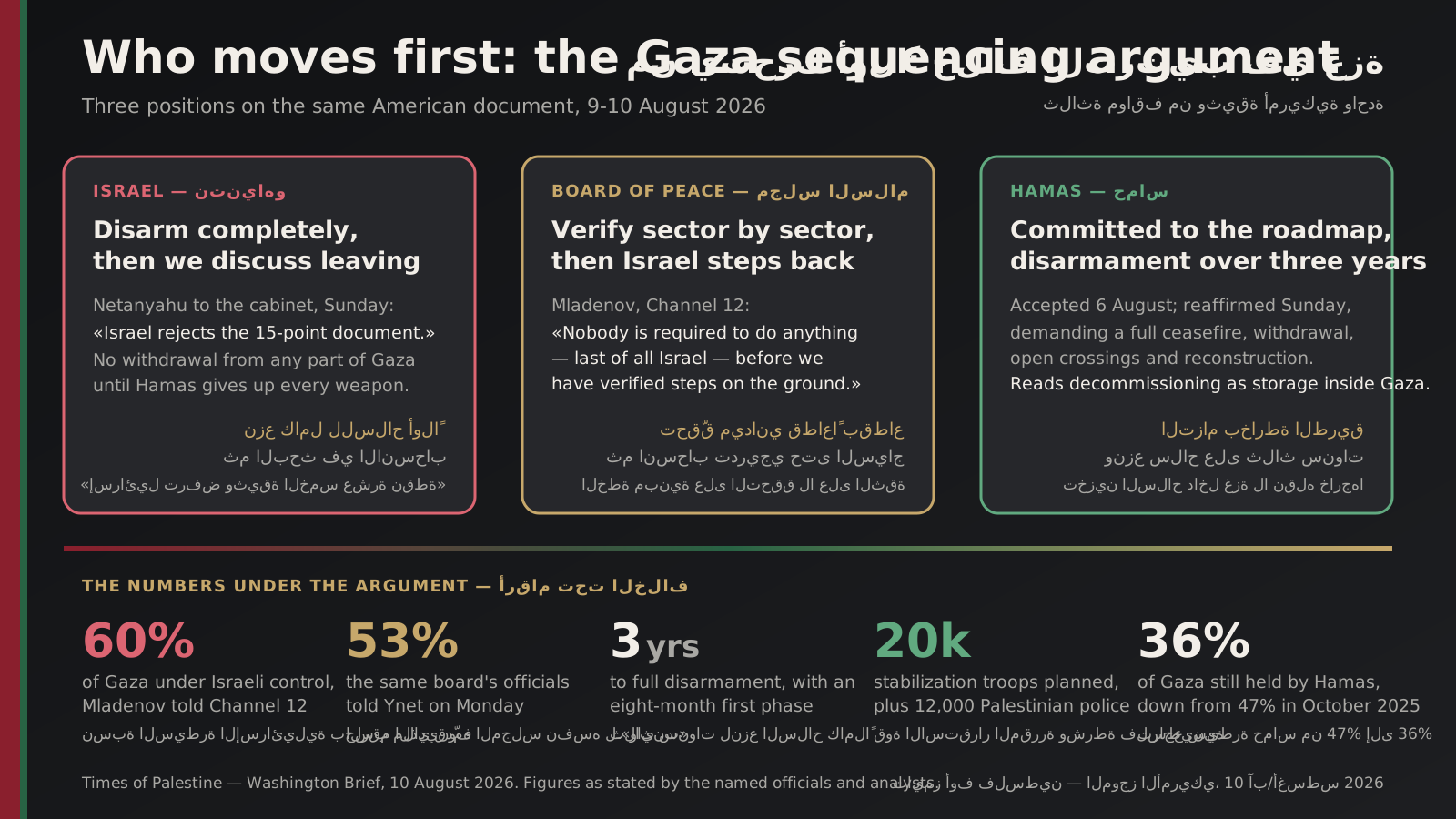
Netanyahu had left no ambiguity. "I want to clarify this: Israel rejects the 15-point document," he told the cabinet. "I have heard people saying, 'You didn't say that.' So here I am saying it again." The army, he added, will not withdraw from any part of Gaza until Hamas is disarmed.
“we have no problem with it as long as he continues to do what we ask — especially regarding restraining attacks in Gaza”
The order of operations Washington describes#
Nickolay Mladenov, the director-general of the American-chaired Board of Peace, spent the same weekend explaining that the plan does not ask Israel to move first either.
"Nobody is required to do anything — last of all Israel — before we actually have verified steps on the ground," he told Israel's Channel 12. The roadmap, he said, is not built on trust: "the only way that we do this is if we all agree that nothing happens on trust."
The sequence he set out runs sector by sector. Once the weapons in an area are decommissioned, "Israel is required to move back progressively, step by step, in stages, ultimately to the fence" — the boundary of the Strip.
Until then the army holds the yellow line, the ceasefire boundary drawn in October 2025 that cuts Gaza into a part its people may enter and a part they may not. Mladenov added that the plan leaves Israel free to answer any threat it judges imminent, and that dismantling the tunnel network — a job he put at more than a decade — could go faster with the board's cooperation.
How much ground that leaves under the army depends on whom you ask inside the same body. Mladenov told Channel 12 that Israel controls more than 60 per cent of Gaza. Board of Peace officials told the Israeli news site Ynet on Monday that the army is holding the original yellow line across roughly 53 per cent and has put nothing beyond it.
For Palestinians the distance between those two figures is measured in neighbourhoods. The interval between verified decommissioning and the fence is where two million people are expected to live in the meantime.
The pullback that was approved, then cancelled#
What a rejection costs can be measured in one file.
Israeli security officials said the prime minister personally approved a pilot withdrawal from three small areas near Rafah in the south — a step cleared by the army, by Netanyahu himself and by the United States — before reversing it within a day and telling the cabinet that nothing moves until Hamas gives up every weapon. The military establishment learned of the reversal from the news, the officials said.
Nothing in Washington's public posture on Monday attached a price to that reversal.
What the document does not define#
The roadmap Hamas accepted last week and Netanyahu refused on Sunday is thinner than either side's rhetoric about it.
Writing on 7 August for the Washington Institute for Near East Policy, a research centre in the capital whose analysts are read closely at the State Department, Neomi Neumann set out its arithmetic: full disarmament within three years, a first disarmament phase of roughly eight months, fourteen days to finalise the text once Israel signs on, and Palestinian elections pencilled in for the autumn.
The word doing the most work is the one nobody has defined. Decommissioning has no agreed meaning, Neumann wrote: Hamas reads it as weapons placed in controlled storage inside Gaza, while Israel insists on physical removal, and the document does not say which categories of weapon are covered or who inspects them.
The institutions meant to carry the plan are mostly future tense as well. There is no Palestinian police force, and neither the International Stabilization Force nor the security arm of the technocratic body meant to govern — the National Committee for the Administration of Gaza, headed by the Gaza-born engineer Ali Shaath and formed in Cairo in January — has been stood up.
The American Civil-Military Coordination Center that is supposed to knit the whole machine together has been largely paralysed since the Iran war, she added. Hamas's own territorial control, by her estimate, has fallen from about 47 per cent of Gaza in October 2025 to roughly 36 per cent.
The force that starts in Rafah#
The stabilization force is the piece Palestinians will meet first. It was authorised by Security Council resolution 2803 in November 2025 for two years, and it is commanded by the American major general Jasper Jeffers.
The design calls for about 20,000 soldiers alongside 12,000 trained Palestinian police, with Indonesia supplying the largest contingent and the deputy commander; President Prabowo Subianto has offered up to 8,000 troops. Morocco, Kazakhstan, Kosovo and Albania have committed personnel, and Egypt and Jordan are to train police.
Israeli television reported on Sunday that preparations for deploying the force inside parts of Gaza have begun. The plan puts it into the Rafah sector first and expands sector by sector, which means the first Gaza city to see a foreign uniform will be the one closest to Egypt, and the one where reconstruction planning has moved furthest.
Congress gets briefings, not a vote#
A Board of Peace delegation led by the senior adviser Josh Gruenbaum, with the retired general Mark Schwartz joining remotely, briefed the national security staffs of the four congressional leaders — John Thune, Chuck Schumer, Mike Johnson and Hakeem Jeffries — on 4 August, and said afterwards that it was determined to work with Congress on a bipartisan basis on peace, security, governance and reconstruction in Gaza.
Briefings are not authorisation. The board's mandate comes from the Security Council, its money from donors and its leverage from the president, and the instrument Congress reached for last week was a letter from twenty-one members asking the administration to restore the sanctions it had lifted from West Bank settlers.
The Iran file underneath#
The coordination centre Neumann described as stalled has been stalled since the war with Iran, and that file is not moving either.
President Donald Trump told Axios on Sunday that "we are only semi-negotiating" with Tehran, adding that Washington is "just watching Iran with its huge inflation and the fact they have no money."
Iran's foreign minister, Abbas Araghchi, said the same weekend, in remarks carried by the Iranian news agency IRNA, that messages passed through intermediaries are not negotiations, and that talks cannot resume until the United States ends what he called its violations of the June memorandum and compensates for them.
That standoff reaches Gaza twice. The Gulf states expected to fund reconstruction earn from oil priced by the calm of their own waterway, and the American centre that is meant to coordinate aid and deconflict the armies inside Gaza has not recovered from the war with Iran.
Two clocks now run against each other. The roadmap gives disarmament three years; the Israeli election is on 27 October, and the prime minister who would have to sign the document is running against the partners who would leave his coalition if he did.
Between them sits the position an American official would state only without his name on it: words do not count, deeds do. In Gaza the deed that counts is a soldier stepping back from a line, and the only such step approved so far is the one the prime minister cancelled.