Transparency & Accountability
Donors bypass World Bank fund for Gaza, sending it nothing
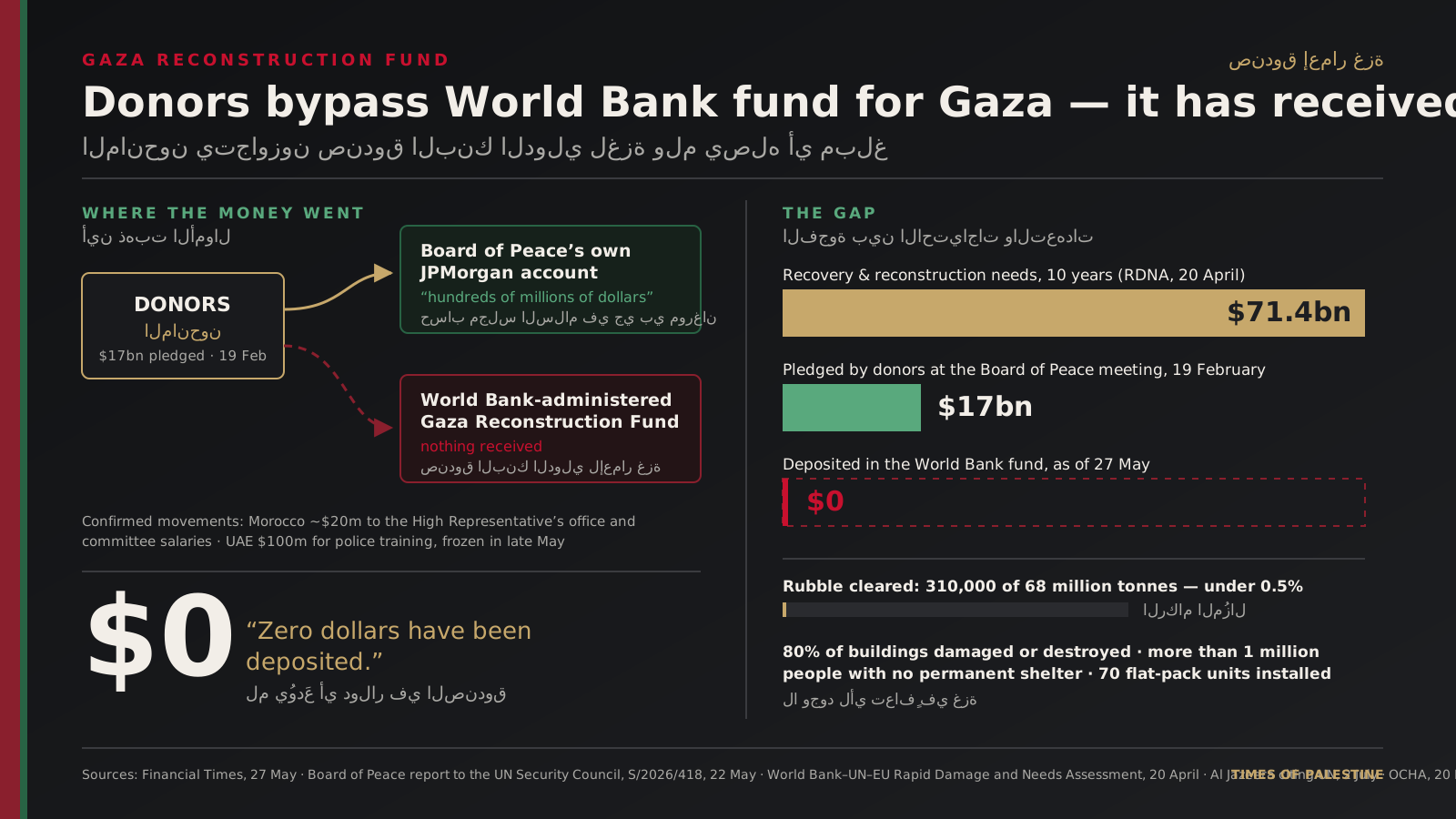
Graphic: Times of Palestine
Original Reporting
The Newsdesk gathers reporting from wire services and primary sources and rewrites every story in-house before publication. How our journalism is made →
The fund created to rebuild Gaza has taken in no money.
Six months after donors announced $17 billion in pledges at the first meeting of the Board of Peace in Washington on 19 February, the Financial Times reported on 27 May, citing four people familiar with the matter, that the World Bank-administered Gaza Reconstruction and Development Fund had received nothing.
"Zero dollars have been deposited," one of those sources told the paper.
The board's own first written report to the UN Security Council, circulated on 22 May as document S/2026/418, put the pledge figure at $17 billion and stated that "the gap between commitment and disbursement must be closed with urgency," adding that funds committed but not disbursed are the difference between a framework on paper and one that delivers on the ground.
Money that has moved went elsewhere. The board's spokesperson told the Financial Times that donations had been deposited directly into a JPMorgan account the board established itself, an account which, unlike the World Bank trust fund, carries no obligation to report its position to contributors or board members.
A board official told the paper that several options had been set up to receive funding and that "at this point, contributors have opted to use other options," and said the board would report its financials to its own executive board "at a time deemed appropriate."
On 11 June a board official told The Hill the organisation had collected "hundreds of millions of dollars" — against the $17 billion announced in February. No donor-by-donor ledger has been published by either the board or the World Bank; Middle East Eye reported on the day of the pledging conference that a full breakdown of the figures was not made available.
What is on the record, donor by donor, is mostly the pledge and not the transfer.
Middle East Eye and Time reported that nine states — Kazakhstan, Azerbaijan, the United Arab Emirates, Morocco, Bahrain, Qatar, Saudi Arabia, Uzbekistan and Kuwait — pledged more than $7 billion between them, with the United States pledging $10 billion on top.
The Arab Weekly reported the UAE pledged $1.2 billion and Saudi Arabia, Kuwait and Qatar $1 billion each; Carnegie Endowment researchers wrote in March that those four states had each pledged a billion dollars or more.
One contribution has a confirmed destination. The Financial Times reported that Morocco has contributed about $20 million, which has gone to the office of Nickolay Mladenov, the board's High Representative for Gaza, and to salaries for the Palestinian technocratic committee formed to run Gaza's civil administration — the National Committee for the Administration of Gaza, led according to the board's report by Chief Commissioner Ali Sha'ath.
A second is pledged and frozen. The same reporting, summarised by the Palestinian outlet Palinfo on 27 May, said the UAE had put forward $100 million to train a new Gaza police force, that the money remained frozen as of late May and that the training programme had not begun.
The largest pledge is not routed through the fund at all. The State Department committed to reallocate roughly $1.2 billion of aid spending towards board priorities but told a senior congressional aide it did not intend to channel that money through the Board of Peace, according to reporting summarised by Tech Times on 11 July.
Senator Catherine Cortez Masto introduced legislation in March to block the department from transferring $1 billion in fiscal 2026 funds to the board, The Hill reported.
A board explanation is on the record. An official quoted by The National on 3 June said the fund had yet to receive money because Gaza remains in a humanitarian phase rather than a reconstruction phase, with reconstruction to begin in Rafah — a city Jared Kushner said could be rebuilt within three years.
Against the money, the physical record. Roughly 68 million tonnes of rubble lie across the Strip and only about 310,000 tonnes, under 0.5 percent, have been cleared, Al Jazeera reported on 2 July citing UN figures, a rate that would take more than 140 years.
The UN Development Programme said in November that clearing most of the rubble is possible in seven years given the right conditions, and that its teams removed more than 50,000 tonnes in the first month after the ceasefire.
Durable shelter has barely started. OCHA reported on 20 February that partners had brought 872 flat-pack housing units into Gaza since the start of the year and that 70 had been installed — 16 at health facilities and 54 at the Al Zaytoun displacement site in Gaza city.
OCHA's shelter partners have been reaching about 20,000 households a week, mainly with mattresses, clothing and kitchen kits rather than housing, because tents and tarpaulins are short.
Briefing the Security Council on 21 May, Mladenov said that "there is no recovery in Gaza," that around 80 percent of buildings are damaged or destroyed and that more than a million people have no permanent shelter. UN News reported the same day that the 2026 Flash Appeal, seeking over $4 billion for nearly three million people in Gaza and the West Bank, was about 13 percent funded.
The bill is larger than the pledges by a factor of four. The final Rapid Damage and Needs Assessment, released on 20 April by the World Bank, the UN and the European Union, put recovery and reconstruction needs at $71.4 billion over ten years.
Two constraints sit in front of any transfer. Security Council Report noted in its July forecast that the 15-point roadmap presented by Mladenov and the guarantors ties reconstruction to phased, verified decommissioning of Hamas weapons in certified areas, and that talks on it were unfinished at the end of the reporting period.
The UN Special Coordinator's office told the Council on 21 May that Israel says it now controls 60 percent of Gaza, up from 52 percent, and that aid operations remain constrained by limited crossings and restrictions on items Israel classes as dual-use.
The Carnegie Endowment's March analysis found the board's charter does not set out oversight and audit arrangements for donor funds. Whether the pledges announced in February reach the trust fund built to receive them, and on what conditions, will be measurable when the board files its next report to the Council.
The tracker above will be refreshed as each figure moves: pledged, transferred, cleared, built.