Politics & Diplomacy
Palestine's election commission opens registration without Gaza and Jerusalem rules
Running file Palestine Votes 2026 →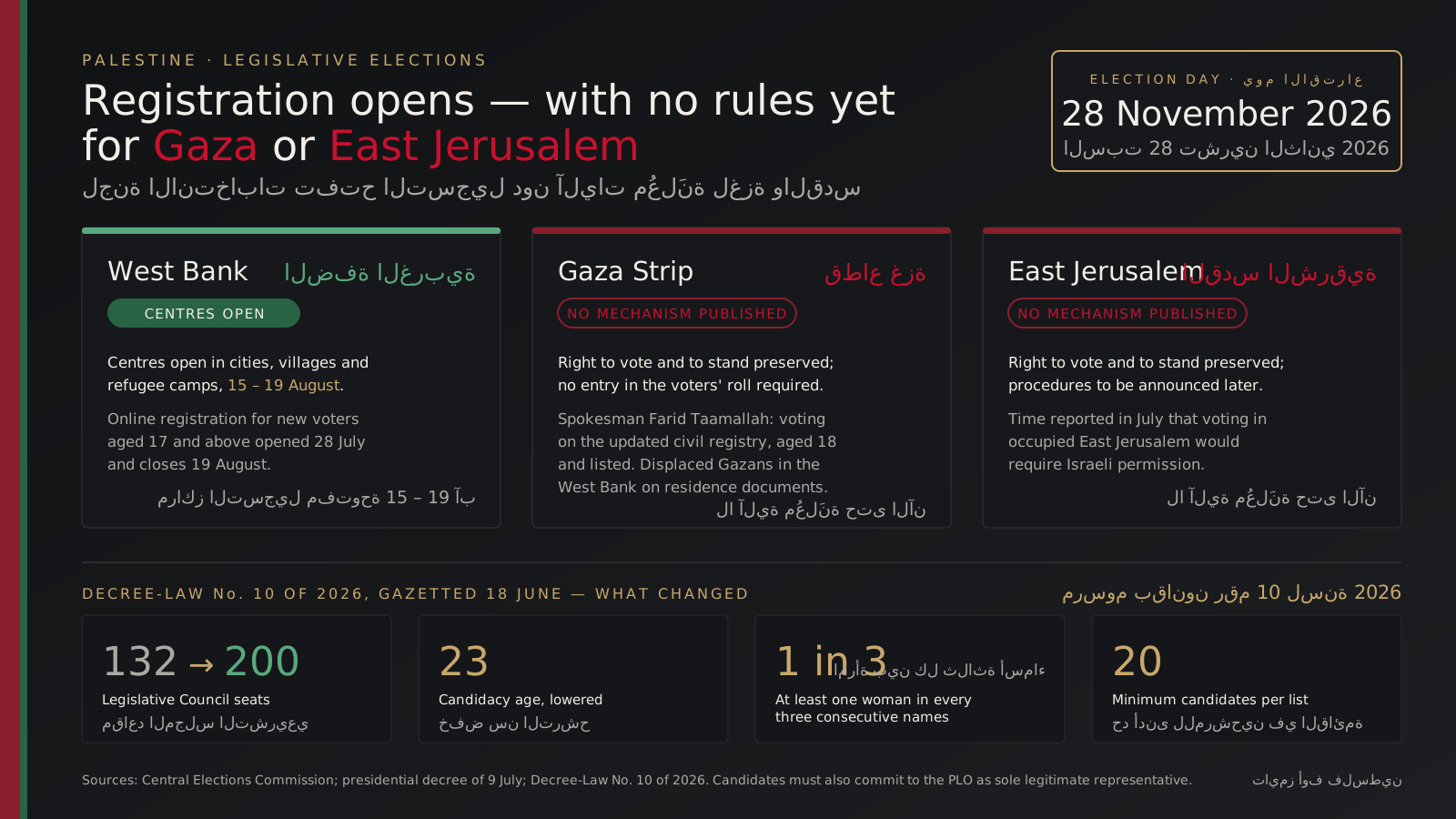
Graphic: Times of Palestine
Original Reporting
The Newsdesk gathers reporting from wire services and primary sources and rewrites every story in-house before publication. How our journalism is made →
Registration centres open in West Bank cities, villages and refugee camps from 15 to 19 August, the Central Elections Commission announced, the first field stage of its preparations for the legislative elections set for 28 November. Online registration for new voters aged 17 and above opened on 28 July and closes on the same date, 19 August, the commission said.
For Gaza and East Jerusalem, no mechanism has been published. The commission said the right of residents in both to vote and to stand is preserved and does not require entry in the voters' roll, and that the procedures for their participation will be announced later.
The commission's spokesman, Farid Taamallah, said in remarks carried by the Masder news network that voting in Gaza would rest on the updated civil registry: anyone aged 18 and listed in it could vote where they are now, with electronic safeguards against double voting.
Gazans displaced to the West Bank, he said, would be registered on residence documents issued by the Interior Ministry rather than having to change the address on their ID cards.
The vote itself rests on a decree issued on 9 July. Its text, carried by the Ramallah news site Raya and Palestinian state broadcaster PBC, sets Saturday 28 November 2026 for legislative elections and calls on Palestinians in Jerusalem, the West Bank and the Gaza Strip to elect members of the Palestinian Legislative Council. The decree was issued under Decree-Law No. 1 of 2007 on general elections and its amendments.
No presidential date was set. The Doha Institute for Graduate Studies wrote that the decree deferred the presidential vote, expected in the first quarter of 2027; Euronews Arabic reported, citing the official WAFA agency, that the date would be fixed under the amended law.
On 3 August, WAFA reported that Abbas told the commission's chairman, Rami Hamdallah, that the elections would be held as scheduled, calling the vote a national and democratic entitlement.
The rules changed shortly before the date was set. The commission itself published Decree-Law No. 10 of 2026, gazetted on 18 June, which raises the Legislative Council from 132 to 200 seats, lowers the candidacy age to 23, requires at least one woman among every three consecutive names on a list, and sets a minimum of 20 candidates per list.
The same amendment, according to the commission's summary of it, requires every candidate to commit to the amended Basic Law, to the decree-law and its amendments, and to the Palestine Liberation Organisation as the sole legitimate representative of the Palestinian people, together with its political and national programme and relevant resolutions of international legitimacy.
That condition first appeared in January, before the April local elections.
The Times of Israel reported that the amendment required all candidates to sign a statement accepting the PLO's national programme, and would likely prevent Hamas and like-minded factions from running; The New Arab reported that Palestinian analysts saw the amendment as designed to exclude Hamas, and that no such requirement applied in the 2006 legislative elections or the 2022 West Bank local elections.
A joint statement published by the anti-corruption coalition AMAN in November 2025, signed by the Independent Commission for Human Rights, the Palestinian NGO Network, the Civic Coalition for Elections and others, said conditioning candidacy on a specific political programme violates the right to political participation under the International Covenant on Civil and Political Rights, to which Palestine has acceded, and conflicts with the Declaration of Independence and the Basic Law.
Hamas rejected the amendments as reflecting a "monopolising of decision-making", Euronews Arabic reported, and said the measures were intended to entrench the existing political reality in the leadership's favour.
On 28 June, Al Jazeera Arabic reported, Hamas, Islamic Jihad, the Palestinian National Initiative, the PFLP, the DFLP and the PFLP-General Command jointly demanded an urgent meeting of faction secretaries-general and elections framed by a unified national strategy. The newspaper Al-Manar reported that Hamas sources told Asharq the movement was studying participation, directly or indirectly.
Israel's Begin-Sadat Center for Strategic Studies described the exclusion of Hamas and Islamic Jihad as a defining feature of the reform package, tied to their designation as terrorist organisations, and wrote that Hamas media are working to portray the vote as lacking public trust and national consensus.
Whether a president may amend election law at all while the Legislative Council does not sit is contested. The Gaza-based Al-Risala reported that Decree-Law No. 10 revived that dispute, and Al-Manar noted that Abbas dissolved the council in 2018.
The legal researcher Issam Abdeen told Al-Araby Al-Jadeed that neither the 2007 law nor the 2026 amendment requires the presidential and legislative votes to be simultaneous, but that Article 36 of the Basic Law fixes a four-year presidential term.
The analyst Hani al-Masri told Al Jazeera Arabic that the occupation is not a spectator and can block a vote, arrest candidates or void results, as in 2006, when dozens of elected members and ministers were detained. He also warned that a 1 per cent threshold could reward families and business figures over political programmes.
Time reported in July that nearly two million people are displaced in Gaza, that voting in occupied East Jerusalem would require Israeli permission, that Gaza's health ministry counted more than 1,000 Palestinians killed in Israeli attacks between the 10 October ceasefire and late June, and that the UN recorded more than 1,000 settler attacks in the West Bank, about six a day, by June.
In April's local elections, just under 16,000 people voted in Deir al-Balah, the only Gaza municipality included.
Under the Oslo accords, as the Times of Israel has reported, Palestinians in Jerusalem may vote at designated post offices; in 2021 the commission said 150,000 residents could instead vote outside the city without Israeli approval. No Israeli decision on voting in Jerusalem in November is on the public record.
The PLO's own parliament follows a separate track. Abbas decreed on 2 February that Palestinian National Council elections would be held on 1 November, and approved the council's 2026 electoral system on 4 June: 350 members, 200 for the homeland constituency and 150 for Palestinians abroad, elected by closed-list proportional representation.
Sky News Arabia, citing a source, reported that no National Council vote will be held inside the West Bank and Gaza, that elected Legislative Council members will sit on the council by law, and that voting abroad will take place in host states.
The commission has not published how many voters have registered so far, nor whether polling stations can be opened in a Gaza Strip where most of the population is displaced. The presidential date remains unfixed.