Politics & Diplomacy
Bessent promises Iran total isolation as Israeli banks drop Palestinians

Image credit: Treasury Secretary Scott Bessent — US Department of the Treasury / Wikimedia Commons, public domain · License
Original Reporting
The Newsdesk gathers reporting from wire services and primary sources and rewrites every story in-house before publication. How our journalism is made →
Washington's weapon of the moment is not a missile. It is a bank account, and the department that controls it spent this week on two files at once.
Treasury Secretary Scott Bessent went on Newsmax's Rob Schmitt Tonight on Thursday evening and promised the most complete financial strangulation of a country ever attempted. "We are going to apply measures like have never been seen in the history of the economic isolation of a country," he said, telling viewers to "watch this space for more announcements coming next week."
He described what is coming as "a combination of economic isolation like the world has never seen before, and the continued blockade in the Strait of Hormuz that will keep anything from going in or out of the Iranian ports." The remarks were reported by Bloomberg and, separately, by The Hill.
Two weeks after the promised announcement lands, on 1 September, a different banking channel closes. It is the one through which almost every shekel in the occupied Palestinian territory is settled, and the same Treasury has spent months quietly asking Israel to keep it open.
What the campaign against Iran has already done#
Bessent calls the effort Operation Economic Fury, a name his department has attached to sanctions announcements since the spring. He summarised the sequence to Newsmax in five words: "We went from Epic Fury to Economic Fury."
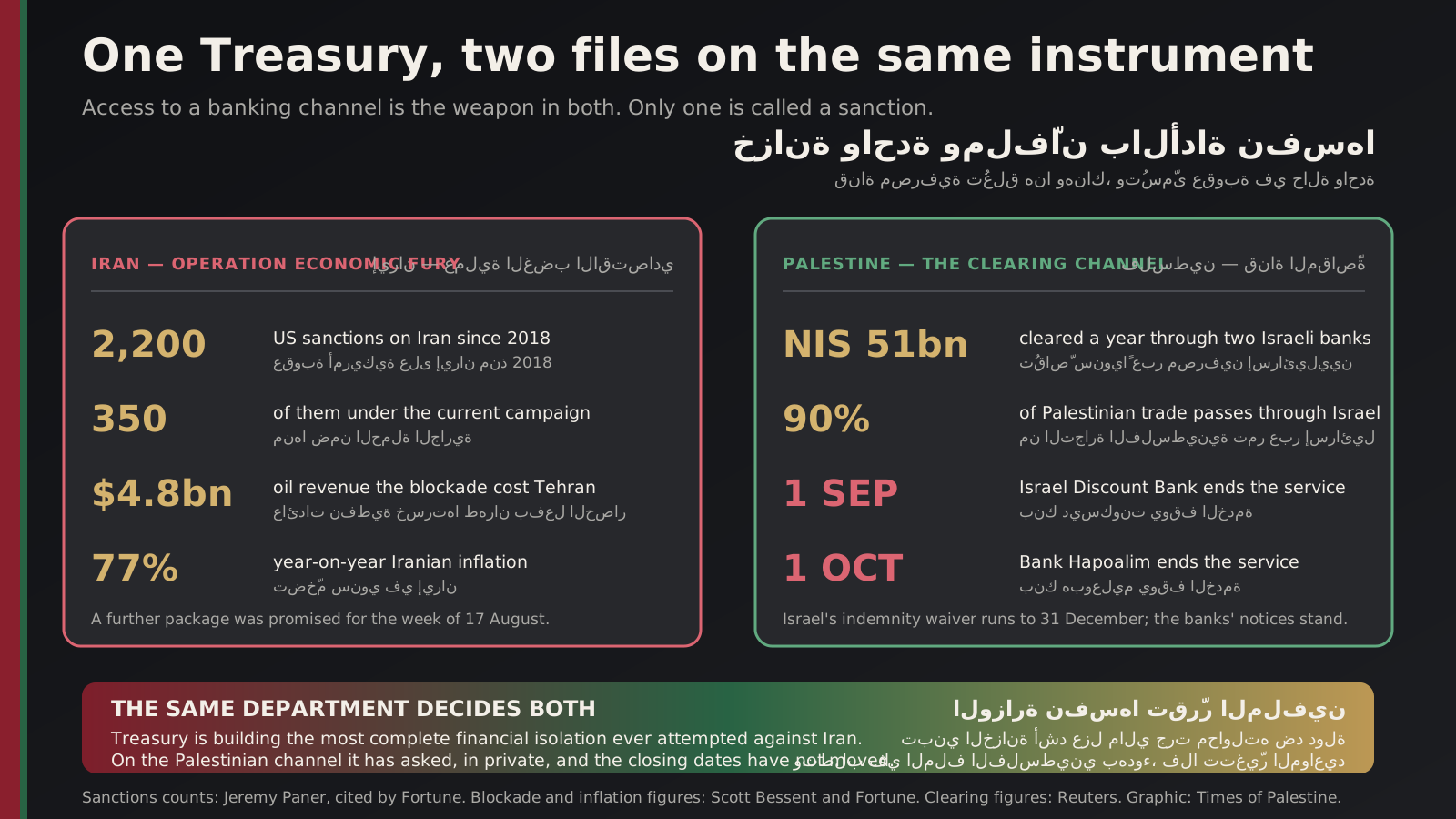
The measure of it is on the record. Jeremy Paner, a sanctions lawyer, counted roughly 2,200 American sanctions imposed on Iran since 2018 in an assessment cited by Fortune on Thursday, of which about 350 have come under Bessent's campaign this year.
Bessent has put the cost to Tehran of the naval blockade at about $4.8 billion in lost oil revenue, The Hill reported. Iranian year-on-year inflation has reached 77 per cent, and the currency has fallen more than a tenth below its prewar level.
Mike Waltz, the American ambassador to the United Nations, told Fortune that Iranians fear the treasury secretary more than they fear the defence secretary, Pete Hegseth, and that "the government is causing the people to suffer, and we're going to keep pressing."
Not everyone in Washington's sanctions world expects the pressure to convert. Miad Maleki of the Foundation for Defense of Democracies, a hawkish research institute, and David Tannenbaum of Blackstone Compliance Services both told Fortune that the measures are working as economics while leaving open whether they produce a policy change.
The channel that closes on the first of September#
The Palestinian banking system cannot settle the currency it uses. Since the Oslo agreements, two Israeli banks — Israel Discount Bank and Bank Hapoalim — have been assigned the job of clearing Palestinian shekel transactions, because Palestinian banks have no access to the Israeli payment system.
Reuters put the volume the two banks handle at 51 billion shekels a year, about $16.6 billion, and reported that roughly 90 per cent of Palestinian trade — food, fuel, medicine — moves through Israel.
Both banks have now given notice. Discount told its Palestinian counterparts in July that it will stop the service on 1 September, and Hapoalim will follow on 1 October, each citing the risk of handling the transactions without a permanent legal arrangement behind them.
The arrangement they mean is an indemnity waiver signed by Israel's finance ministry, shielding the banks from lawsuits should a Palestinian account later be tied to an armed group. Finance Minister Bezalel Smotrich has issued those waivers in shortening increments through his term, and the current one runs only to 31 December.
Yahya Shunnar, the governor of the Palestinian Monetary Authority, told Reuters that severing the relationship "could have profound consequences — not only for Palestinians but for Israelis (and) for regional stability."
Washington asked, and the dates did not move#
The American record on this file is longer than the current administration's silence suggests.
In October 2024, Treasury Secretary Janet Yellen used a press conference at the annual meetings of the International Monetary Fund and the World Bank to press the point in public. "We look forward to the Israeli cabinet extending the waivers to preserve correspondent banking relationships for banks in the West Bank," she said, tying it to economic stability in the occupied territory.
Bessent inherited the file and has worked it privately. Reporting by the Times of Israel describes American diplomats raising correspondent banking directly with the Israeli government and warning that pushing the Palestinian economy into cash contradicts the anti-money-laundering logic Washington applies everywhere else.
That pressure produced something. Smotrich extended the indemnity to the end of the year, past the 27 October Israeli election, and a State Department spokesperson welcomed the decision this month. What it did not produce was a withdrawal of the banks' termination notices, which is the date that actually governs.
Congress has asked, too. On 16 September last year, Senators Elizabeth Warren, Chris Coons, Brian Schatz, Jack Reed, Jeanne Shaheen and Mark Warner wrote jointly to Secretary of State Marco Rubio and to Bessent, urging the administration to "press the Israeli government to stop withholding clearance revenues and disrupting correspondent banking relationships." No public answer from the Treasury has followed.
What exclusion looks like from the Palestinian side#
For a reader in Ramallah or Nablus, financial isolation is not a policy being debated. It is the condition already in place, arriving through two separate mechanisms.
The first is the money that exists. Mohammed Samhouri, writing for the Arab Center Washington DC in February, calculated that Israel had withheld about $4.5 billion in clearance revenues by the end of last year — Palestinian customs duty and value-added tax that Israel collects at the ports and owes onward under the Paris Protocol, amounting to two-thirds of the Authority's income.
His accounting put the Authority's total debt near $14.6 billion, including $2.5 billion owed to its own employees in unpaid salary and $3.4 billion owed to Palestinian banks. The sum Israel is withholding is of the same order as the figure Bessent cites as the achievement of a naval blockade.
The second is whether money can move. Melanie Robbins of the Atlantic Council, in an issue brief published in March, described the result as an "absurd state of affairs" in which West Bank banks hold physical currency while their digital balances in Israeli correspondent accounts drain away.
Gaza is further along that road. Its economy runs largely on cash, and the informal channels that carry it are themselves sanctions targets: when the Treasury designated a Hamas financing network on 23 July, its notice named a Gaza money transfer business as the point where cryptocurrency was converted into usable money.
That is the closed circle Palestinians live inside. The formal banking channel is being switched off by commercial notice, the informal one is being switched off by designation, and the department deciding both is the one now advertising its ability to isolate a country completely.
The argument Washington has not had#
The Iran package promised for next week has not been described in public, and Treasury has not said whether it will reach banks in third countries that also handle regional payments — the kind of secondary measure that has historically made compliance officers in Amman and Ramallah cautious about Palestinian accounts long before any rule required it.
Nor has the administration said what it will do if the 1 September date arrives with the notices intact. The waiver Washington helped secure expires in December, the banks' decisions do not depend on it, and no American official has publicly named a consequence for letting five million people fall out of the shekel system.
The distance between the two files is the distance between a policy Washington is proud of and one it will not discuss. On Iran, financial exclusion is announced on television as the sharpest instrument the United States owns. On Palestine, the same instrument is being used by someone else, and Washington's position is that it has raised the matter.

%20(cropped).jpg?width=640)